HUMAN-LS: Health Equality, Migration, and Diversity – Data Driven Assessment of Disparities, Digitization, and Diversity in Prevention, Medical Care, and Nursing Care in Lower Saxony
Duration: 10/2025 - 09/2030

A joint project of:
Hannover Medical School
- Institute for Epidemiology, Social Medicine, and Health Systems Research
- Department of Psychiatry, Social Psychiatry, and Psychotherapy
- Division of Nursing Sciences
Leibniz University Hannover
- Institute for Health Economics
- Institute for Insurance Management
- Institute for Business Informatics
Center for Health Economics Research Hannover (CHERH)
The CHERH is a center in Hanover where medical professionals, economists, and health scientists from Leibniz University Hannover (LUH) and Hannover Medical School (MHH) collaborate on research related to health economics.

Newsfeed
Here you will find publications and internal and external events related to migration, diversity, and health care.
Event on “Intercultural Medicine” on October 2, 2026Dr. Kathrin Krüger, Malin Plüschke, Gina Bianca Stapper, Sarah Damouni, and Wiebke Hübner attended a continuing education seminar organized by the Lower Saxony Medical Association (Ärtzekammer Niedersachsen) last Friday, October 2, on the topic of “Intercultural Medicine”. Four engaging presentations focused on various aspects of intercultural health care. The program included the topics “Health of Immigrants: Successes and Challenges,” “Psychiatric Care for People with an Immigration Background,” “Culturally Sensitive Communication and Transcultural Competence in Practice,” and “Racism in Primary Care—Options for Action and Spaces for Reflection”. We look forward to more exciting events organized by the Lower Saxony Medical Association on this topic.
On October 5, 2026, the first meeting of our HUMAN-LS Project Advisory Board took place at Leibniz University Hannover. During the event, participants discussed future collaboration and mutual expectations throughout the project’s duration. Particularly valuable was the networking initiated among project participants and various advisory board members, which is to be further strengthened as the project progresses. Two presentations, one by Prof. Dr. Hajo Zeeb on “The NAKO Health Study as a Resource for National Health Research” and the other by Mr. Özcan Irkan, who introduced the Lower Saxony Integration Council (Niedersächsischer Integrationsrat), provided valuable insights for the project members. The concluding World Café session provided deeper insights into four of the project’s seven research initiatives. During this session, both advisory board members and project members were able to offer valuable input and new perspectives for the further development of the various research initiatives. We would like to express our sincere thanks for your participation and the fruitful exchange.
Here you'll find past news, publications, and events!

We are researching...
- how various factors influence access to and utilization of medical care.
- In particular, we take an intersectional approach focusing on migration, age, gender, sexual orientation, and socioeconomic status.
- In doing so, we focus on medical, nursing, and preventive care.
Our target group consists of people with a so-called "migration background" as well as intersectionally situated groups.
The research objective is:
- to identify gaps in care, and
- to develop strategies for equitable healthcare.
To this end, we use the following methods, among others:
- Quantitative data analysis
- Qualitative interviews
- Focus groups
- Questionnaires
- AI-supported analysis
Get in touch with the project team:
Shared project email: human-ls@mh-hannover.de
General Project Information in Various Languages
Basic project information in various languages
Project information in different languages
Subprojects
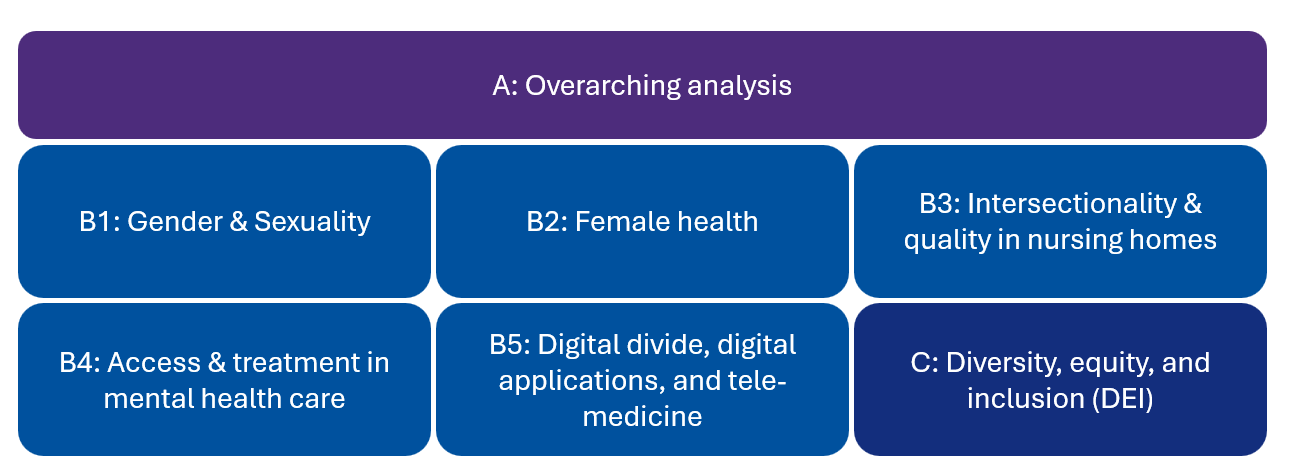
Subprojects
About the subproject
- Subproject B1 examines health inequalities as well as the specific healthcare needs of LGBTQIA* individuals with and without a migration background in Lower Saxony.
- The goal is to identify barriers in access to, utilization of, and the quality of healthcare and, based on this, to develop recommendations for non-discriminatory and needs-based care. A particular focus is on mental health.
Research Focus
Examination of access conditions, availability, and quality of health services, as well as the specific needs of LGBTQIA* individuals, particularly taking migration experiences into account.
Overarching research questions
- What structural, institutional, and individual barriers influence access to healthcare for LGBTQIA* individuals, particularly those with a migration background?
- What specific care needs exist with regard to diagnosis, treatment, and, in particular, mental health?
- What measures are necessary to sustainably improve non-discriminatory, needs-based care?
Approach
- The subproject follows a mixed-methods approach comprising three central components: a systematic inventory of care services and the identification of research gaps, a qualitative survey of the experiences, needs, and perspectives of affected individuals and experts, and a quantitative analysis of secondary data to identify gaps in care, particularly in the area of mental health.
Methods
- Research on experts, services, and gaps in care in Lower Saxony (status quo analysis)
- Literature review on diagnosis, treatment, and needs of LGBTQIA* individuals
- Qualitative interviews/surveys with affected individuals and experts following targeted recruitment (including MHH)
- Analysis of patient and secondary data on the care situation (especially mental health)
- Compilation of results and derivation of recommendations for improving care
Team
- Lead:
- Staff:
- PhD student at MHH (Clinical Department of Psychiatry) tba
-
M. Sc. Marie-Theres Mayr
Publications
- TBD
Further Reading
About the subproject
We are investigating the experiences and decisions of young women (ages 14–25) with a migration background regarding access to contraception following abortions and births in Lower Saxony.
Research Focus
Individual experiences, knowledge, and decision-making mechanisms of young Ms with a migration background regarding access, availability, as well as challenges and barriers in accessing gynecological care.
Overarching research questions
- What do young women with a migrant background in Lower Saxony experience when accessing and deciding on contraception after an abortion or after giving birth?
- How do structural and financial conditions, as well as knowledge gaps, influence these experiences and the support that young migrant women receive?
- What do young Ms with a migrant background need to improve their reproductive autonomy within the German healthcare system?
Approach
The research is based on a mixed-methods approach.
The methodological framework consists of three parts: a systematic review aimed at identifying existing knowledge gaps regarding the global situation of contraception for young women with a migrant background, qualitative interviews and focus groups, which examine young women’s lived experiences, their individual barriers, and experiences in detail; and quantitative data analysis, which examines billing data from statutory health insurance funds in Germany to identify specific gaps in care.
Methods
- Systematic review,
- Qualitative interviews and focus groups,
- Quantitative data analysis of billing data
Team
- Prof. Dr. Christian Krauth
- Dr. Kathrin Krüger
- Gina Bianca Stapper, M. Sc. ((she/her) Contact person for the subproject)

Publications
- tba
Further reading
- e.g., RKI - Health of Mss with a Migration Background
About the subproject
- Subproject B3 examines how nursing home quality is perceived from the perspective of residents and their families in Lower Saxony, and how diversity, migration experience, and cultural sensitivity can be integrated into a user-based quality measure for inpatient long-term care.
- The starting point is the Consumer Choice Index Six Dimension (CCI-6D), a tool for assessing nursing home quality from the user’s perspective. B3 examines how the CCI-6D can be applied in Germany and whether an additional dimension regarding diversity/cultural sensitivity is comprehensible, measurable, and practically applicable.
Research Objective
Development, German adaptation, and application of a user-based quality index for nursing homes, with a particular focus on migration-related and intersectional care needs.
Overarching research questions
- How do residents and their families rate the existing CCI-6D dimensions of nursing home quality in the German context?
- Can diversity/cultural sensitivity be formulated as a comprehensible additional quality dimension? What is its relevance?
- How does an intervention change the perceived quality in nursing homes?
Approach
- The subproject follows a mixed-methods approach. First, German preference weights for the six CCI-6D dimensions will be collected based on a discrete-choice experiment. Subsequently, a potential seventh dimension regarding diversity/cultural sensitivity will be developed qualitatively and based on the literature, cognitively validated, and prepared for field application. In a further step, the index will be applied in nursing homes to examine perceived quality and potential intervention effects.
Methods
- Literature review on CCI-6D, user-based quality measures, cultural sensitivity, and diversity in long-term care
- Discrete-choice experiment with residents and family members to determine German CCI-6D preference weights
- Qualitative interviews, cognitive probing, and a pretest to develop and test a potential 7D dimension
- Evaluation of quality reports as a convergence test
- Field application/field experiment in cooperating nursing homes with treatment and control groups; quality measures as outcomes
Team
- Lead:
- Dr. Kathrin Damm
- Prof. Dr. Annika Herr
- Prof. Dr. Arndt Reichert
- Staff:
- M. Sc. Robert Mayen
Publications
- TBD
Further reading (selection)
- Milte, R., Ratcliffe, J., Bradley, C., Shulver, W., & Crotty, M. (2019). Evaluating the quality of care received in long-term care facilities from a consumer perspective: Development and construct validity of the Consumer Choice Index-Six Dimension instrument. Ageing & Society, 39(1), 138-160. doi.org/10.1017/S0144686X17000861
- Milte, R., Ratcliffe, J., Chen, G., & Crotty, M. (2018). What characteristics of nursing homes are most valued by consumers? A discrete choice experiment with residents and family members. Value in Health, 21(7), 843-849. doi.org/10.1016/j.jval.2017.11.004
- Milte, R. K., Mpundu-Kaambwa, C., Chen, G., Crotty, M., & Ratcliffe, J. (2022). What constitutes preferred long-term care provided in residential aged care facilities? An empirical comparison of the preferences of the general population, residents, and family members. Value in Health, 25(2), 257-267. doi.org/10.1016/j.jval.2021.09.001
- Milte, R. K., Jadczak, A. D., Visvanathan, R., & Ratcliffe, J. (2024). Evidence for the external validity of the Consumer Choice Index Six Dimension (CCI-6D) for people living in residential aged care with dementia. Ageing & Society, 44(12), 2755-2776. doi.org/10.1017/S0144686X23000247
About the subproject
- We investigate health inequalities in access to psychiatric and psychotherapeutic care for people with migration-specific determinants, as well as ways to improve care.
Research Topic
- Name-based discrimination in outpatient psychotherapeutic care
- Ethnocultural referencing (broaching) in the psychotherapeutic process
- The influence of migration-specific determinants (MsD) on the initiation and decision-making processes in the context of coercive measures in acute psychiatric care.
Research Questions
- The first project investigates whether and to what extent outpatient psychotherapists make selection decisions based on nationality and socioeconomic status when admitting new patients.
- The second project focuses on the role of ethnocultural broaching in the therapeutic process. It examines how practitioners’ addressing of ethnocultural aspects affects treatment-related attitudes and evaluations among people with migration-specific determinants. The goal is to identify factors that improve treatment expectations and, thereby, potentially also treatment outcomes.
- The third project examines the use of coercive measures in acute psychiatric wards. Through qualitative interviews with patients and practitioners, different perspectives on decision-making processes, experiences, and evaluations of these measures are analyzed, with the aim of identifying possible connections between migration-specific determinants and decision-making processes, the therapeutic relationship, and experiences related to coercive measures.
Methods
- Project 1: Correspondence study, quantitative analysis
- Project 2: Experimental study and qualitative interviews
- Project 3: Qualitative interviews
Team
- Prof. Dr. med. Kai G. Kahl
- Dr. Ivo Heitland
- Chiara Jacobi
- Tamar Unger
- Ellyn Saenger
- Other participants
Publications
- TBA
Further reading
- TBD
About the subproject
- We are researching population groups with long-, medium-, and short-term migration backgrounds, including refugees (target groups), who are affected by a “digital divide” due to historical, economic, social, and educational factors; that is, access to valuable, up-to-date information and IT regarding healthcare and Nursing varies and is often lacking.
Research Focus
- We analyze widely used media, e.g., websites and posts/videos on typical social networks (Facebook, TikTok, etc.).
Overarching research questions
- In which media can information on the “digital divide” and the disadvantages faced by the target groups be found, and how can this information be collected (semi-)automatically (using scraping software robots)?
- What results and insights can be obtained or derived (semi-)automatically from large amounts of text—including text extraction from videos?
- How can interventions—including automated multilingual interventions for the target groups—in various media and apps help bridge the “digital divide” and reduce disadvantages, particularly in Lower Saxony?
Approach
- First, we identify the media most frequently used by the target groups.
- Then we collect posts and videos (semi-)automatically from frequently used media, including Turkish, Ukrainian, Arabic, and other languages, which may also be automatically translated and transcribed. Downloads, transcriptions, and translations are performed (semi-)automatically using scraping robots and AI APIs from major generative AI providers.
- AI-based content analysis and sentiment analysis are then performed on the large volumes of text.
- For interventions, we may post automatically translated content on social media and apps that provide target-group-specific health and care information, e.g., on preventive medical checkups, disease prevention, vaccinations, or depression and trauma. We also aim to offer a user-friendly, multilingual Android app and easy-to-understand, multilingual websites. Additionally, information will be distributed in print form at mosques, women’s shelters, and through refugee organizations, particularly in the Hanover region. The Android app and websites must also enable user-friendly feedback to measure usage, acceptance, and success and to improve them iteratively.
Methods
- (Semi-)automated scraping of websites and social networks.
- Qualitative, (semi-)automated, AI-based content analysis and sentiment analysis of large volumes of text.
- Usage, acceptance, and success analyses of the interventions in widely used media and the Android app.
Team
- Prof. Dr. Michael H. Breitner
- Fenja Schulte
- Finn Borchers
- Sarah Damouni
About the subproject
Subproject C – “Diversity, Equity & Inclusion (DEI)” – examines how diversity, equity, and inclusion can be strategically embedded in hospitals and long-term care facilities. The focus is on how DEI can be systematically integrated into healthcare organizations as a leadership and management task.
The background is that healthcare and long-term care facilities are becoming increasingly diverse—both in terms of patients and employees. At the same time, there has often been a lack of sustainable organizational strategies to structurally embed diversity in governance, Human Resources, and organizational culture.
The subproject therefore analyzes international examples from North America and Scandinavia and examines which approaches are transferable to Lower Saxony. The goal is to develop practice-oriented recommendations for action and guidelines for hospitals and long-term care facilities.
Objectives
- Examination of the implementation of DEI in hospitals and care facilities.
- Analysis of international strategies and examples of best practices.
- Development of practical recommendations for Lower Saxony.
- Promotion of sustainable and inclusive organizational structures in the healthcare sector.
Methods
Mixed methods:
- Scoping review & context analysis
- Systematic analysis of international research on DEI in the healthcare sector.
- Examination of political and institutional frameworks.
- Quantitative Survey
- Comprehensive survey of all hospitals in Lower Saxony.
- Survey of long-term care facilities on organizational culture, human resources management, and DEI measures.
- Qualitative research
- Interviews with executives and diversity officers.
- Focus groups with nursing staff and other stakeholders.
- International case studies
- Examination of DEI strategies in North America and Scandinavia.
- Analysis of successful implementation approaches and potential for transferability.