Morbidity compression and its alternatives
Brief description
In cooperation with the AOK Lower Saxony, we are working in the project Morbidity compression and its alternatives on the question of how the health of the population is developing against the background of increasing life expectancy. We are investigating whether there will be a compression of morbidity or an expansion of morbidity over time. The answer to this question determines, for example, whether, from a scientific point of view, working life can be shortened or extended and in which direction medical care should be developed. [more...]
Project funding
We have acquired numerous research projects for our research activities in the field of "Morbidity compression and its alternatives". Here you will find a list of the project titles sorted by sponsor. For many of these projects, we have compiled a brief description and the publications published to date on an extra page.
German Research Foundation
- Morbidity compression and its alternatives in the context of health inequality (Project leader: Prof. Dr. Siegfried Geyer; project duration 2018-2020)
- How long can we work? The development of working life from a health perspective (Project management: Dr. Juliane Tetzlaff; project duration 2020-2023)
- Rethinking morbidity compression and morbidity expansion: Differential morbidity development and social inequalities in health impairments and chronic diseases (Project management: Prof. Dr. Siegfried Geyer; Project duration 2022-2025)
- Incidence of mental illness in existing type 2 diabetes mellitus and cardiovascular disease: Health inequalities and identification of vulnerable groups in health insurance data in the time trend between 2005 and 2019 (Project management: PD Dr. Jelena Epping, project duration 2023-2026)
- Development of subjective health against the background of the increase in higher school-leaving qualifications - A gender- and age-group-differentiated analysis of structural, psychosocial and behavioral influencing factors (Project management: PD Dr. Stefanie Sperlich; project duration 2024-2026)
Lower Saxony Ministry of Science and Culture
- INDICA - The INDICA research project is dedicated to the investigation of health inequalities in diabetes care in Lower Saxony
- Modern work - healthy work? Changes in work-related physical activity as an explanatory factor in the development of physical and mental morbidity (Project management: Dr. Johannes Beller; project duration 2023-2024)
- Morbidity expansion or dynamic equilibrium? The long-term development of type 2 diabetes, the role of health-related behavioral patterns and medical treatments (Project management: Prof. Dr. Dr. Siegfried Geyer; Project duration 2019-2022)
- Doctoral scholarship on the topic of "The development of morbidity using the example of type 2 diabetes mellitus" (Supervision: Prof. Dr. Siegfried Geyer; project duration 2014-2016)
AOK Lower Saxony
- Several research projects since 2015 (Project management: Prof. Dr. Siegfried Geyer)
- The project "Morbidity compression and its alternatives" has been funded by the AOK Lower Saxony since 2013.
Research priorities within the scope of the project
Background
As part of the research activities, time trends regarding subjective health indicators are also examined. They record how people individually experience and evaluate their health and thus differ from objective health indicators, which are determined using medical parameters (DeSalvo and Muntner 2011). Subjective health assessments are influenced by physical illnesses, but psychosocial aspects are also included in the assessment, such as socioeconomic status, the extent of psychosocial stress and mental well-being (Spuling et al. 2017).
Studies have shown that subjective health can predict the occurrence of illnesses and the risk of mortality (Ernstsen et al. 2011, Jylhä 2009, Scott et al. 1997). In addition, subjective health predicts the utilization of medical services and the level of illness-related costs (DeSalvo et al. 2009, Hardy et al. 2011, Menec and Chipperfield 2001). Subjective health indicators therefore represent a central target variable for prevention and health promotion measures (Klotz et al. 2006).
Health indicators used
Different aspects of the subjective experience of health are considered in this research project. In addition to the global single item 'subjective health', the health-related quality of life (SF 12) is used. With six items each, it measures psychological and physical dimensions of health, such as limited role function, pain, vitality and social functioning (Resnick et al. 2001).
In addition, functional limitations in everyday skills and self-care abilities are taken into account. These limitations relate to basic activities of living (ADL), such as being able to eat independently, and instrumental activities of living (IADL), such as being able to go shopping independently (Hopman-Rock et al. 2018). Objectively measured indicators of functional limitations such as grip strength are also used (Taekema et al. 2010).
Data basis and time period
The analyses of time trends are based on different population-based survey data. While the development of subjective health and health-related quality of life (SF12) are examined using the Socioeconomic Panel (Wagner et al. 2007), the analyses of functional limitations are based on the SHARE data (Börsch-Supan et al. 2013). The observed time periods differ depending on the data sets used and the underlying health indicator; they vary between nine (2004-2013) and 22 years (1995-2016).
Central research questions
The following overarching research questions are the focus of the analysis:
- How does subjective health in the population develop over time, and what is the significance of age, period and cohort effects in this regard?
- How do health trends differ between women and men and at different stages of life?
- How do socially induced health inequalities develop over time?
- How can time trends in subjective health be explained? What significance do the medical sociological explanatory approaches of 'structural', 'psychosocial' and 'behavioral causation' have in this context?
- What health policy and practical consequences can be derived from the findings?
Literature
Börsch-Supan A, Brandt M, Hunkler C et al. Data resource profile: The Survey of Health, Ageing and Retirement in Europe (SHARE). International Journal of Epidemiology. 2013;42(4):992-1001.
DeSalvo KB, Jones TM, Peabody J et al. Health care expenditure prediction with a single item, self-rated health measure. Medical Care. 2009;47(4):440-447.
DeSalvo KB, Muntner P. Discordance between physician and patient self-rated health and all-cause mortality. The Ochsner Journal. 2011;11(3):232-240.
Ernstsen L, Nilsen SM, Espnes GA et al. The predictive ability of self-rated health on ischaemic heart disease and all-cause mortality in elderly women and men: the Nord-Trondelag Health Study (HUNT). Age and Ageing. 2011;40(1):105-111.
Hardy SE, Kang Y, Studenski SA, Degenholtz HB. Ability to walk 1/4 mile predicts subsequent disability, mortality, and health care costs. Journal of General Internal Medicine. 2011;26(2):130-135.
Hopman-Rock M, van Hirtum H, de Vreede P, Freiberger E. Activities of daily living in older community-dwelling persons: A systematic review of psychometric properties of instruments. Aging Clinical and Experimental Research. doi.org/10.1007/s40520-018-1034-1036.
Jylhä M. What is self-rated health and why does it predict mortality? Towards a unified conceptual model. Social Science & Medicine. 2009;69(3):307-316.
Klotz T, Haisch J, Hurrelmann K. Prevention and health promotion: the goal is sustained high quality of life. German Medical Journal International. 2006;103(10):606-609.
Menec V, Chipperfield J. A prospective analysis of the relation between self-rated health and health care use among elderly Canadians. Canadian Journal of Aging. 2001;20(3):293-306.
Resnick B, Nahm ES. Reliability and validity testing of the revised 12-item Short-Form Health Survey in older adults. Journal of Nursing Measurement. 2001;9(2):151-161.
Scott WK, Macera CA, Cornman CB, Sharpe PA. Functional health status as a predictor of mortality in men and women over 65. Journal of Clinical Epidemiology. 1997;50(3):291-296.
Spuling SM, Huxhold O, Wurm S. Predictors of self-rated health: Does education play a role above and beyond age? The Journals of Gerontology, Series B: Psychological Sciences and Social Sciences. 2017;72(3):415-424.
The project "Morbidity compression and its alternatives" examines the development of subjective health and functional limitations as well as specific diseases. The focus is primarily on diseases that occur frequently in the population. With the increase in life expectancy over time, the morbidity spectrum in the population is also changing. The focus on individual, specific diseases therefore makes an important contribution to understanding the underlying processes of morbidity compression or morbidity expansion. Against this background, it is being investigated whether the average lifespan in these diseases is expanding over time or whether an increasingly longer lifespan is being spent without specific diseases.
The project group is currently working on the diseases diabetes mellitus, multimorbidity, lung cancer, myocardial infarction and stroke.
The following questions are being addressed:
- How does the incidence of disease develop over time?
- How does the lifespan free of these diseases develop?
- Are there social inequalities in the incidence of these diseases?
- Is there an increase or decrease in health inequalities over time?
In addition to the content-related issues, the research project "Morbidity compression and its alternatives" also places a methodological focus on the processing and validation of health insurance data. Due to the high complexity of the data structure and the large number of cases of more than approx. 2 million insured persons, who have approx. 23 million prescribed drugs and more than 150 million billed services in the outpatient sector every year, we are looking at the potential and limits of big data.
We are currently addressing the following questions:
- How representative are AOK Lower Saxony policyholders compared to the population of Lower Saxony and the Federal Republic of Germany?
- How can diagnostic information be validated?
- How can disease severity be determined in the health insurance data?
- How long should the observation periods be set in order to determine incidence rates?
- Do incidences of selected diseases differ between health insurance data and data from health surveys such as DEGS or GEDA?
Explanatory approaches
Advances in medical diagnostics and treatment options have a significant influence on the development of morbidity and mortality in the population, but psychosocial and demographic factors are also of central importance in this context. A further aim of the research activities is to shed light on the temporal trends in subjective health and specific diseases from this medical-sociological perspective. [more...]
Team and cooperation partners
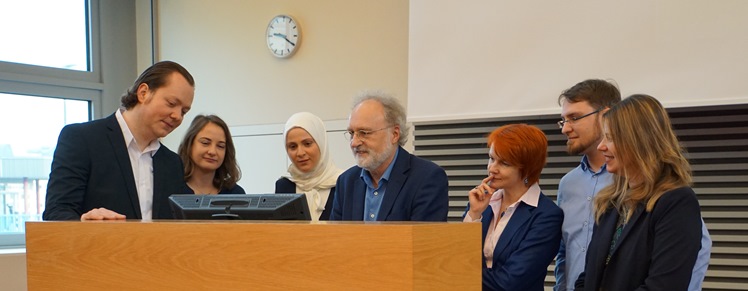
Our project team consists of academic staff from the Research and Teaching Unit Medical Sociology, some employees from the Department of Health Services Research at the AOK Lower Saxony and doctoral students.
Project management: Prof. Dr. Siegfried Geyer
Scientific collaboration:
Dr. Johannes Beller
Susanne Steffens
PhD students:
Sahar Sidahmed
Cooperation partner of the AOK Lower Saxony:
Dr. Sveja Eberhard
Dr. Jona Stahmeyer
International cooperation partners:
Dr. Alexander Miething
Prof. Enrique Regidor
Dr. Lourdes Lostao Unzu
Prof. Dr. Dr. Marc Luy
Lectures, workshops and publications
The workshop of the Working Group "Health, Morbidity and Mortality" of the European Association of Population Studies took place at Hannover Medical School from September 4 to 6, 2019. Over three days, 25 participants intensively discussed current trends in the analysis of morbidity and mortality and exchanged views on methodological and content-related aspects.
From August 13 to 22, 2019, Juliane Tetzlaff, Jelena Epping and Johannes Beller led a working group at this year's Summer Academy of the German National Academic Foundation on the topic of "Morbidity compression and its alternatives: How healthy will we grow old?". With 13 highly motivated and committed scholarship holders, the lecturers were able to discuss such topics as "Am I ill or do I just feel that way?", "How long will we live?", "How long can we work?", "How long do we have to work?" or "How long do we have to work?" over seven intensive workshop days. How long do we have to work? or "Can we afford our health?", to name but a few.
After each workshop day, students had the opportunity to record their thoughts and open questions in an essay. This resulted in a collection of essays which, after consultation with the authors, will be made available here for interested visitors to download. This collection of essays supports the project team in developing new approaches for the further development of the research project. We are grateful for the enriching time we spent together in Leysin.
In July 2017, Prof. Siegfried Geyer gave a presentation on"Morbidity compression in myocardial infarction: The development 2006 to 2015" at the workshop of the working group "Health, Morbidity and Mortality" of the EAPS (European Association for Population Studies) in Novosibirsk, Russia.
In June 2015, an AOK symposium was held in Hanover. Prof. Dr. Dr. Siegfried Geyer presented interim results of the research project in a lecture entitled "Sick later and healthy longer? Morbidity compression and its consequences". Representatives of health insurance companies, trade unions, employers' associations and state politicians discussed the effects of morbidity trends on the design of healthcare policy with the scientists.
The book
Geyer S, Eberhard S. Sick later and healthy longer? Morbidity compression and its alternatives. Bern: Hogrefe; 2021.
Articles in peer-reviewed journals (sorted chronologically in descending order):
Epping J, Safieddine B, Geyer S, Tetzlaff J. Are prevalences in survey and routine data comparable? Comparison of heart attack prevalence rates in health insurance data from the AOK Lower Saxony and in data from the German Health Interview and Examination Survey for Adults (DEGS1). [Are prevalence rates comparable in survey and routine data? Analysis of prevalence rates of myocardial infarction in claims data of the AOK Lower Saxony and in data of German Health Interview and Examination Survey for Adults (DEGS1)]. Public Health, AGENS Supplement: Secondary Data - Methods and Findings. 2021 (accepted).
Epping J, Geyer S, Eberhard S, Tetzlaff J. Completely different or quite similar? The socio-demographic structure of the AOK Lower Saxony compared to the general and working population in Lower Saxony and Germany. [Completely Different or Quite similar? The Sociodemographic Structure of the AOK Lower Saxony in Comparison to the General and Working Population in Lower Saxony and the Federal Republic of Germany]. Healthcare. 2021 (accepted).
Safieddine B, Sperlich S, Epping J, Lange K, Geyer S. Development of comorbidities in type 2 diabetes between 2005 and 2017 using German claims data. Scientific Reports. 2021;11(1).
Klar MK, Geyer S, Safieddine B, Tetzlaff F, Tetzlaff J, Sperlich S. Trends in healthy life expectancy between 2002 and 2018 in Germany - Compression or expansion of health-related quality of life (HRQOL)? SSM - Population Health. 2021;13.
Grasshoff J, Beller J, Kuhlmann BG, Geyer S. Increasingly capable at the ripe old age? Cognitive abilities from 2004 to 2013 in Germany, Spain, and Sweden. Plos One. 2021;16(7)
Sperlich S, Beller J, Epping J, Safieddine B, Tetzlaff J, Geyer S. Are Disability Rates among People with Diabetes Increasing in Germany? A Decomposition Analysis of Temporal Change between 2004 and 2015. Journal of Aging and Health. 2021;33(3-4):205-16.
Tetzlaff F, Epping J, Tetzlaff J, Golpon H, Geyer S. Socioeconomic inequalities in lung cancer - a time trend analysis with German health insurance data. Bmc Public Health. 2021;21(1).
Beller J, Bauersachs J, Schafer A, Schwettmann L, Heier M, Peters A, et al. Diverging Trends in Age at First Myocardial Infarction: Evidence from Two German Population-Based Studies. Scientific Reports. 2020;10(1).
Tetzlaff J, Geyer S, Westhoff-Bleck M, Sperlich S, Epping J, Tetzlaff F. Social inequalities in mild and severe myocardial infarction: how large is the gap in health expectancies? Bmc Public Health. 2021;21(1).
Sperlich S, Klar MK, Safieddine B, Tetzlaff F, Tetzlaff J, Geyer S. Life stage-specific trends in educational inequalities in health-related quality of life and self-rated health between 2002 and 2016 in Germany: findings from the German Socio-Economic Panel Study (GSOEP). Bmj Open. 2021;11(3).
Beller J, Epping J. Disability trends in Europe by age-period-cohort analysis: Increasing disability in younger cohorts. Disability and Health Journal. 2021;14(1).
Tetzlaff F, Epping J, Sperlich S, Tetzlaff J. Widening income inequalities in life expectancy? Analyzing time trends based on German health insurance data. Journal of Epidemiology and Community Health. 2020;74(7):592-7.
Beller J, Regidor E, Lostao L, Miething A, Kroger C, Safieddine B, et al. Decline of depressive symptoms in Europe: differential trends across the lifespan. Social Psychiatry and Psychiatric Epidemiology. 2021;56(7):1249-62.
Tetzlaff F, Epping J, Golpon H, Tetzlaff J. Compression, expansion, or maybe both? Growing inequalities in lung cancer in Germany. Plos One. 2020;15(11).
Tetzlaff J, Geyer S, Tetzlaff F, Epping J. Income inequalities in stroke incidence and mortality: Trends in stroke-free and stroke-affected life years based on German health insurance data. Plos One. 2020;15(1).
Safieddine B, Sperlich S, Beller J, Lange K, Epping J, Tetzlaff J, et al. Socioeconomic inequalities in type 2 diabetes in employed individuals, nonworking spouses and pensioners. SSM - Population Health. 2020;11.
Sperlich S, Beller J, Epping J, Tetzlaff J, Geyer S. Trends in self-rated health among the elderly population in Germany from 1995 to 2015-the influence of temporal change in leisure time physical activity. Bmc Public Health. 2020;20(1).
Epping J, Geyer S, Tetzlaff J. The effects of different lookback periods on the sociodemographic structure of the study population and on the estimation of incidence rates: analyses with German claims data. Bmc Medical Research Methodology. 2020;20(1).
Sperlich S, Tetzlaff J, Geyer S. Trends in good self-rated health in Germany between 1995 and 2014: do age and gender matter? International Journal of Public Health. 2019;64(6):921-33.
Beller J, Miething A, Regidor E, Lostao L, Epping J, Geyer S. Trends in grip strength: Age, period, and cohort effects on grip strength in older adults from Germany, Sweden, and Spain. Social Science & Medicine: Population Health. 2019;9.
Geyer S, Tetzlaff J, Eberhard S, Sperlich S, Epping J. Health inequalities in terms of myocardial infarction and all-cause mortality: a study with German claims data covering 2006 to 2015. International Journal of Public Health. 2019;64(3):387-97.
Geyer S, Eberhard S, Schmidt BM, Epping J, Tetzlaff J. Morbidity compression in myocardial infarction 2006 to 2015 in terms of changing rates and age at occurrence. A longitudinal study using claims data from Germany. PLoS ONE. 2018;13 (8):e0202631.
Stahmeyer JT, Geyer S, Epping J, Tetzlaff J, Eberhard S. Expenditure trends in statutory health insurance and the influence of demographic change. Federal Health Gazette-Health Research-Health Protection. 2018;61(4):432-41.
Tetzlaff J, Epping J, Sperlich S, Eberhard S, Stahmeyer JT, Geyer S. Widening inequalities in multimorbidity? Time trends among the working population between 2005 and 2015 based on German health insurance data. International Journal for Equity in Health. 2018;17(103).
Bachus L, Eberhard S, Weißenborn K, Muschik D, Epping J, Geyer S. Morbidity compression in stroke? Longitudinal analyses on changes in the incidence of stroke [Morbidity compression and stroke? Longitudinal analyses on changes in the incidence of stroke]. Health Services. 2017;81(04):351-60.
Muschik D, Tetzlaff J, Lange K, Epping J, Eberhard S, Geyer S. Change in life expectancy with type 2 diabetes: a study using claims data from Lower Saxony, Germany. Population Health Metrics. 2017;15(5).
Tetzlaff J, Muschik D, Epping J, Eberhard S, Geyer S. Expansion or compression of multimorbidity? 10-year development of life years spent in multimorbidity based on health insurance claims data of Lower Saxony, Germany. International Journal of Public Health. 2017;62(6):679-86.
Muschik D, Icks A, Tetzlaff J, Epping J, Eberhard S, Geyer S. Morbidity compression, morbidity expansion, or dynamic equilibrium? The time trend of AOK-insured patients with type 2 diabetes in Lower Saxony, Germany. Journal of Public Health. 2017;25(1):19-28.
Tetzlaff J, Junius-Walker U, Muschik D, Epping J, Eberhard S, Geyer S. Identifying time trends in multimorbidity-defining multimorbidity in times of changing diagnostic practices. Journal of Public Health. 2016;25(2):215-22.
Geyer S. Morbidity compression: a promising and well-established concept? International Journal of Public Health. 2016;61:727-8.
Muschik D, Jaunzeme J, Geyer S. Are spouses' socio-economic classifications interchangeable? Examining the consequences of a commonly used practice in studies on social inequalities in health. International Journal of Public Health. 2015;60:953-60.
Jaunzeme J, Eberhard S, Geyer S. How "representative" are SHI data? Demografische und soziale Unterschiede und Ähnlichkeiten zwischen einer GKV-Versichertenpopulation, der Bevölkerung Niedersachsen sowie der Bundesrepublik am Beispiel der AOK Niedersachsen [How "representative" are data from statutory health insurances? Demographic and social differences and similarities between a statutory health insurance population, the population of Lower Saxony and the Federal Republic of Germany at the example of the AOK Niedersachsen]. Bundesgesundheitsblatt. 2013;56:447-54.
Geyer S. The morbidity compression hypothesis and its alternatives. Das Gesundheitswesen. 2015;77:442-6.
Trachte F, Sperlich S, Geyer S. Compression or expansion of morbidity? Entwicklung der Gesundheit in der älteren Bevölkerung [Compression or expansion of morbidity? The development of health in the elderly population]. Journal of Gerontology and Geriatrics. 2015;48(3):255-62.