November 23, 2016
Prof. Krauss official member of the network of medical experts
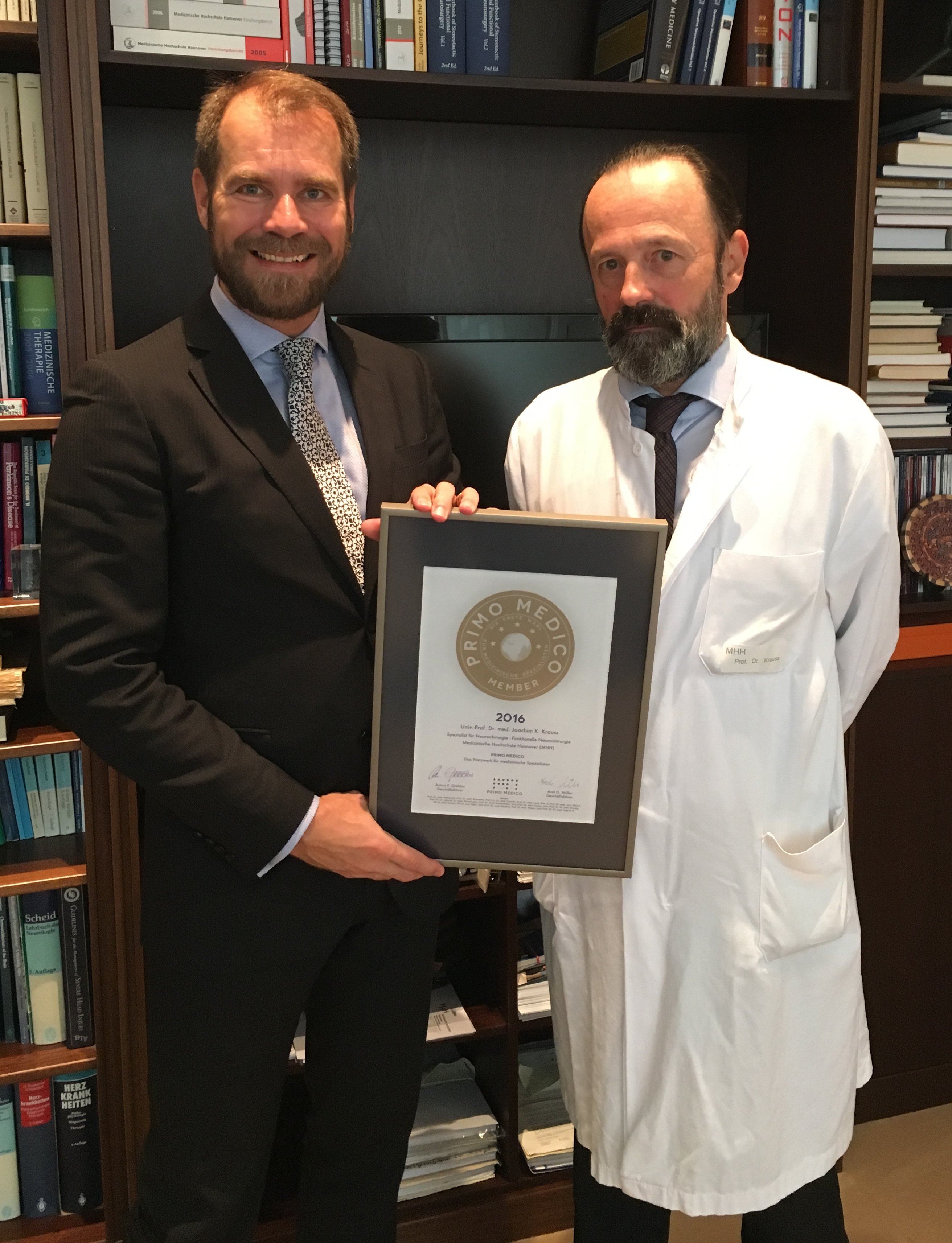
Professor Joachim K. Krauss was presented with the Seal of the Year 2016 by Asmus Grebbin, Managing Director of PRIMO MEDICO. Prof. Dr. Dr. Krauss is now an official member of the network, which currently includes over sixty medical specialists from various departments in Germany, Austria and Switzerland.
Prof. Krauss is a specialist in functional neurosurgery and has been Director of the Clinical Department of Neurosurgery/ MHH since 2005. His research activities include experimental and clinical studies with a focus on the treatment of movement disorders. He is a specialist in neurosurgery and neurology and has an additional qualification in special pain therapy. He introduced deep brain stimulation in the globus pallidus for the treatment of cervical dystonia and spinal cord stimulation for the treatment of orthostatic tremor. He is also researching the use of deep brain stimulation in psychiatric disorders. He is also President of the World Society for Stereotactic and Functional Neurosurgery and Honorary President of the European Society for Stereotactic and Functional Neurosurgery.
PRIMO MEDICO is a network for medical experts in German-speaking countries. The aim of the network is to create a direct link between patient and physician and thus offer every patient the opportunity to find a suitable specialist for their condition. The quality of the network is ensured by a medical advisory board and access criteria. Our network service is also available to international patients.
June 2016
DGNC awards
- Dr. med. Andreas Wloch, assistant physician at the Clinical Department of Neurosurgery, presented the poster entitled "Hyperkinesia after several years of pallidal stimulation" at the 67th Annual Meeting of the German Society of Neurosurgery (DGNC) in Frankfurt am Main and was selected by the DGNC jury for a POSTER - PRIZE NEUROMODULATION of the DGNC. The prize is endowed with € 500.00. The official presentation of the prize will take place during the opening ceremony of the 68th Annual Meeting of the DGNC on May 14, 2017 in Magdeburg.
- Mr. Mahmoud Abdallat, assistant physician at the Clinical Department of Neurosurgery, presented a paper entitled "Long-term results of deep brain stimulation for the treatment of chronic neuropathic pain" at the 67th Annual Meeting of the German Society for Neurosurgery (DGNC) in Frankfurt am Main and was selected by the DGNC jury for the DGNC's NEUROMODULATION AWARD. The prize is endowed with € 500.00. The official presentation of the prize will take place during the opening ceremony of the 68th Annual Meeting of the DGNC on May 14, 2017 in Magdeburg.
30.05.2016
World's first 3D reconstruction of a skull using a new computer-assisted method
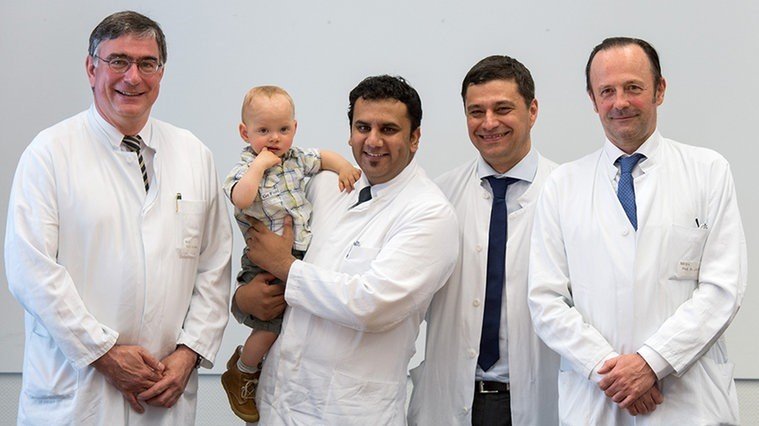
The world's first 3D reconstruction of a skull has been achieved at the Medical School using a new computer-assisted method. An implanted mesh improves the developmental prognosis after operations for premature closure of the cranial suture.
Little Emil suffered from a rare disease: craniosynostosis occurs statistically in only one in 2,000 children. This is the premature closure of one or more cranial sutures. Normally, these remain flexible in the first few years of life so that the head and brain can grow and develop. Emil could be helped at Hannover Medical School (MHH). Surgeons from the Clinical Department of Oral and Maxillofacial Surgery and the Clinical Department of Neurosurgery reconstructed the boy's skull three-dimensionally on the computer and implanted a new type of mesh during an operation in November 2015. The material is absorbed by the body, the implant dissolves after a few months and is replaced by the body's own bone. This allows the skull to develop "normally". It was the first operation using this method worldwide. Emil was five months old at the time of the operation, he has since celebrated his first birthday and is doing well.
Craniosynostosis: too early ossification of the cranial suture
Ossification too early - with serious consequences "Ossification of the cranial sutures too early means that the brain does not have enough space to grow," explains Dr. Dr. Majeed Rana, Associate Professor and Deputy Medical Director of the Clinical Department of Oral and Maxillofacial Surgery. The cause of craniosynostosis is unclear in most cases. If the condition is not treated, it can lead to asymmetrical deformation of the skull, developmental disorders of the brain, neurological deficits and visual impairment. There are different variants of the disease. In most cases, the so-called arrow suture above the crown of the head is closed. This was also the case with Emil. "We noticed shortly after the birth that his head was a little deformed," reports Emil's father, Oliver T. But as this is not unusual in newborns, he and his wife Katharina waited. "Our midwife then recommended that we have him examined by a specialist," recalls the father.
At the age of six weeks, the parents presented Emil to Dr. Rana and his colleague Dr. Elvis Josef Hermann, Senior Consultant and Head of Pediatric Neurosurgery at the Clinical Department of Neurosurgery. The physicians waited until the optimal time for the procedure had come. "The deformity had increased, the skull had grown too much in length. The craniosynostosis could be further verified using imaging techniques," explains the neurosurgeon.
Mesh made from absorbable material
In the conventional surgical procedure, the closed suture is sawn out of the skull to create more flexibility for the skull and more space for the brain. "Good results can be achieved with this method, but sometimes a slight deformation remains," explains Dr. Hermann. So the two surgeons suggested the new surgical method, which they had developed together, to the parents. A lot had to be prepared for the operation. With the help of complex 3D calculations, a medical technology engineer from the Clinical Department determined the optimal head shape for Emil and used this data to create a cutting template and the mesh implant, which was precisely adapted to the little patient. The production of a patient-specific cranial implant from bioresorbable material using computer-assisted reconstruction is completely new. The Clinical Department is working together with the medical technology company KLS Martin.
Implant guides the growth of the skull
During the procedure, the closed cranial suture and other wedge-shaped pieces were sawn out of Emil's skull exactly symmetrically according to the template made. The surgeons then placed the new type of mesh over this and placed the scalp back on top. "The mesh acts as a guiding structure for the regrowing bone cells," explains Dr. Rana. "The skull bones slowly grow back in the desired shape and eventually close the gaps completely. The mesh dissolves over time." This allows the growth of the skull to be controlled and the development of the shape almost predicted. How quickly the implant is resorbed can be influenced during production. In the first eight weeks after the operation, the mesh primarily provides stability, after which it becomes more flexible so that the brain can develop. After eight to twelve months, it should be completely dissolved. The facial surgeon is enthusiastic about the new method: "The big advantage is that we can control the growth of the skull. We can ensure that it develops as symmetrically as possible and thus achieve an optimal cosmetic result."
Development as planned
This positive outlook also convinced Katharina and Oliver T. "If there is a chance to achieve an optimal result, then we definitely wanted to take it," says Oliver T. Emil has developed normally since his operation. The one-year-old boy is just starting to walk and is already speaking his first words. "He is also very musical," says his father happily. The physicians are very pleased with the little boy's skull growth so far. "Everything is developing as planned," says Dr. Rana with satisfaction. The symmetrical growth of the head not only solves the functional organic problems of the affected children, but also has important aesthetic effects - a normally shaped head gives no cause for teasing or stigmatization.
Promising new implant
Between ten and 20 children with craniosynostosis are treated at the MHH every year. "Patients with a more complex clinical picture will benefit most from the new surgical method," explains Prof. Dr. Dr. Nils-Claudius Gellrich, Director of the Clinical Department of Oral and Maxillofacial Surgery and Head of the Interdisciplinary Center for Facial Malformations at the MHH. He can imagine that the procedure will become standard therapy for these patients at the MHH. The facial surgeons and neurosurgeons believe that the resorbable implant material made of polyglycolide has good prospects for the future. "It will also find its way into other areas of cranial surgery," says Prof. Dr. Joachim Kurt Krauss, Director of the Clinical Department of Neurosurgery. "Thanks to its properties, the material has many advantages over metal and plastic implants." These properties could, for example, also help to avoid repeated surgical interventions in the treatment of tumor patients or accident victims.
06.05.2016
Third-party funding for research projects
The company Medtronic International granted Prof. Dr. med. Joachim K. Krauss, Clinical Department of Neurosurgery, €10,000 for the "History Exhibition Project - Movement Disorders Surgery". The project systematically shows the development steps in functional neurosurgery up to the establishment of new techniques in neuromodulation.
May 2016
3rd International Congress on Treatment of Dystonia
The 3rd International Congress on the Treatment of Dystonia took place from May 4 to 7, 2016. The 500 participants from all continents met at the Hannover Congress Centrum (HCC) and spoke about current and innovative treatment concepts.
Dystonia is a movement control disorder which, according to the latest estimates, affects around 160,000 people in Germany. The disorder occurs in very different forms and can affect different parts of the body. Typical symptoms include spasmodic movements, twitching or poor posture such as a "torticollis". Contrary to widespread opinion, the clinical picture is not psychological, but an organic disease caused by a malfunction of the biological control circuits in the brain. For mostly unexplained reasons, there is a pathologically increased "firing rate" of nerve cells in certain areas of the brain. This overactivity triggers involuntary, persistent muscle tension, hence the name "dystonia" (=Greek/Latin for "disturbed muscle tension").
18.04.2016
Prof. Dr. med. Dr. h.c. Hermann Dietz deceased
Prof. Dietz headed and built up the Clinical Department of Neurosurgery at the MHH from 1970-1993. During this time, he made the Clinical Department of Neurosurgery known as a nationally and internationally recognized scientific and academic institution, which also played a central role in the development of German neurosurgery. He was greatly appreciated for his encouragement and support and for his great and selfless commitment with which he earned lasting merits in the German Society of Neurosurgery. With his passing, we have lost a representative of the founding generation of the university, an exemplary teacher and researcher.
15.04.2016
Elected to a committee
Prof. Dr. med. Joachim K. Krauss, Clinical Department of Neurosurgery, was appointed Chair of the WFNS Stereotactic and Functional Neurosurgery Committee at the Congress of the World Federation of Neurosurgical Societies (WFNS) in Tehran in April 2016.
13.01.2016
Vercise study initiation meeting
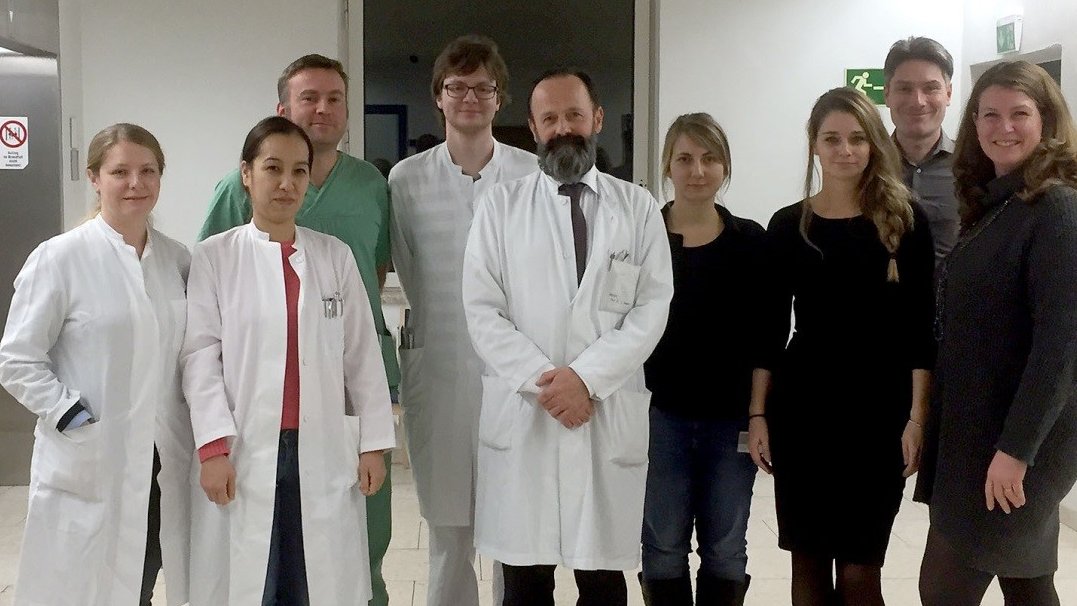
Vercise is a post-market clinical study entitled "Vercise DBS Dystonia Registry: Registry of Deep Brain Stimulation with the VERCISE™ System for Treatment of Dystonia" to determine the safety and performance of the DBS neurostimulation system. The Clinical Department of Neurosurgery at Hannover Medical School is the first clinic in Germany and Europe to be included in the study.