Implant infections
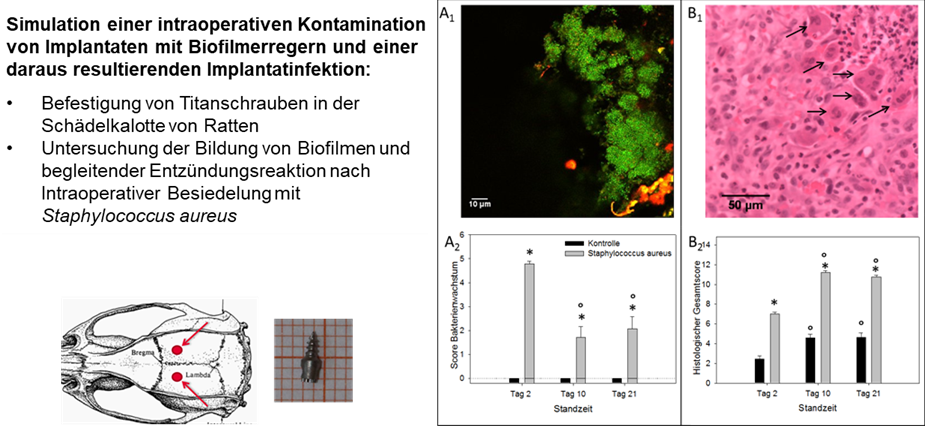
Implant-associated infections are one of the main causes of implant failure and represent a major challenge in many surgical areas. As a rule, these infections are caused by bacteria that adhere to the implant surface, organize themselves in complex layers of mucus, so-called biofilms, and induce chronic inflammation with destructive changes to the surrounding tissue. Systemic drug therapy is rarely successful, as the bacteria organized in biofilms are often resistant to antibiotics and the body's own immune system.
In our working group, we have established a rodent model in which self-sustaining biofilm formation with a local inflammatory reaction of the surrounding tissue occurs after infection of a transcranial screw with biofilm pathogens. This model is suitable for the preclinical screening of new implant materials and surfaces before their suitability is tested in more complex procedures. For example, this animal model can be used to investigate the effect of the release of antibacterial agents from functionalized implant surfaces in biofilm-associated infections.
Sun J, Eberhard J, Glage S, Held N, Voigt H, Schwabe K, Winkel A, Stiesch M. Development of a peri-implantitis model in the rat. Clin Oral Implants Res. 2020 Mar;31(3):203-214. DOI: 10.1111/clr.13556
Hong B, Winkel A, Stumpp N, Abdallat M, Saryyeva A, Runge J, Stiesch M, Krauss JK. Detection of bacterial DNA on neurostimulation systems in patients without overt infection. Clin Neurol Neurosurg. 2019 Sep;184:105399. DOI: 10.1016/j.clineuro.2019.105399
Glage S, Paret S, Winkel A, Stiesch M, Bleich A, Krauss JK, Schwabe K. A new model for biofilm formation and inflammatory tissue reaction: intraoperative infection of a cranial implant with Staphylococcus aureus in rats. Acta Neurochir (Vienna). 2017 Sep;159(9):1747-1756. DOI: 10.1007/s00701-017-3244-7
Hong B, Winkel A, Ertl P, Stumpp SN, Schwabe K, Stiesch M, Krauss JK. Bacterial colonization of suture material after routine neurosurgical procedures: relevance for wound infection. Acta Neurochir (Vienna). 2018 Mar;160(3):497-503. DOI: 10.1007/s00701-017-3404-9
Collaborations
Prof. Dr. Andre Bleich, Dr. Silke Glage (Institute of Laboratory Animal Science and Central Animal Laboratory, MHH)
Prof. Dr. Meike Stiesch, Dr. Andreas Winkel (Clinical Department of Dental Prosthetics, MHH)
Funding
DFG Research Unit 2591 - SCHW1176/7-1