Movement disorders
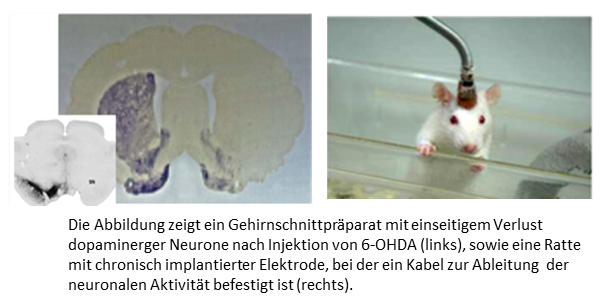
As an Animal model for movement disorders we mainly use the 6-OHDA Parkinson's disease model of the rat. The local injection of 6-hydroxydopamine (6-OHDA) into certain brain regions leads to selective degeneration of dopaminergic neurons in the midbrain. In particular, this model realistically depicts the changes in neuronal activity in Parkinson's disease and is therefore particularly suitable for preclinical studies. As the injection is unilateral, the rats show only very slight motor disturbances, which only become visible in special behavioral tests. However, these are accompanied by abnormal neuronal activity similar to that of Parkinson's disease patients. In addition, an injection of the dopaminergic substance levodopa can trigger dyskinesia (involuntary, uncontrollable movements) in these rats for a few minutes. Such dyskinesias are a common clinical side effect after long-term dopaminergic medication in patients with Parkinson's disease and one of the main indications for DBS. In the awake, freely moving rat, we test the effects of DBS in various clinically used and potentially new target regions on motor performance and on levodopa-induced dyskinesias. At the same time, we derive the neuronal activity of selected brain regions and neuronal networks in awake rats. Particular care is taken to ensure that the rat's freedom of movement is not restricted by the attached stimulation and recording cable. We have already shown that in rats treated with 6-OHDA, neuronal activity is altered in different frequency bands similar to Parkinson's patients and can be normalized by DBS. We are using this information to further develop the so-called "adaptive stimulation".