Between diagnosis and transplantation: How well informed are patients?
An interdisciplinary team from medicine, communication science and psychology has investigated this at the MHH
The patient journey for kidney and liver transplants usually begins inconspicuously: with fatigue, water retention or digestive complaints. This is followed by a diagnosis, often a long conservative therapy - and if this fails, the last step is a transplant. Inclusion on the waiting list is accompanied by close monitoring, explanatory discussions and psychological preparation for the procedure. After the operation, follow-up care, immunosuppression and psychosocial support determine the further course of the procedure.
Study at the MHH examines the need for information
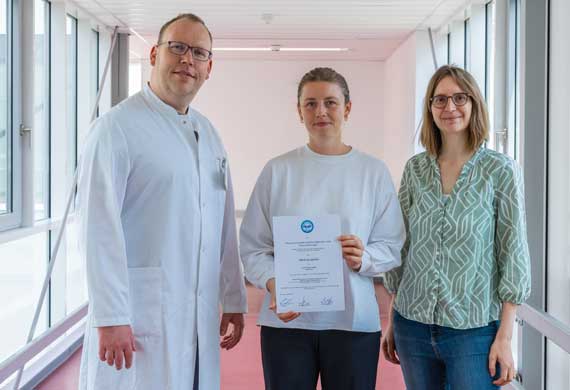
How well are patients prepared for this journey before an abdominal organ transplant? An interdisciplinary team from medicine, communication science and psychology has investigated this at the MHH. In a study, Teresa Linge, a doctoral student at the Clinical Department of General, Visceral and Transplant Surgery (VCH), and colleagues asked 131 patients at the interdisciplinary transplant outpatient clinic about their information status and needs before an organ transplant. "Our aim was to determine the information needs of patients before a transplant and to identify information gaps and opportunities for improvement," explains Teresa Linge, who is now a junior physician in Berlin.
Information promotes the transplant process
The study showed that the most frequently used sources for affected patients are conversations with physicians, medical professionals and their information materials - as well as the internet. "We know from international studies that reliable, structured information and open, patient-centered Communications promote patients' trust in treatment and support their active participation," says Lisa Felgendreff, M. Sc., from the Institute for Journalism and Communications Research (IJK) in Hanover at the Hanover University of Music, Drama and Media, who has been a visiting researcher at the MHH since January 2025.
Liver and kidney patients: Different requirements
Current offers are often general - and not tailored to the specific requirements of liver or kidney transplants. The needs differ significantly: kidney transplant patients are usually closely connected through dialysis and are well informed. Liver patients, on the other hand, often only see their GP every six months. "This is where we see a particular need for action," says Teresa Linge, who received an award for her abstract on the study at the German Society of Surgery (DGHC) 2025 congress.
Communications with physicians remain central
"Communications with physicians are perceived as reliable and trustworthy," emphasizes PD Dr. Philipp Felgendreff, transplant surgeon at VCH. However: "Many patients, who have more and more questions, are meeting fewer and fewer physicians." This makes it all the more important to close information gaps - not only to prevent myths, but also to improve the outcome of the transplant.
According to the study, in which Prof. Dr. Elena Link, an expert in science communication at Johannes Gutenberg University Mainz, was also involved, questions about waiting times, the surgical procedure, risks and aftercare are among the most common. Relevant information helps patients to be better prepared, manage their expectations - and regain some control over the complex process.
"This area is still little researched in Germany. Scientific literature is almost only available from other countries," says Lisa Felgendreff, whose research focuses on evidence-based health information. Her goal: Communications that inform rather than overwhelm - and meet patients at eye level.