Strabismus (= squint)
What different forms of squint are there?
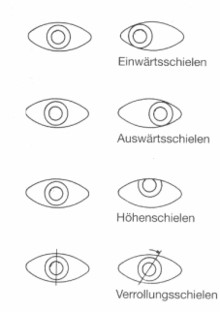
Strabismus refers to the deviation of one eye. This is caused by an imbalance of the eye muscles. There are the following types:
- External strabismus (exotropia): One eye deviates outwards.
- Internal strabismus (esotropia): One eye deviates inwards.
- Vertical strabismus (vertical divergence): One eye is above / below the other eye.
- Positive vertical divergence: Legal eye is above the left eye.
- Negative vertical divergence: Left eye is above the Legal eye.
- Rolling strabismus (cyclorotation): One eye rotates.
- Incyclorotation: One eye turns inwards
- Excyclorotation: One eye turns outwards
The types of strabismus can also be classified according to the time of onset:
- Congenital (congenital): Congenital strabismus or strabismus occurring in the 1st year of life
- Acquired: Strabismus occurring in the course of life
Risk factors for acquired strabismus: High blood pressure, diabetes, neurological diseases, space-occupying lesions
Information on strabismus
Summarized for you at a glance
- When do double vision occur? In the case of acquired strabismus, patients notice double vision. In this case, the eyes have worked together up to a certain point. Both eyes were parallel and looked in the same direction. If a strabismus occurs, one eye looks in a different direction and the same image is perceived in two different places. Double vision therefore occurs.
- Why do squinting children not have double vision? In the case of congenital strabismus, the visual impression of the squinting eye is suppressed so that no double vision is perceived. This is actually a good strategy. Unfortunately, this puts the visual development of this eye at a disadvantage. By suppressing the visual impression of the squinting eye, the development of vision and the cooperation of the two eyes, 3D vision (stereo vision), is disadvantaged.
- What to do: Prescription glasses are often the treatment of first choice! If one squinting eye is slightly worse than the other in terms of visual development (amblyopia), then occlusion therapy is often carried out. This involves covering the better eye with an eye patch in order to actively promote the visual development of the worse eye.
- OP? You can find information on this in our flyer. www. mhh.de/fileadmin/mhh/augenheilkunde/bilder/Sehschule/Schiel-OP-flyer.pdf
- Does my child have a squint? An examination to determine whether or not a squint is present can be carried out from the 3rd month of life Onwards, a squint is usually still physiological. From the 3rd month of life, the eyes should be parallel most of the time. An age-appropriate orthoptic examination can rule out a manifest strabismus that requires treatment. This can be carried out in vision schools with orthoptists.