Welcome to the Department of Experimental Pneumology
Here you will find information on our projects, employees, job vacancies and much more!

Contact person
Univ.-Prof. Dr. rer. nat. Ulrich A. Maus
Head of Department and Principal Investigator of the German Center for Lung Research (DZL)
Office
Phone 0511 / 532 9617
Fax 0511 / 532 9699
Postal address
Hannover Medical School
Department of Experimental Pneumology
Feodor-Lynen-Strasse 21 + 23
30625 Hanover
The Department of Experimental Pneumology focuses on translational research into the pathobiology of bacterial infections and chronic remodeling processes of the lung. One focus of our work is the characterization of the mechanisms that define the lung's defense function against inhaled bacterial pathogens and the development and evaluation of new interventional measures to improve the lung's defense against infection. In addition, we are researching pathomechanisms of chronic fibrosing lung diseases (pulmonary fibrosis) as part of the German Center for Lung Research (DZL).
Experimental models of pulmonary infections and chronic lung diseases form an essential basis of our infection biology-oriented research.
Selected third-party funded projects
- Characterization of the pathobiology of acute lung injury after bacterial infection within the framework of the German Center for Lung Research DZL, BREATH Hannover site. Funding: BMBF.
- Investigation of the pathomechanisms of chronic fibrosing lung diseases as part of the German Center for Lung Research DZL, BREATH Hannover site. Funding: BMBF.
- Effect of short- and long-term ECMO treatment on cardiopulmonary regeneration and cerebral function in heart and lung failure. Funding: DFG.
- Influence of lung ageing on the course of bacterially induced lung damage. Funding: DFG.
- Function of mononuclear phagocytes in the early phase of bacterial infection of the lung. Funding: Niedersächsischer Verein zur Bekämpfung der Tuberkulose e. V.
Programs for the promotion of young scientists and physicians
Our Department participates
- in the MHH's StrucMed program for the promotion of young medical scientists
- in the MD/PhD study programs "Molecular Medicine" of the MHH
- in the PhD study programs "Infection Biology" of the Center for Infection Biology (ZIB) of the MHH
- on the "Biomedicine" study programmes at the MHH
Selected literature from 2008 onwards
Moyé S, Bormann T, Maus R, Sparwasser T, Sandrock I, Prinz I, Warnecke G, Welte T, Gauldie J, Kolb M, Maus UA. Regulatory T Cells Limit Pneumococcus-Induced Exacerbation of Lung Fibrosis in Mice. J Immunol. doi: 10.4049/jimmunol.1900980, 2020.
Orihuela CJ, Maus UA, Brown JS. Can animal models really teach us anything about pneumonia? Pro. Eur Respir J. 55:1901539, 2020.
Tort Tarrés M, Aschenbrenner F, Maus R, Stolper J, Schuette L, Knudsen L, Lopez Rodriguez E, Jonigk D, Kühnel MP, DeLuca D, Prasse A, Welte T, Gauldie J, Kolb MR, Maus UA. The FMS-like tyrosine kinase-3 ligand/lung dendritic cell axis contributes to regulation of pulmonary fibrosis. Thorax. 74:947-957, 2019.
Bonniaud P, Fabre A, Frossard N, Guignabert C, Inman M, Kuebler WM, Maes T, Shi W, Stampfli M, Uhlig S, White E, Witzenrath M, Bellaye PS, Crestani B, Eickelberg O, Fehrenbach H, Guenther A, Jenkins G, Joos G, Magnan A, Maitre B, Maus UA, Reinhold P, Vernooy JHJ, Richeldi L, Kolb M. Optimizing experimental research in respiratory diseases: an ERS statement. Eur Respir J. 51:1702133, 2018.
Madrahimov N, Boyle EC, Gueler F, Goecke T, Knöfel AK, Irkha V, Maegel L, Höffler K, Natanov R, Ismail I, Maus U, Kühn C, Warnecke G, Shrestha ML, Cebotari S, Haverich A. Novel mouse model of cardiopulmonary bypass. Eur J Cardiothorac Surg. 53:186-193, 2018.
Dommaschk A, Lang L, Maus R, Stolper J, Welte T, Maus UA. Colonization-induced protection against invasive pneumococcal disease in mice is independent of CD103 driven adaptive immune response. Eur J Immunol. 0:1-10, 2018.
Dommaschk A, Ding N, Tort Tarres M, Bittersohl LF, Maus R, Stolper J, Jonigk D, Braubach P, Lippmann T, Welte T, Maus UA. Nasopharyngeal colonization with Streptococcus pneumoniae triggers dendritic cell dependent antibody responses against invasive disease in mice. Eur J Immunol 47:540-551, 2017.
Behler-Janbeck F, Takano T, Maus R, Stolper J, Jonigk D, Tort Tarrés M, Fuehner T, Prasse A, Welte T, Timmer MS, Stocker BL, Nakanishi Y, Miyamoto T, Yamasaki S, Maus UA. C-type Lectin Mincle Recognizes Glucosyl-diacylglycerol of Streptococcus pneumoniae and Plays a Protective Role in Pneumococcal Pneumonia. PLoS Pathog 12:e1006038, 2016.
Knippenberg S, Ueberberg B, Maus R, Bohling J, Ding N, Tort Tarres M, Hoymann HG, Jonigk D, Izykowski N, Paton JC, Ogunniyi AD, Lindig S, Bauer M, Welte T, Seeger W, Guenther A, Sisson TH, Gauldie J, Kolb M, Maus UA. Streptococcus pneumoniae triggers progression of pulmonary fibrosis through pneumolysin. Thorax 70:636-646, 2015.
Knippenberg S, Brumshagen C, Aschenbrenner F, Welte T, Maus UA. Arginase 1 activity worsens lung-protective immunity against Streptococcus pneumoniae infection. Eur J Immunol 45:1716-1726, 2015.
Behler F, Maus R, Bohling J, Knippenberg S, Kirchhof G, Nagata M, Jonigk D, Izykowski N, Mägel L, Welte T, Yamasaki S, Maus UA. Macrophage-inducible C-type lectin Mincle-expressing dendritic cells contribute to control of splenic Mycobacterium bovis BCG infection in mice. Infect Immun 83:184-196, 2015.
Bischof A, Brumshagen C, Ding N, Kirchhof G, Briles DE, Gessner JE, Welte T, Mack M, Maus UA. Basophil expansion protects against invasive pneumococcal disease in mice. J Infect Dis 210:14-24, 2014.
Steinwede K*, Henken S*, Bohling J, Maus R, Ueberberg B, Brumshagen C, Brincks EL, Griffith TS, Welte T, Maus UA. TNF-related apoptosis-inducing ligand (TRAIL) exerts therapeutic efficacy for the treatment of pneumococcal pneumonia in mice. J Exp Med 209: 1937 - 1952, 2012 (*shared first authorship).
Brumshagen C, Maus R, Bischof A, Ueberberg B, Bohling J, Osterholzer JJ, Ogunniyi AD, Paton JC, Welte T, Maus UA. FMS-like tyrosine kinase-3 ligand (Flt3L) treatment of mice aggravates acute lung injury in response to S. pneumoniae: role of pneumolysin. Infect Immun 80: 4281 - 4290, 2012.
Ding N, Dahlke K, Janze AK, Mailer PC, Maus R, Bohling J, Welte T, Bauer M, Riedemann NC, Maus UA. Role of p38 mitogen-activated protein kinase in posttraumatic immunosuppression in mice. J Trauma Acute Care Surg 73: 861 - 868, 2012.
Behler F, Steinwede K, Balboa L, Ueberberg B, Maus R, Kirchhof G, Yamasaki S, Welte T, Maus UA. Role of Mincle in Alveolar Macrophage-Dependent Innate Immunity against Mycobacterial Infections in Mice. J Immunol 189: 3121 - 3129, 2012.
Steinwede K, Maus R, Bohling J, Voedisch S, Braun A, Ochs M, Schmiedl A, Länger F, Gauthier F, Roes J, Welte T, Bange FC, Niederweis M, Bühling F, Maus UA. Cathepsin G and Neutrophil Elastase Contribute to Lung-Protective Immunity against Mycobacterial Infections in Mice. J Immunol 188: 4476 - 4487, 2012.
Weber M, Lambeck S, Ding N, Henken S, Kohl M, Deigner HP, Enot DP, Igwe EI, Frappart L, Kiehntopf M, Claus RA, Kamradt T, Weih D, Vodovotz Y, Briles DE, Ogunniyi AD, Paton JC, Maus UA *, Bauer M *. Hepatic induction of cholesterol biosynthesis reflects a remote adaptive response to pneumococcal pneumonia. FASEB J 26: 2424 - 2436, 2012 (* shared senior authorship).
Karpurapu M, Wang X, Deng J, Park H, Xiao L, Sadikot RT, Frey RS, Maus UA, Park GY, Scott EW, Christman JW. Functional PU.1 in macrophages has a pivotal role in NF-kB activation and neutrophilic lung inflammation during endotoxemia. Blood 118: 5255 - 5266, 2011.
Steinwede K, Tempelhof O, Bolte K, Maus R, Bohling J, Ueberberg B, Länger F, Christman JW, Paton JC, Ask K, Maharaj S, Kolb M, Gauldie J, Welte T, Maus UA. Local delivery of GM-CSF protects mice from lethal pneumococcal pneumonia. J Immunol 187: 5346 - 5356, 2011.
Hahn I, Klaus A, Janze AK, Steinwede K, Ding N, Bohling J, Brumshagen C, Serrano H, Gauthier F, Paton JC, Welte T, Maus UA. Cathepsin G and neutrophil elastase play critical and nonredundant roles in lung-protective immunity against Streptococcus pneumoniae in mice. Infect Immun 79: 4893 - 4901, 2011.
Hahn I, Klaus A, Maus R, Christman JW, Welte T, Maus UA. Dendritic Cell Depletion and Repopulation in the Lung after Irradiation and Bone Marrow Transplantation in Mice. Am J Respir Cell Mol Biol 45: 534 - 541, 2011.
Jonigk D, Golpon H, Bockmeyer CL, Maegel L, Hoeper MM, Gottlieb J, Nickel N, Hussein K, Maus U, Lehmann U, Janciauskiene S, Welte T, Haverich A, Rische J, Kreipe H, Laenger F. Plexiform lesions in pulmonary arterial hypertension composition, architecture, and microenvironment. Am J Pathol 179: 167 - 179, 2011.
Henken S, Bohling J, Martens-Lobenhoffer J, Paton JC, Ogunniyi AD, Briles DE, Salisbury VC, Wedekind D, Bode-Böger SM, Welsh T, Bange FC, Welte T, Maus UA. Efficacy profiles of daptomycin for treatment of invasive and noninvasive pulmonary infections with Streptococcus pneumoniae. Antimicrobial Agents and Chemotherapy 54: 707 - 717, 2010.
Herbold W, Maus R, Hahn I, Ding N, Srivastava M, Christman JW, Mack M, Reutershan J, Briles DE, Paton JC, Winter C, Welte T, Maus UA. Importance of CXC chemokine receptor 2 in alveolar neutrophil and exudate macrophage recruitment in response to pneumococcal lung infection. Infect Immun 78: 2620 - 2630, 2010.
Henken S, Bohling J, Ogunniyi AD, Paton JC, Salisbury VC, Welte T, Maus UA. Evaluation of biophotonic imaging to estimate bacterial burden in mice infected with highly virulent compared to less virulent Streptococcus pneumoniae serotypes. Antimicrob Agents Chemother 54: 3155 - 3160, 2010.
Winter C, Herbold W, Maus R, Länger F, Briles DE, Paton JC, Welte T, Maus UA. Important role for CC chemokine ligand 2-dependent lung mononuclear phagocyte recruitment to inhibit sepsis in mice infected with Streptococcus pneumoniae. J Immunol 182: 4931 - 4937, 2009.
Denzel A, Maus UA, Gomez MR, Moll C, Niedermeier M, Winter C, Maus R, Hollingshead S, Briles DE, Kunz-Schughart LA, Talke Y, Mack M. Basophils enhance immunological memory responses. Nat Immunol 9: 733 - 742, 2008.
Taut K, Winter C, Briles DE, Paton JC, Christman JW, Maus R, Baumann R, Welte T, Maus U. Macrophage Turnover Kinetics in the Lungs of Mice Infected with Streptococcus pneumoniae. Am J Respir Cell Mol Biol 38: 105 - 113, 2008.
Schreiber O, Steinwede K, Ding N, Srivastava M, Maus R, Länger F, Prokein J, Ehlers S, Welte T, Gunn MD, Maus UA. Mice That Overexpress CC Chemokine Ligand 2 in Their Lungs Show Increased Protective Immunity to Infection with Mycobacterium bovis Bacille Calmette-Guérin. J Infect Dis 198: 1044 - 1054, 2008.
Vacancies
If you are interested in a research assistant position or an MTA/BTA position, please do not hesitate to contact us directly.
School internships
School internships are arranged through the Hannover Biomedical Research School (HBRS) of the MHH.
Study-related internships, diploma theses, master's theses
If you are interested in an internship or a diploma/master's thesis as part of your studies in Biomedicine/Biotechnology or a similar field, please contact us directly. We will be happy to discuss the current possibilities.
Postdocs/Scientific staff
PhD students
- Femke Hollwedel
- Mike Robert Lühmann
- Marie Moog
- Lena Ostermann
- Marieke Reinboth
- Lara-Kristin Steinmetz
Medical-technical staff
Office
Directions by public transportation
Subways: U3/U7/U9 in the direction of Altwarmbüchen/Fasanenkrug
Stop: Noltemeyerbrücke or Spannhagengarten
Change to bus: 123 or bus 137
Stop: Neue-Land-Straße
Directions by car
From Hamburg on the A7 to the Hannover-Kirchhorst interchange, continue on the A37 towards Hannover.
From Dortmund or Berlin on the A2 to the Hannover-Buchholz interchange, continue on the A37 towards Hannover.
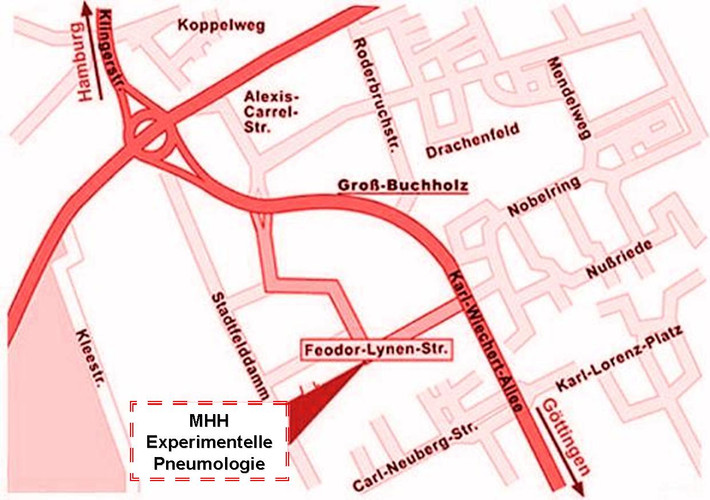
Take the A37 or the Messeschnellweg to the Weidetor traffic circle and turn into Karl-Wiechert-Allee (see sketch). Then turn right into Rudolf-Pichlmayr-Straße.
At the T-junction (Feodor-Lynen-Straße) you will find us in the 2nd building on the legal side.
Coming from Kassel, take the A7 to the Hannover-Süd interchange and continue on the A37 towards Hannover. The A37 merges into the Messeschnellweg.