20 years of service to education: simulation patients at MHH
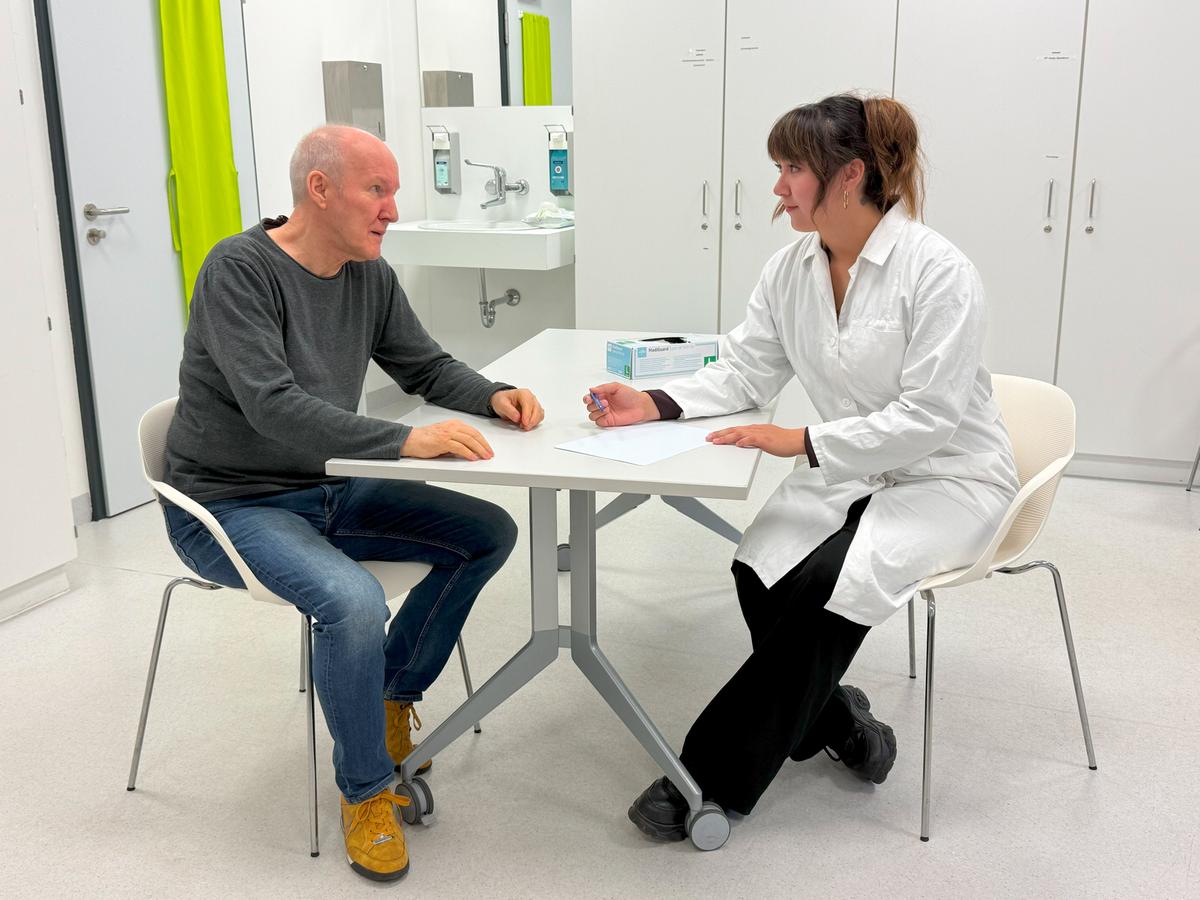
Simulated patient Adrian Anders in a physician-patient consultation with medical student Tessa Pfeffer. Copyright: Janna Zurheiden/MHH
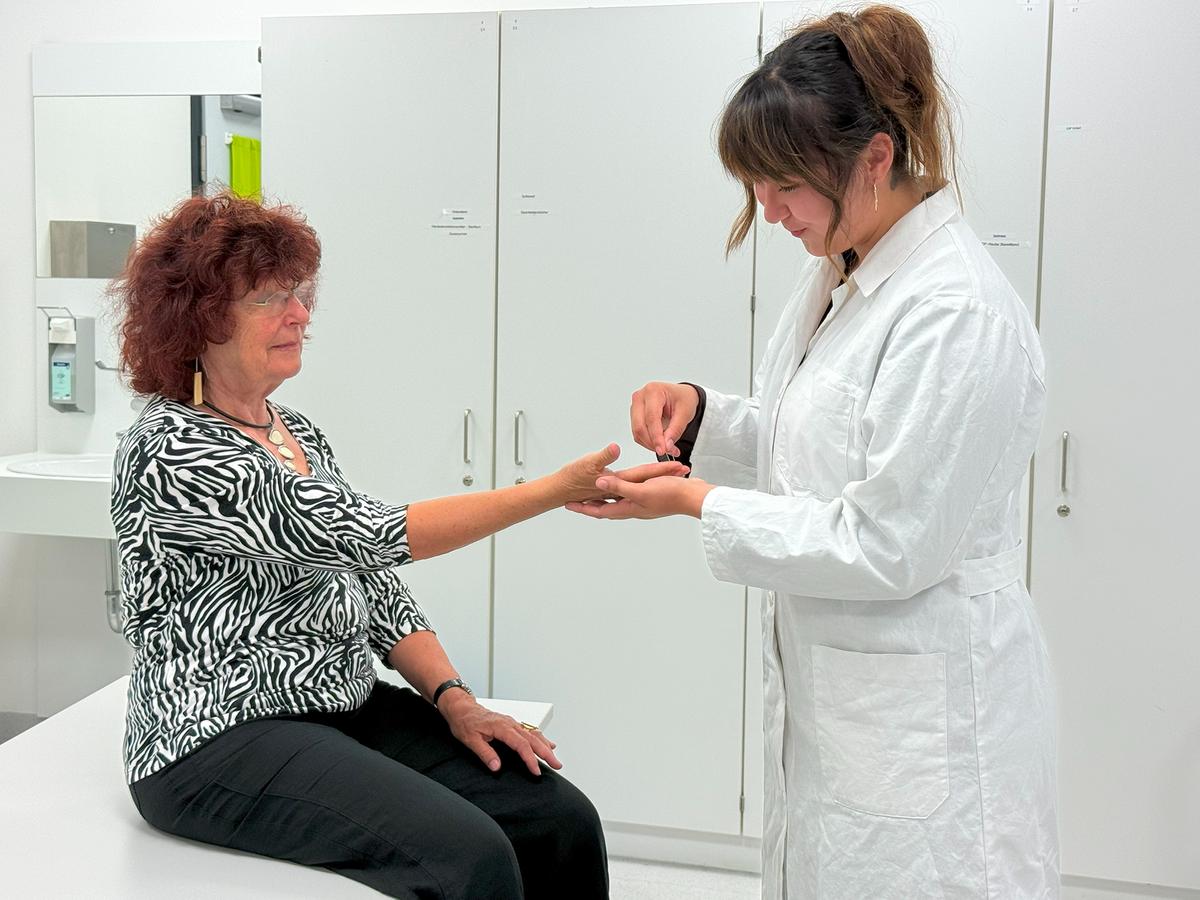
Clinical scenarios such as this one with simulation patient Anita Pape-Schön offer medical students like Tessa Pfeffer the opportunity to practice taking a medical history in a controlled environment. Copyright: Janna Zurheiden/MHH
She actually only comes in for her annual checkup, but for the past few months she has repeatedly noticed that her hands go numb at night. At the general practice, a young physician greets her and asks about her symptoms. “Suddenly, objects just fall out of my hands,” the patient reports. The physician examines her hands and performs a few tests. “Do your hands ever tingle?” she asks. “Yes, sometimes—a little bit right now, too.” After further examinations, the diagnosis is quickly confirmed: carpal tunnel syndrome. In this case, medical student Tessa Pfeffer made the correct diagnosis. She is in her third year of medical school at the MHH. Sitting across from her is simulation patient Anita Pape-Schön, 78 years old. The doctor-patient conversation was just a simulation, designed to give the student the opportunity to take a medical history and make a diagnosis on her own in as realistic an examination setting as possible. Currently, around 80 simulation patients are available at the MHH for exercises in medical interviewing, Communications in difficult situations, and physical examinations. They are trained and prepared for their various assignments by the team of the MHH Simulation Patient Program (SPP-MHH). The program is led by Prof. Dr. Thomas von Lengerke, who has overseen it since its inception, together with his team from the Medical Psychology Unit at MHH. The benefits of using simulation patients in teaching are numerous; the most important include the protection of real patients, the diversity and repeatability of roles of varying difficulty, reliable assessments, and qualified feedback.
For more than 15 years as a simulation patient, engaging with the younger generation
Anita Pape-Schön has already been through many such conversation scenarios; she has been part of the simulation patient program for more than 15 years. “I got involved back then through a friend who spoke very enthusiastically about it. At the time, I thought it would be a great way to spend my retirement,” says the Hanover resident. “Connecting with the younger generation has always been important to me. Here, I can contribute and help the young students at the same time.” Anita Pape-Schön looks forward to her sessions, which usually take place in the training rooms of the MHH Skills Lab. The students are grateful to be able to practice not only with real patients but also in a controlled environment. “I just took my oral-practical OSCE exams, which test not only physical examinations and medical terminology but also structured medical communication,” explains student Tessa Pfeffer. The exercises with the simulation patients helped her a great deal in preparing for this exam and for her future practice. “Above all, they showed me that, in addition to technical skills, it’s just as important to be able to respond to each individual and the specific situation.” This is also important to Adrian Anders. He joined the program as a simulation patient two years ago and enjoys putting his acting talent to use for teaching. “As a bonus, I also learn a lot about diseases and my own body in the process,” he adds.
The HannibaL model degree program launched the simulation patient program 20 years ago
The Medical Psychology Unit at MHH launched the simulation patient program 20 years ago when the HannibaL model degree program began. “The aim was to reflect the model’s philosophy of providing medical students with as many opportunities for practical training as possible right from the start. The simulation patients make themselves available to our students for exercises so that they can develop the practical skills that are important for their future medical practice,” explains psychologist Prof. Dr. Thomas von Lengerke, director of the program, which he established at the MHH and has overseen ever since. While the use of simulation patients was initially intended for the Diagnostic Methods module and the OSCE exams, the program has gradually expanded to include additional modules and elective courses, as well as other study programmes at the MHH such as dentistry, public health, and Midwifery Science. They are now also used in the training of dieticians and in the Lower Saxony Medical Association’s proficiency exams for physicians who completed their training abroad. “We can no longer do without simulation patients in teaching at the MHH,” emphasizes Professor von Lengerke. His team includes psychologist Svenja Kümmel, who coordinates the program and highlights its diverse applications: “We use our simulation patients in both teaching and exams—specifically in conversation skills and Communications, whether it involves taking a medical history, simulating physical examinations, or delivering difficult or bad news and specific diagnoses.”
New simulation patients wanted
Applications from new simulation patients are welcome at any time. In addition to being outgoing and enjoying acting, applicants should also be willing and able to serve as simulation patients during the week. Please submit applications online at https://www.mhh.de/simulationspatienten/ or by email to: simulationspatienten@mh-hannover.de.
Text: Bettina Dunker