Treatment with “gene scissors”: MHH researchers use base editing to treat alpha-1 antitrypsin deficiency.
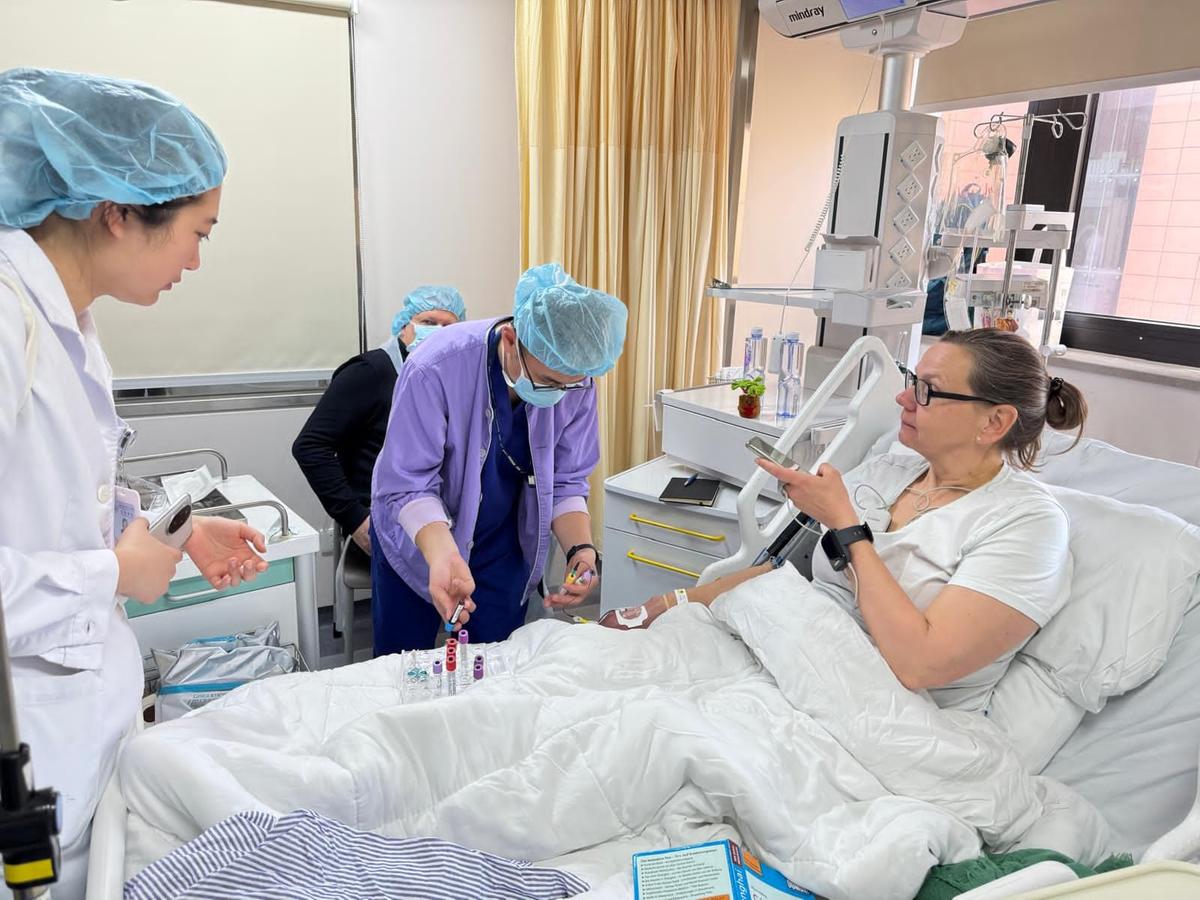
Patient Katrin H. during her treatment at a hospital in Shanghai. Copyright: Michael Ott/MHH
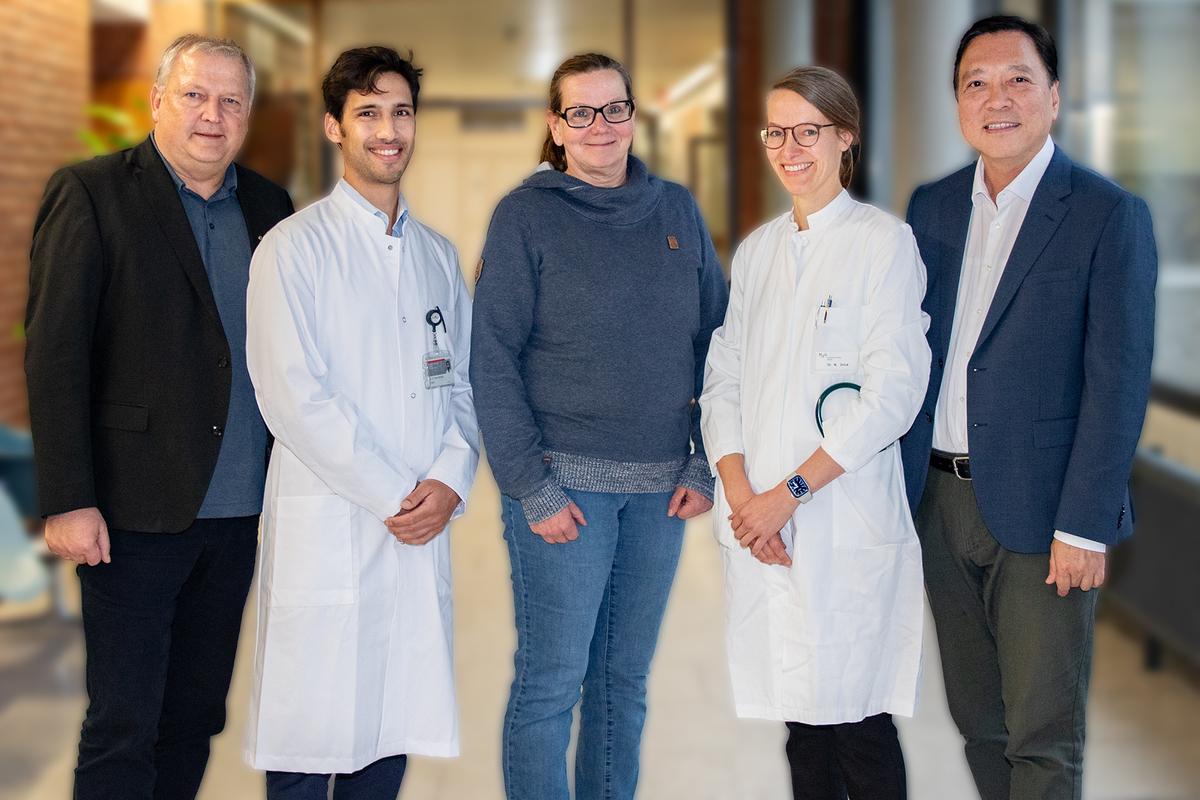
Delighted with the successful treatment of alpha-1 antitrypsin deficiency through gene correction (from left): Prof. Dr. Michael Ott, Dr. Dr. Simon Krooss, patient Katrin H., PD Dr. Nora Drick, and Dr. Quinggong Yuan. Copyright: Karin Kaiser/MHH
Alpha-1 antitrypsin deficiency (AATM) is a congenital metabolic disorder. It is caused by a genetic defect that results in the protective protein alpha-1 antitrypsin (AAT) being produced only in a defective form. This deficiency primarily damages the lungs and the liver and can lead to serious conditions such as pulmonary emphysema, liver fibrosis, or liver cirrhosis. In particularly severe cases, an organ transplant is the last resort. There is currently no curative treatment. A team from the Clinical Department of Gastroenterology, Hepatology, Infectious Diseases and Endocrinology and the Clinical Department of Pneumology and Infectious Diseases at Hannover Medical School (MHH), in collaboration with Renji Hospital in Shanghai, China, has now succeeded for the first time in effectively correcting the underlying genetic defect and successfully treating seven patients with AATM. Using CRISPR/Cas9 technology—commonly known as “genetic scissors”—and a specialized biotechnological tool, the researchers specifically modified a tiny defective building block in the genetic material of the AAT-producing liver cells. In technical terms, this procedure is referred to as base editing. The initial findings on the safety and efficacy of this gene correction have been published in the journal *Journal of Hepatology*.
Cell launches its own repair program
Alpha-1 antitrypsin is produced mainly in the liver and travels via the bloodstream to the lungs, where it protects the tissue from being broken down by the body’s own enzymes. “Like most congenital genetic disorders, alpha-1 antitrypsin deficiency is caused by a single tiny building block in the DNA—a so-called base—being incorrectly incorporated,” explains Prof. Dr. Michael Ott, senior physician at the Clinical Department of Gastroenterology and head of the Laboratory for Cell and Gene Therapy. In many gene therapies, an intact, functional copy of the defective gene is introduced into the cell using, for example, special viral vectors. This is intended to restore the missing or impaired protein production. The MHH researchers are taking a completely different approach. They are focusing on the mutation itself. What makes this gene repair method unique is that, after the mutated base is modified, a single-strand break is created on the opposite strand. The cell then automatically initiates its natural repair program and incorporates the correct counterpart into the second strand as well. As a result, the mutation disappears without causing a double-strand break in the DNA. “We tested this approach for other diseases in animal studies for a long time until, thanks to a long-standing collaboration with Renji Hospital in Shanghai, we were able to conduct a joint clinical trial there,” says Dr. Dr. Simon Krooss, a physician and scientist at the Clinical Department of Gastroenterology. Since the disease occurs primarily in Europe and the U.S., but is rare in Asia, the MHH sent seven patients, accompanied by medical staff, to Shanghai. The costs were covered by a Chinese company that has further improved the base-editing method and holds the patents for it.
The disease is often overlooked
One of those affected is Katrin H. The 55-year-old had been suffering from shortness of breath for years and was becoming increasingly unable to handle physical exertion. As a result, she had to give up her career as an anesthesiologist. “The symptoms are usually nonspecific, which is why the disease is often diagnosed late,” says associate professor PD Dr. Nora Drick, functional senior physician at the Clinical Department of Pulmonology. “The disease is often initially mistaken for bronchial asthma.” Katrin H. was then diagnosed with AATM at the MHH in 2011. Because the patient has the most severe form of this genetic defect—in which the body no longer produces any functional protective protein at all—she received what is known as augmentation therapy. In this therapy, the missing protein is administered into the body via a vein—every week, for the rest of her life. “But the treatment didn’t help much; the disease has continued to progress slowly and relentlessly,” says Katrin H. At the beginning of 2026, she learned about the study and was certain: “This is my chance.”
Clinical trial planned at MHH
In March, the 55-year-old flew to Shanghai, accompanied by Professor Ott. She stayed there for four weeks and received an infusion of the new gene therapy drug. Subsequent blood tests showed that her body was once again producing functional AAT. Side effects: none. She has not needed augmentation therapy since then. “For me, this is like winning the lottery,” says Katrin H. joyfully. While the gene therapy cannot reverse the damage to her lungs and liver that had already occurred by that point, the patient can now hope that her disease has been halted and that her condition will not deteriorate further. The Hanover resident can therefore continue working at her office job in the field of hospital hygiene.
In the future, flights to Shanghai will no longer be necessary for AATM patients to benefit from this therapy, which has not yet been approved. The clinical trial at the MHH is scheduled to resume in early 2027. And the procedure is not limited to AATM, a disease that affects an estimated 120,000 people in Europe. “In the long term, this revolutionary approach can be applied to the treatment of other congenital genetic liver diseases in which a single base in the DNA must be replaced,” emphasizes Professor Ott.
The original publication, “Liver biopsy confirms precise and efficient correction of SERPINA1 after in vivo base editing in a patient with alpha-1 antitrypsin deficiency,” can be found here.
Further information on alpha-1 antitrypsin deficiency (AATM) can be found here.
Text: Kirsten Pötzke