The goals: early detection of disease risks, development of risk communication, and improvement of care
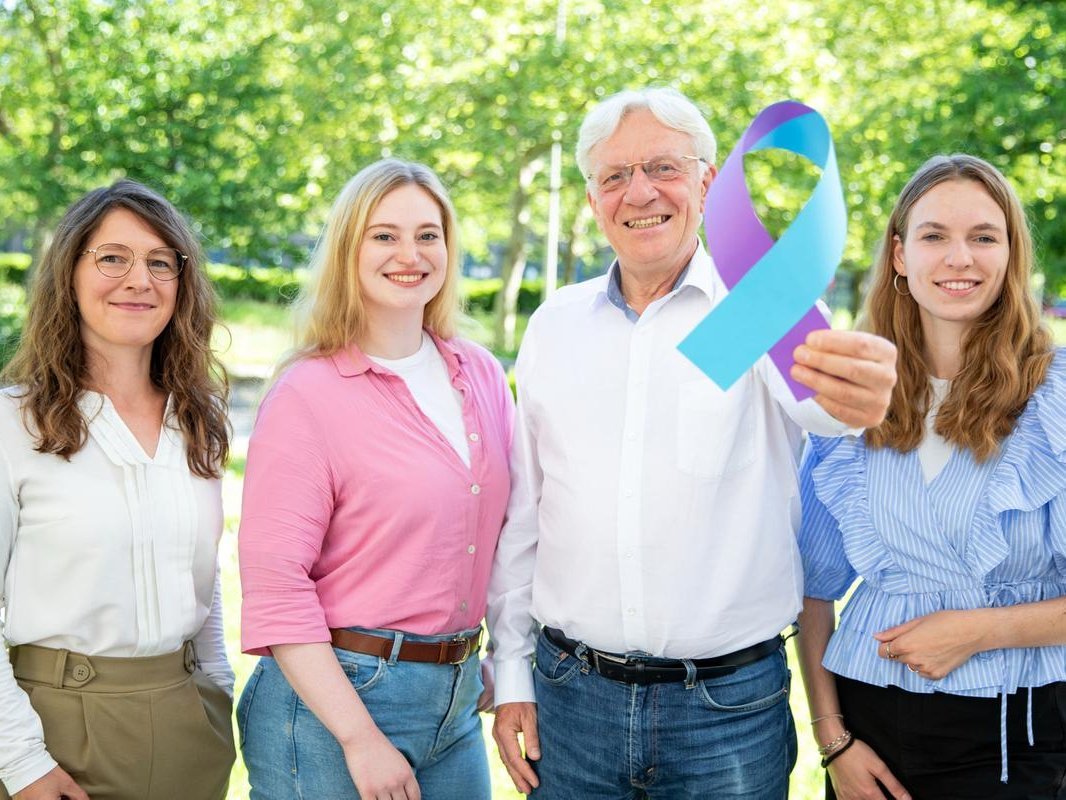
Exploring the potential of AI in the early detection of cancer: Dr. Kathrin Krüger, Viktoria Wiesner, Prof. Dr. Christian Krauth, and Laura Böhme. Copyright: Karin Kaiser/MHH
In Germany, approximately 518,000 people are newly diagnosed with cancer each year, and the trend is rising. For those affected, the disease is usually associated with significant physical and psychological strain, and it often results in high treatment costs for the healthcare system. Through prevention and early detection of the disease, the chances of successful treatment can be increased, and the progression of the disease can be slowed or even halted. At the same time, costs for the healthcare system can be reduced. This is precisely where the ROKAVI project comes in. The acronym ROKAVI stands for Risk Predictionin Oncology: Development of anAI Algorithm, Insured Persons’ Preferences, and Ethical Implications. Under the leadership of the Institute of Epidemiology, Social Medicine and Public Health Research at Hannover Medical School (MHH), AI-based models for the early detection of disease risks are to be developed using health insurance data
Data with great potential
The impetus for the project came from the Health Data Use Act (GDNG), which took effect in 2024. It allows statutory health insurance providers to use routine data to inform insured individuals about their individual health risks. A key area of this data-driven preventive healthcare concerns cancer. “We are investigating whether AI-based algorithms for assessing cancer risk can be developed using health insurance data—such as diagnoses, services provided, and sociodemographic information,” explains ROKAVI project leader Prof. Dr. Christian Krauth from the Institute of Epidemiology, Social Medicine and Public Health Research at MHH. His team, which includes health scientists Dr. Kathrin Krüger and Viktoria Wiesner as well as statistician Laura Böhme, aims to explore the potential of predictive models that health insurance companies could use to inform their policyholders. One of the project’s partners is the IT company ITSC GmbH, which has several years of experience implementing data-driven projects for statutory health insurance providers. The participating health insurance providers, Pronova BKK and mkk – meine krankenkasse, are making their routine data available to ROKAVI. Together, they have more than 1.3 million insured members. Other partners include the statutory health insurance provider BKK 24 and the Comprehensive Cancer Center Hannover (CCC Hannover).
Comparing innovative and traditional models
In the ROKAVI project, researchers first identify which types of cancer—such as prostate, breast, lung, or colorectal cancer—are particularly well-suited for a predictive model. They then develop a traditional statistical model and an innovative model based on artificial intelligence (AI) for a selected type of cancer. These models will be compared in terms of their predictive accuracy to identify the most suitable one. “One of our hypotheses is that an AI-based algorithm for predicting cancer provides more precise risk assessments than traditional statistical models,” says Professor Krauth.
Ethical guidelines for the use of predictive models
The second part of the project involves creating an ethical framework for the use of predictive models and developing appropriate risk communication strategies for cancer prediction. To this end, the MHH team is drawing on the expertise of the CCC Hannover. Among other things, the project aims to determine whether, to what extent, and in what form insured individuals wish to receive information about their cancer risk. The goal is to safeguard insured individuals’ right to informational self-determination. The MHH team is also interviewing representatives from health insurance companies to gather their assessments of the benefits and risks of the developed predictive model. Based on the results, the ROKAVI team will then formulate recommendations for the use of predictive models.
Can positive experiences be applied to Germany?
ROKAVI launched in April and is funded for three years with approximately one million euros from the Innovation Fund of the Joint Federal Committee. In Germany, there has been no previous experience with prediction models based on routine data from health insurance companies. “International studies show that such models support the prevention and early detection of cancer, lead to better patient care, and can also reduce healthcare costs,” says Professor Krauth. He is therefore eager to find out whether this could also apply to Germany.
Text: Tina Götting
SERVICE
Further information can be found here.