A research team has identified new genes and gene variants associated with an increased incidence of breast cancer.
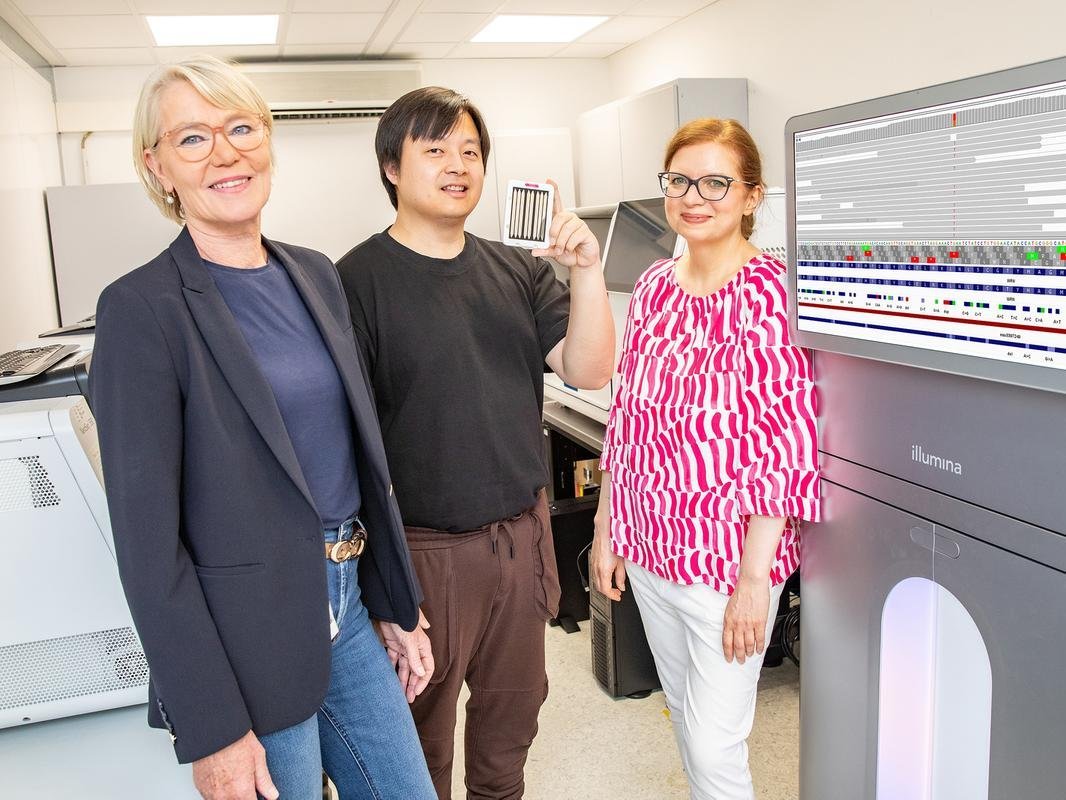
At the MHH Institute of Human Genetics: Prof. Dr. Doris Steinemann, Dr. Bernardus Aldrige Allister, and Prof. Dr. Monika Golas (from left). Copyright: Karin Kaiser/MHH
Breast cancer is the most common cancer among women in Germany: About one in eight Ms will develop it during their lifetime. In about five to ten percent of cases, a hereditary predisposition is the underlying cause. Thirteen risk genes have currently been identified for genetic diagnosis, including the BRCA1 and BRCA2 genes. Mutations in these genes are associated with a significantly increased risk of breast cancer.
Now, a research team led by Prof. Dr. Doris Steinemann of the Institute of Human Genetics at Hannover Medical School (MHH) and Prof. Dr. Monika Golas of the Institute of Human Genetics at the University of Augsburg and Augsburg University Hospital has identified additional genes and gene variants associated with an increased incidence of breast cancer. The German Research Foundation (DFG) funded this study, the results of which were published in the journal “npj Breast Cancer.” The first author is Dr. Bernardus Aldrige Allister, formerly of the MHH Institute of Human Genetics.
New candidate genes for cancer
People with a family history of breast or ovarian cancer—or those who have developed breast cancer at a young age or bilaterally—have an increased risk of cancer. They can seek genetic counseling and testing. The testing screens for disease-relevant variants in the high-risk genes BRCA1 and BRCA2, as well as eleven other risk genes. A clear genetic cause can be identified in about 20 percent of those seeking counseling. This gives them access to personalized options for early detection, risk reduction, and treatment. For the remaining individuals, the cause remains unclear for the time being.
The research team led by Professor Steinemann and Professor Golas has now analyzed the entire set of genes and gene activity in blood samples from 134 individuals with breast or ovarian cancer, or both breast and ovarian cancer. In all of these individuals, routine testing of the 13 known cancer risk genes had previously failed to reveal a genetic cause for their cancers. “Our results point to the importance of additional genes that play a central role in DNA repair and genome stability and are thus new candidate genes for families with suspected hereditary breast and ovarian cancer,” says Professor Steinemann.
Centres for hereditary breast and ovarian cancer provide support
Among the candidate genes were also genes that had previously been associated primarily with rare diseases. In these diseases, both copies of the gene—that is, the maternal and paternal copies—must typically be altered for the disease to occur. The study’s results suggest that alterations in just one copy of some of these genes could also increase susceptibility to breast and ovarian cancer.
“As the number of genome sequencing projects increases, it will become possible to better assess the significance of rare genetic variants—including through participation in genomDE, the pilot project for comprehensive diagnostics and personalized therapy selection for rare and oncological diseases,” says Professor Golas.
Ms and men with a family history of breast and/or ovarian cancer, as well as those who have developed breast or ovarian cancer at a young age, can find support at the Centres for Familial Breast and Ovarian Cancer and their partner organizations, such as the Centre for Familial Breast and Ovarian Cancer at MHH.
Text: Bettina Bandel
SERVICE
The original publication,“Multi-omics analysis in suspected hereditary breast and ovarian cancer cases reveals novel candidate susceptibility factors,” can be found here.