Real-time data exchange: The TelePIN network enables high-quality remote treatment.
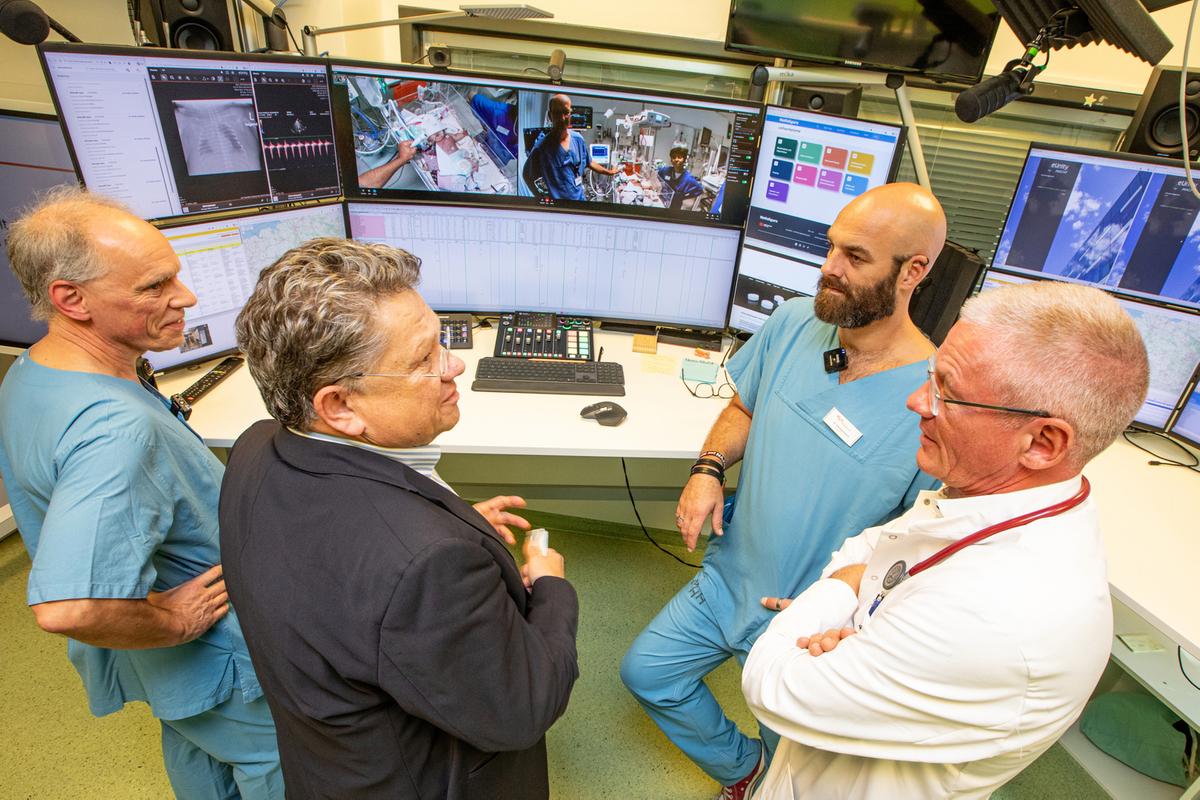
An excellent example of team spirit, digitalisation and cross-site collaboration in healthcare: Lower Saxony’s Minister for Health, Dr Andreas Philippi (second from left), is being briefed on TelePIN by Dr Michael Sasse, Dr Henning Rathert and Prof. Dr Philipp Beerbaum. Copyright: Karin Kaiser/MHH
In Germany, care for critically ill children is at risk - there is a lack of functioning structures, technical equipment, and, above all, staff. The team at Intensive Care Unit 67 at the Children’s Hospital of the Hannover Medical School (MHH) is working to counter this dire situation. Twenty years ago, they founded the Paediatric Intensive Care Network (PIN) to enable closer cooperation with other Clinical Departments. Thanks to telemedicine, this collaboration is now taking a giant leap forward: data, images, and videos can be exchanged in real time between participating children’s hospitals in Lower Saxony and beyond. For example, in a complex case, a small children’s hospital can bring in experts from a larger centre. The child’s examination or treatment then takes place jointly and live. The entire initiative is called TelePIN.
“I am very pleased that we have succeeded in implementing such a comprehensive telemedicine project for the first time in the modern medical history of our state. Especially in light of the upcoming hospital reform, this project will significantly increase the effectiveness of the future hospital landscape,” said Dr. Andreas Philippi. The Lower Saxony Minister of Social Affairs, Labor, Health, and Equality visited the MHH Children’s Hospital today to learn more about TelePIN.
Challenging healthcare situation
As is the case throughout Germany, the healthcare situation in Lower Saxony is also very strained in some regions: “Of the 29 pediatric hospitals in total, only four currently have a specialized ward for paediatric intensive care. And in these hospitals, only half of all paediatric intensive care beds can be staffed because of a statewide shortage of nursing staff and physicians,” explains Dr. Michael Sasse, senior physician at the Clinical Department of Paediatric Cardiology and Intensive Care Medicine and head of TelePIN. To at least partially close these gaps, he and his team at Pediatric ICU 67 initiated the new telemedicine tool. TelePIN entered its pilot phase in early 2025. Currently, seven children’s hospitals in Lower Saxony are already integrated into the system, and funding for an additional 15 children’s hospitals in Lower Saxony and three Clinical Departments in Bremen has recently been secured. The MHH Children’s Hospital serves as the central control unit.
Real-time acute care
The hub of activity at the Children’s Hospital is the so-called TelePIN cockpit. This specially equipped room houses all the technology needed for live Communications with the other children’s hospitals, including seven giant screens and a mobile camera robot with three integrated cameras. Thanks to these live connections, children’s lives have already been saved. “The technology enables us to provide remote support during examinations and procedures - both in their execution and in their interpretation,” explain Dr. Sasse and Dr. Henning Rathert, the project’s technical director. Here’s an example: A newborn is being examined at a participating children’s hospital. Thanks to the live connection, the MHH experts are present in real time during this examination: They view ultrasound images, track the heart’s movements, and monitor the child’s vital signs on the screen. In addition to these detailed views, they also get an overview of the overall situation at the patient’s bedside.
Ensuring comprehensive care
The system complies with data protection regulations and is particularly well-suited for acute and emergency care in paediatric intensive care. The long-term goal is to connect all children’s hospitals in Lower Saxony and Bremen, the adjacent regions of neighboring federal states, and the emergency medical services to TelePIN. This is intended to ensure comprehensive, high-quality care for children with life-threatening illnesses. “This allows us to reduce the number of transfers to other children’s hospitals and help alleviate staff shortages,” says Prof. Dr. Philipp Beerbaum, Director of the Clinical Department of Paediatric Cardiology and Intensive Care Medicine. At the same time, the system - which allows all hospitals to network with one another - serves as a valuable tool for sharing expertise. A shared patient data management system is currently being integrated into TelePIN, and an information tool for tracking bed occupancy is already available.
A forward-looking project
The MHH’s system can be technically adapted to other intensive care fields, such as surgery, cardiology, and pulmonology. “TelePIN is an excellent example of team spirit, digitalization, and cross-site networking in patient care,” summarizes Prof. Dr. Frank Lammert, MHH Vice President and Executive Board Member for Patient Care. According to the state government’s plans, the project will be funded with approximately 6 million euros from Structural Fund II, with half of the amount provided by the federal government and half by the state.
Text: Tina Götting