Patients, family members, physicians, and nurses discuss the quality of life gained at the first meeting of long-term liver transplant recipients.
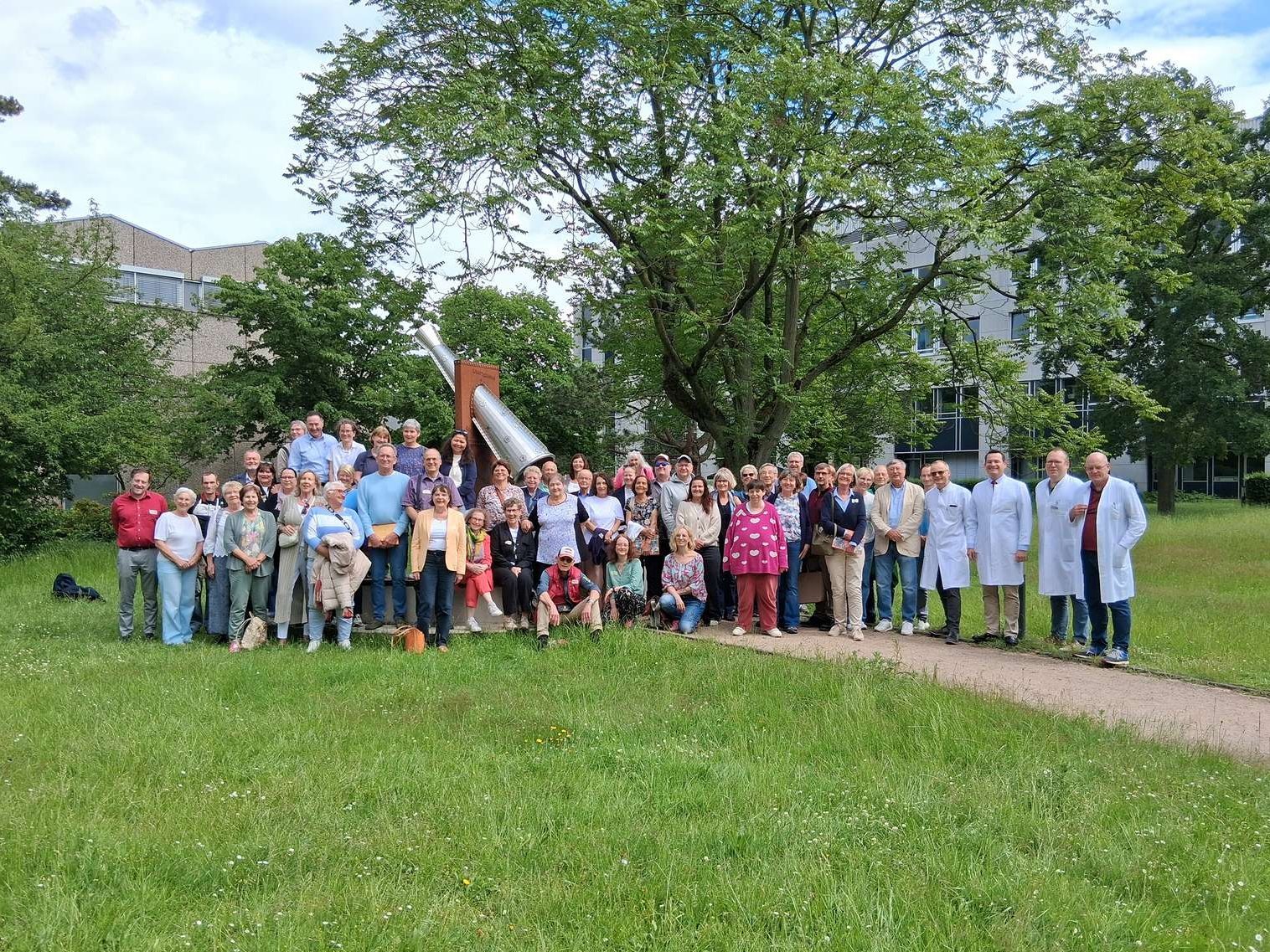
At the Thank You Monument in the MHH Patient Garden: Long-term liver transplant recipients, their families, and medical staff thank the organ donors. Copyright: Cornelius van Beekum/MHH
Thanks to organ donations, they have been leading active lives for more than 35 years: About 20 patients and their families are meeting for the first time at the Hannover Medical School (MHH)—and reconnecting with physicians and nurses who have cared for them over many years. Many received a new liver in the 1980s and 1990s. This makes them among the people worldwide with the longest survival times following a liver transplant.
“These patients impressively demonstrate what transplant medicine can achieve,” says Prof. Dr. Moritz Schmelzle, Director of the Clinical Department of General, Visceral and Transplant Surgery and Head of the Transplant Centre at MHH. “Thanks to organ donation, many of them have gained decades of life, started families, pursued careers, and experienced important life events.”
A life regained
One example is Ilse K., who received a liver transplant in 1985 at the age of 36 after physicians had classified her cancer as inoperable and incurable. Forty-one years later, she looks back on a fulfilling family life with two children, three grandchildren, and two great-grandchildren. At the event, she said, “Thanks to the transplant, I’ve not only been able to watch my children and their children grow up, but I’m also seeing one of my grandchildren go to college.”
In addition to presentations and panel discussions, the event focuses primarily on personal interaction. Many participants did not realize that there were so many others with such long survival times. Together, they can now look back on their life journeys—and on more than 35 years with a donor organ that has given them a new lease on life.
Advances in transplantation and follow-up care
“Over the past few decades, we’ve made great strides in transplant medicine. Treatment with immunosuppressants is now more targeted. Hygiene and dietary guidelines are simpler,” explains Prof. Dr. Burckhardt Ringe, former senior physician at the MHH Clinical Department of General, Visceral and Transplant Surgery. “The early days were difficult because we had to learn everything from scratch: the surgical techniques and the entire management of transplant recipients.”
MHH’s pioneering work in liver transplantation
Prof. Dr. Rudolf Pichlmayr founded the liver transplantation program at MHH in 1972. Since then, more than 4,000 donor livers have been transplanted at MHH. The internationally renowned surgeon made Hanover one of the world’s leading transplantation centers and shaped the development of organ transplantation in Germany for decades. The long-term results achieved today are also a testament to the pioneering medical work of his team.
Transplant medicine for all age groups
The MHH is one of Germany’s largest transplant centers and has decades of experience in transplant medicine and research. This expertise benefits patients. Each year, the MHH performs 300 to 400 organ transplants. In 2025, these included 24 hearts, 110 lungs, 80 livers, 148 kidneys, and three pancreases. Recipients come from all age groups—from infants to seniors.
Text: Camilla Mosel