The Center for Neuroendocrine Tumors at the Comprehensive Cancer Center Lower Saxony (CCC-N) receives ENETS certification. Patient involvement is a central component.
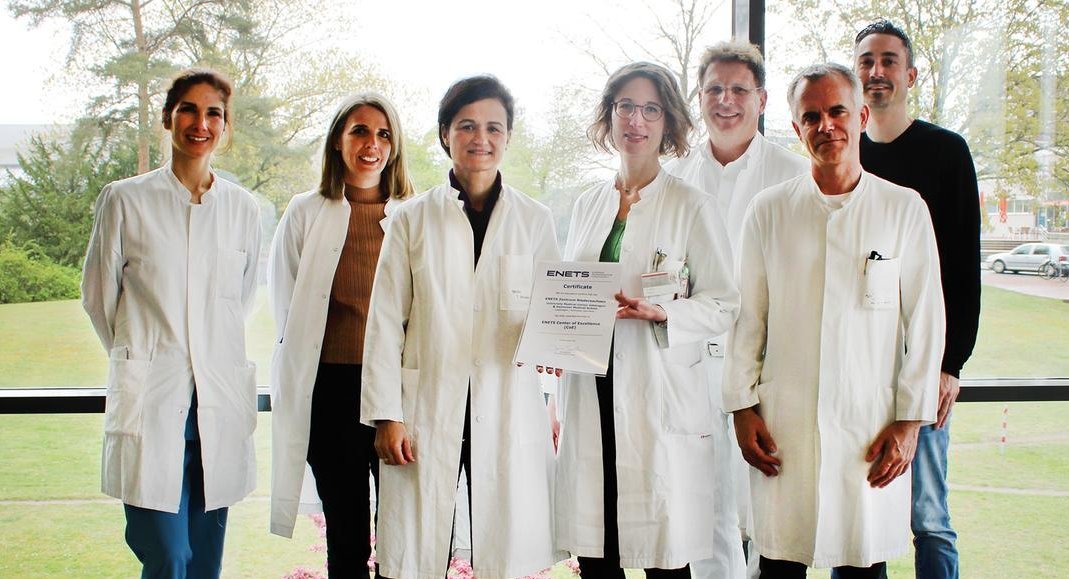
From left: PD Dr. Cornelia Dewald (Head of Interventional Radiology, MHH), PD Dr. Susanne Isfort (Managing Director, CCC Hannover), Dr. Tanja Reineke-Plaaß (Senior Physician, Institute of Pathology, MHH), Dr. Desiree Weiberg (senior physician, Clinical Department of Nuclear Medicine, MHH), Dr. Thomas Brunkhorst (senior physician, Clinical Department of Nuclear Medicine, MHH), PD Dr. Thomas Wirth (Head of the NEN Center Hannover), and David Göbel (Coordinator, NEN Center Hannover). Copyright: Jana Illmer/MHH
The Comprehensive Cancer Center Lower Saxony (CCC-N) strengthens personalized diagnostics and therapy for rare tumor diseases: The newly established Cooperative Center for Neuroendocrine Neoplasms (NEN), with locations at the University Medical Center Göttingen (UMG) and the Hannover Medical School (MHH), has been certified for the first time by the European Neuroendocrine Tumor Society (ENETS) as a Center of Excellence. It is thus one of only 15 specialized centers currently in Germany.
Diagnostic and therapeutic challenges
“The umbrella term ‘neuroendocrine neoplasms’ refers to various tumors that, while they can occur in different organs, all originate in so-called neuroendocrine cells,” explains PD Dr. Thomas Wirth, Director of the Center for Neuroendocrine Tumors at the Hannover site and senior physician in the Clinical Department of Gastroenterology, Hepatology, Infectious Diseases and Endocrinology at Hannover Medical School (MHH). “These cells are found in numerous organs of the human body, meaning that neuroendocrine tumors can, in principle, develop almost anywhere. However, they are most commonly found in the gastrointestinal tract, particularly in the small intestine, appendix, stomach, and pancreas.”
Diagnosis is often challenging because neuroendocrine tumors frequently grow slowly, cause nonspecific symptoms for a long time, and are therefore often detected only at a late stage. Added to this is their varied presentation, with imaging and laboratory findings that can differ significantly. Treatment is also complex and requires a personalized strategy that takes into account the tumor type, hormonal activity, disease stage, and growth dynamics in equal measure.
Patients require comprehensive, individually tailored diagnostics and treatment. This demands specialized expertise and experience. Through close integration into the European ENETS network, patients gain access to current treatment standards, innovative treatment concepts, and clinical trials at the forefront of European medicine. The NEN Center thus makes an important contribution to the further development of specialized care for rare tumor diseases—regionally, nationally, and internationally.
Combined expertise in an interdisciplinary network
At the NEN Center of the CCC-N, specialized teams with particular expertise collaborate in an interdisciplinary manner—including experts in gastroenterology, oncology, endocrinology, surgery, radiology, nuclear medicine, and pathology. “Our common goal is to provide patients with access to innovative, evidence-based treatment approaches tailored to the specific characteristics of their disease,” explains PD Dr. Alexander König, spokesperson for the NEN Center at the CCC-N, director of the Center for Neuroendocrine Tumors at the Göttingen site, and senior physician in the Clinical Department of Gastroenterology, Gastrointestinal Oncology, and Endocrinology at the UMG. “We utilize state-of-the-art diagnostic procedures, innovative therapeutic strategies, and structured follow-up care concepts. Our goal is to provide the best possible medical care while simultaneously ensuring and improving quality of life.”
“The certification is a special recognition of our joint work and the high level of commitment from all participating Departments,” explain the two center directors. It is noteworthy that certification was achieved just about a year after the center’s founding—a success resulting from the rapid, structured development as well as the close and trusting collaboration between UMG and MHH.
Patient involvement as a central component
A distinctive feature of the NEN Center is the close involvement of patients and their advocacy groups. To this end, the CCC-N’s NEN Center maintains close contact with the Neuroendocrine Tumors Network (NeT) e.V. With Dr. Susanne Ude-Koeller and Dr. Kristina Dmoch-Bockhorn, two patient representatives are also actively involved in the center, having played a key role in guiding and supporting its establishment and certification.
“For patients with neuroendocrine tumors, it is crucial to be treated at a specialized center where experience, interdisciplinary collaboration, and access to modern therapies are combined,” emphasizes Dr. Susanne Ude-Koeller, patient representative for the Göttingen site. “The new NEN Center at the CCC-N creates exactly these conditions and provides patients with additional reassurance and guidance in what is often a complex medical situation.”
Consultation hours and contact
Patients with neuroendocrine neoplasms can contact the NEN Center at the CCC-N for evaluation and treatment planning.
Hanover (MHH) location:
Contact via the Gastroenterological Oncology Day Clinic and Outpatient Clinic:
Hours: Mon–Thu 8:00 AM–3:30 PM and Fri 8:00 AM–1:30 PM
Phone hours: Mon–Thu 10:00 AM–12:00 PM and Fri 2:00 PM–3:00 PM
Email: gastro-onkologische-tagesklinik.ambx@mh-hannover.de
Phone: 0511-532 6760, Fax: 0511-532 2021
Göttingen (UMG) location:
Contact: angela.gries@med.uni-goettingen.de or elsbeth.kersting@med.uni-goettingen.de
Office hours:
- until July 1, 2026: Tuesdays, 8:00 a.m.–3:00 p.m.
- from July 1, 2026: Thursdays, 8:00 a.m.–3:00 p.m.
SERVICE
You can find further information and contact persons here.