MHH pediatric radiology: An MRI simulator playfully prepares young patients for the examination in the "tube".
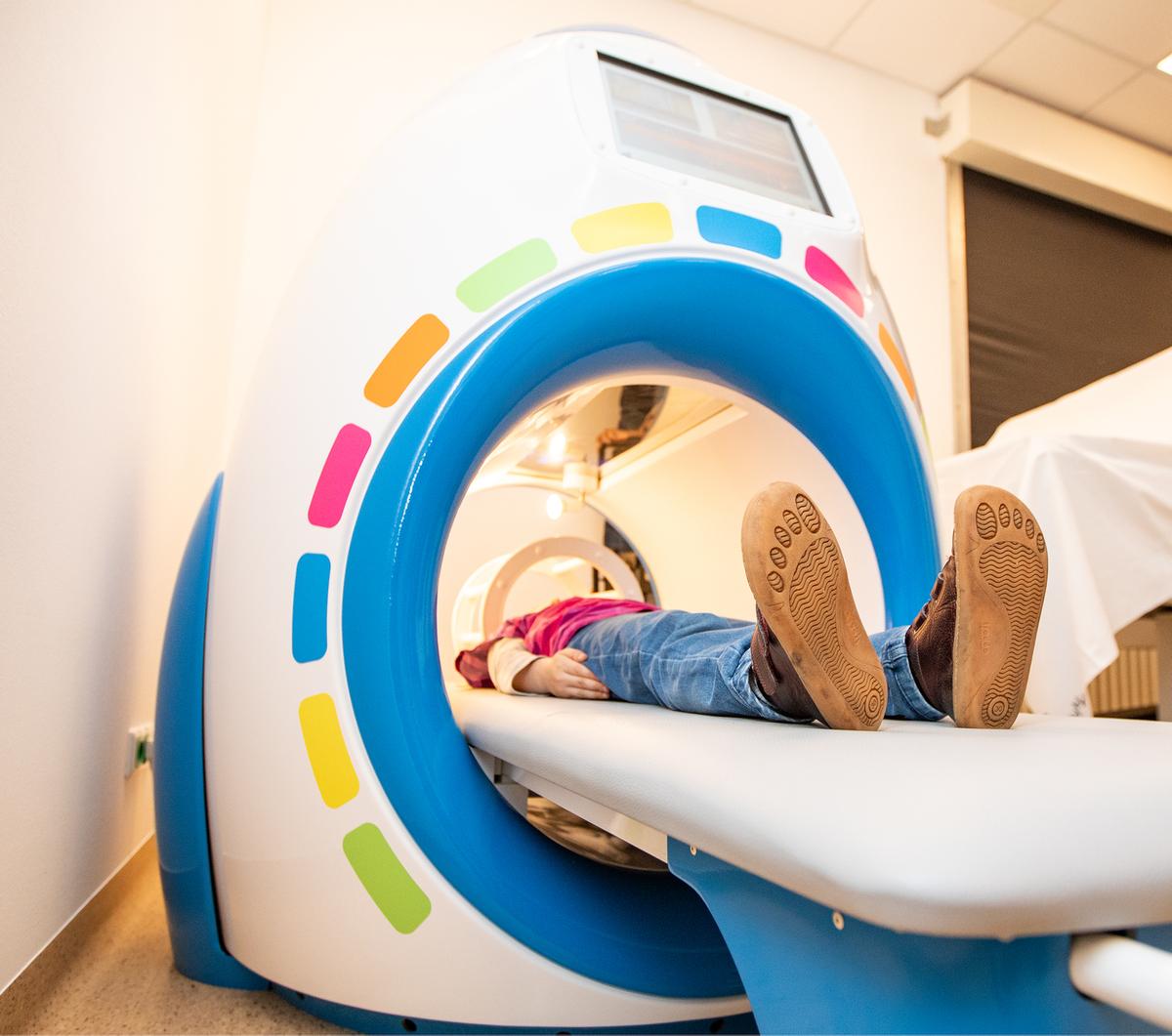
Fun with a learning effect: While the child practices the examination in the MRI simulator, it can watch a movie. Copyright: Karin Kaiser/MHH
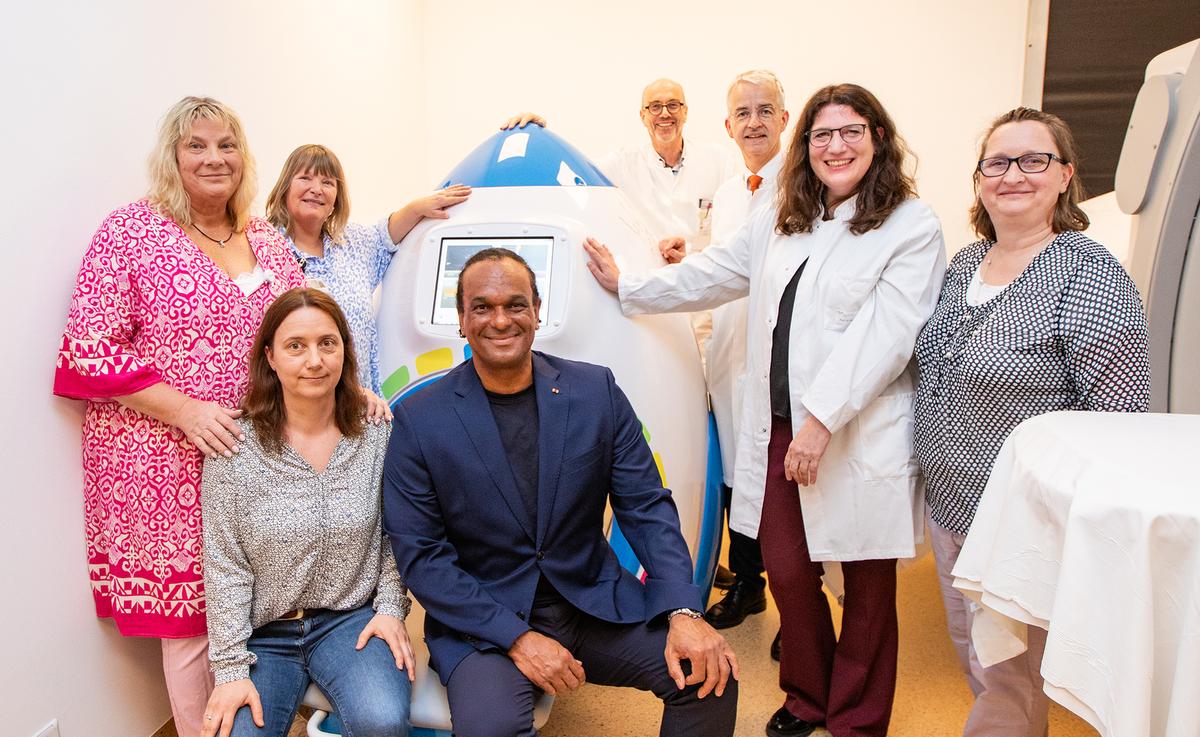
Celebrating the outcome of the joint initiative: Claudia Erzfeld-Dokanikis and Annette Wiens from Spieloase, Prof. Dr Frank Wacker, Director of the Institute of Diagnostic and Interventional Radiology, Prof. Dr Frank Lammert, Vice-President of the MHH, Prof. Dr Diane Renz, Head of Paediatric Radiology, Stefanie Günther (top row, from left) and Kristin Buchholz, team leaders in paediatric radiology, and Martin Rietsch, patron of the campaign (bottom row, from left). Copyright: Karin Kaiser / MHH
Many children find appointments in the Clinical Department unpleasant - especially when it involves an examination using magnetic resonance imaging (MRI). It's good if young patients can be prepared for this and their fear of the "tube" is taken away. The pediatric radiology department of the Children's Hospital at Hannover Medical School (MHH) now has a training device for this purpose. Children can practice the examination in a playful way in an MRI simulator. It is the first MRI simulator in Lower Saxony. The costs for the device, which amounted to around 30,000 euros, were raised by the children's hospital's play oasis team in a major fundraising campaign.
Cramped facility with loud noises
More than 1,000 MRI examinations are carried out at the children's hospital every year. The method allows high-resolution cross-sectional images of soft tissues such as organs, muscles, nerves and vessels to be created without X-rays. "MRI is used, for example, after joint injuries, for inflammatory changes and for oncological issues," explains Prof. Dr. Diane Renz, Head of Paediatric Radiology, a division of the Institute of Diagnostic and Interventional Radiology. The MRI examinations take an average of 30 to 45 minutes. For the children, the long periods of lying still, the loud noises and the cramped conditions in the facility are a major challenge. Not everyone can cope. If the procedure has to be aborted, a new examination is required, but then under anaesthetic or with sedatives. "Of course, we would prefer not to do this, because anesthesia involves a lot more effort and also carries risks," says Professor Renz. The pediatric radiologist is very pleased that the MRI simulator now provides a way to optimally prepare the children for the examination. This avoids duplicate examinations and the images are of better quality because there are fewer movement artifacts such as blurring or smearing.
All steps are trained
The MRI simulator in the form of a "rocket" looks as if it is inviting you to take a little adventure flight. With its help, the children can practise the examination - including the various sounds. The children's radiology or play-oasis staff help them with this. They explain the examination in detail and push the child on a couch into the device. They then go through all the steps of the process together. "This includes, for example, the breathing and holding of breath required for the examination," explains Stefanie Günther, senior medical technologist for radiology (MTR) at MHH Pediatric Radiology. The exercise is then evaluated so that the child knows what it did well and what could perhaps be done a little better. The MRI simulator, which is primarily intended for the four- to eight-year-old age group, has already proved its worth in the first tests. "The children get a better sense of time and can estimate what's coming up. That helps them immensely," says Stefanie Günther. Figures from Paris prove her right: an MRI simulator has been in use at the city's largest children's hospital since 2013. There, almost 80 percent of children between the ages of three and six do not need anesthetics or sedatives for an MRI examination. The pediatric radiology team is hoping for a similar success at the MHH.
Sportsmen and sportswomen donated jerseys
The idea of purchasing an MRI simulation device came from the play oasis team at the children's hospital. The teachers had repeatedly noticed that MRI examinations are not easy for many children. "We had a look at the device in London in 2021 and were immediately impressed," reports Claudia Erzfeld-Dokanikis, Head of the play oasis. To raise the necessary money, she launched a large jersey auction - and was supported by many well-known clubs and athletes. The EC Hannover Indians, the Hannover Scorpions, the Hannover United basketball team, Waspo 98 Hannover, the Recken TSV Hannover-Burgdorf and the gymnast Andreas Toba were all involved. But many international clubs also provided jerseys with autographs, such as Lazio Rome, Atlético Madrid and FC Arsenal. Before the auction, interested parties were able to view all 70 jerseys on the MHH plus Foundation website and choose their favorite. MHH plus also handled the donations for the campaign.
More donations than expected
The highlight of the fundraising campaign was an event at Jagdschloss Springe in the summer of 2024. Around 400 guests came to get their hands on a jersey at the auction. The patron of the event was footballer, coach and rapper Martin Rietsch. "It was a successful afternoon that brought us a huge step forward in financing the equipment. Together with other donations from parents' associations, we raised a total of 35,000 euros," says Claudia Erzfeld-Dokanikis. "With this sum, we were not only able to commission the construction of the MRI simulator, but also had money for accessories and small necessary modifications."
Text: Tina Götting