Refillable port-delivery system continuously delivers a medication.
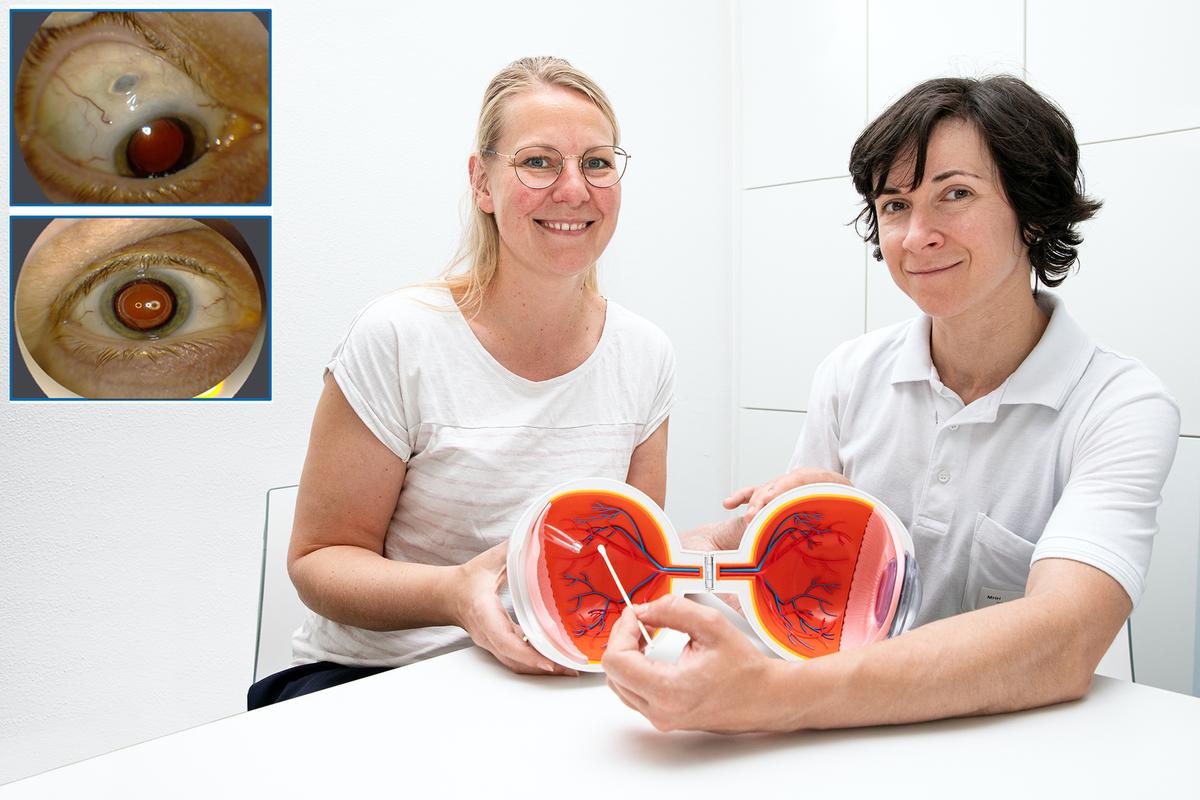
Dr. Ekaterina Sokolenko (right) and Anke Beckmann use an eye model to show where the PDS implant is located in the eye. The small photos in the upper left illustrate that the implant disappears under the upper eyelid; it is normally not visible. Copyright: Karin Kaiser/MHH
Age-related macular degeneration (AMD) is the most common cause of vision loss in older adults. Several million people in Germany are affected by this chronic retinal disease. There are two different types of macular degeneration: dry and wet AMD. Although the wet form of AMD is less common, it progresses more rapidly. It is usually treated with regular injections into the eye. There is now a promising alternative: As part of the Sightspire study, the Clinical Department of Ophthalmology at Hannover Medical School (MHH) is offering patients the option of having a small, refillable implant placed in the eye that continuously releases medication over a long period of time. The so-called Port Delivery System (PDS) significantly reduces the number of necessary doctor visits and eases the burden of treatment.
Patients lose their vision
Age-related macular degeneration (AMD) is a disease that affects the retina in the back of the eye, specifically the macula—the area responsible for the sharpest vision. The wet (neovascular) form of AMD usually develops from dry AMD. In this form, abnormal, leaky blood vessels grow in the area of the macula. This can lead to swelling, bleeding, and potential vision loss. “It is believed that vascular endothelial growth factor (VEGF), a protein, contributes to the formation of these blood vessels,” explains Senior Physician Dr. Ekaterina Sokolenko. Those affected lose their vision and are often no longer able to read, which severely limits their quality of life. In Germany, approximately 400,000 people suffer from wet AMD.
A major burden for older adults
Various medications are now available to treat the disease. Injection therapy with the drug ranibizumab, which blocks the action of VEGF proteins, has been a proven treatment for several decades. This requires patients to visit the eye clinic regularly for the rest of their lives so that the physician can administer the injection into their eye. The interval between treatments varies from person to person. “For these patients—most of whom are elderly—each visit involves travel, waiting time, and often a fear of the injection,” says Anke Beckmann, senior study coordinator. “In addition, treatment at the Clinical Department is still followed by an appointment at an ophthalmologist’s private practice to ensure that no eye infection develops after the treatment.”
As small as a grain of rice
“There is a great need for a less invasive, yet effective and safe treatment option,” notes Dr. Sokolenko. As part of Roche’s Sightspire study, she and her team now aim to evaluate the safety and efficacy of the port-delivery system. “The implant is about the size of a grain of rice and is inserted through a two-millimeter incision behind the lens. The procedure takes about 40 minutes and can be performed under local or general anesthesia,” explains the ophthalmologist. After spending one night under observation, the patient can leave the Clinical Department. The implant is not visible to others; it is hidden beneath the upper eyelid. It can remain in the eye for a lifetime, continuously releasing the same amount of medication from there. The system must be refilled every six to nine months. The major advantage: To refill it, the medication is not injected directly into the eye, but rather into the implant through a membrane. The PDS has been admitted in the U.S. since 2021, and its market launch in Europe is now also planned.
Study participation available
“People with wet AMD who are interested in participating in the study are welcome to contact us,” says Anke Beckmann. The Sightspire study lasts about 19 months. During this time, participants receive comprehensive care, and changes in their vision are closely monitored compared to their pre-study status. Eligible participants are individuals aged 50 and older who were first diagnosed with wet AMD no more than two years ago. Additional eligibility criteria will be determined during a preliminary examination. Those interested should contact the study team at the Clinical Department of Ophthalmology by phone at 0511/532-9411 or via email at Augenklinik.Studien@mh-hannover.de.
Further information can be found here. An overview of other MHH studies on various eye diseases can be found here.
Text: Tina Götting