Clinical study in seven European countries compares the efficacy of two HIV drugs in people with advanced disease for the first time.
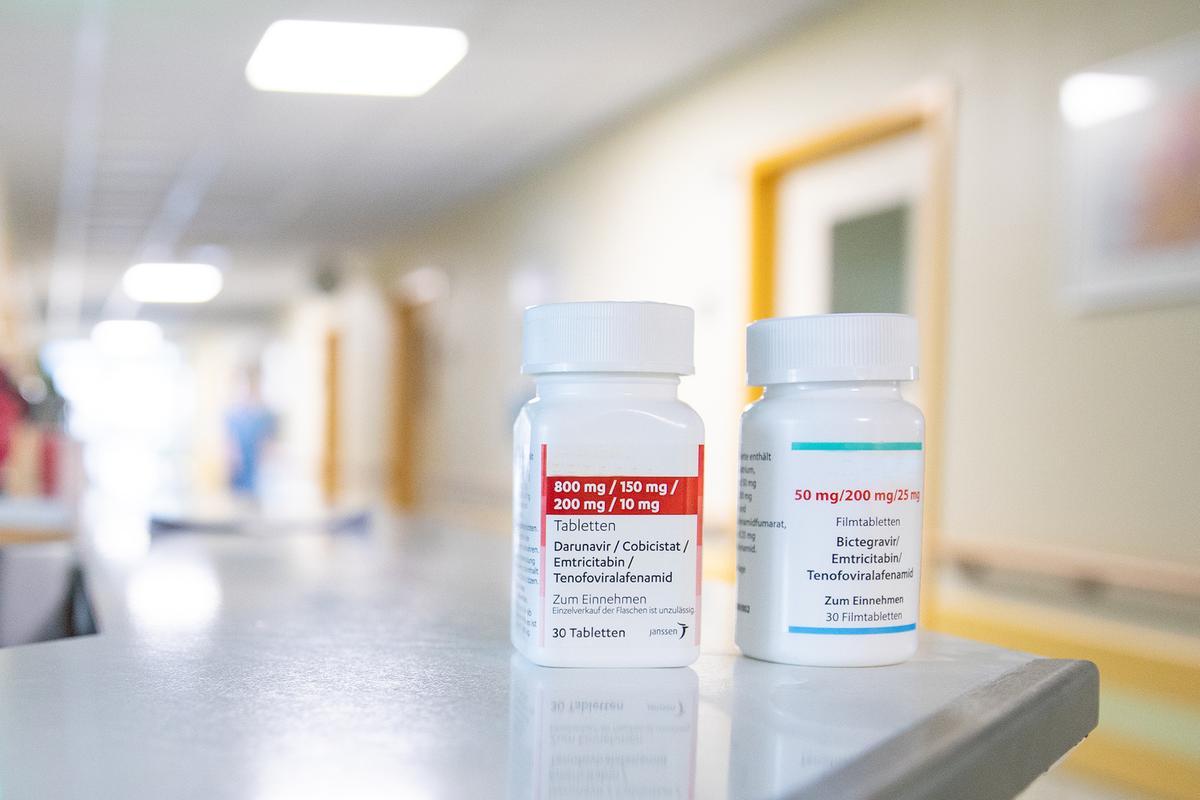
Effective and safe, even with late diagnosis: MHH study examines two antiretroviral drugs in people with advanced HIV disease. Copyright: Karin Kaiser/MHH
Around 40 million people worldwide live with an HIV infection. In Germany, there are around 100,000 people affected. If the infection is not treated, at some point the body can no longer defend itself against pathogens or tumor cells. This leads to acquired immune deficiency syndrome, which can result in several life-threatening illnesses. HIV infection can now be treated well. If therapy is started early enough, those affected have a normal life expectancy. How medication works in people with advanced HIV disease, however, has not yet been scientifically proven - until now. In a comprehensive clinical study led by Prof. Dr. Georg Behrens, senior physician at the Clinical Department of Rheumatology and Immunology at Hannover Medical School (MHH), researchers from 56 medical centers in Belgium, Germany, France, Great Britain, Ireland, Italy and Spain have looked at precisely this group of patients and investigated which drugs work best for those with severe disease. The results were published on December 1, World AIDS Day, in the renowned journal "The Lancet Infection Diseases".
"Late presenters" have fewer immune cells
The HI virus belongs to the group of retroviruses that use their own enzyme to transcribe their genetic material into DNA and incorporate it into the genome of the host cell. HI viruses primarily attack CD4 cells of the immune system. These white blood cells, also known as T helper cells, activate defense cells and thus control the immune system during infections. The number of CD4 cells can therefore be used to determine the extent to which HIV has already damaged the immune system. In healthy people, the number is between 500 and 1500 T helper cells per microliter of blood. In people with a late HIV diagnosis - also known as "late presenters" - it is less than 350 CD4 cells per microliter. The weakened immune system leads to a progressive disease with a poor long-term prognosis for those affected and increases the risk of dying from AIDS.
Virus replication prevented
The LAPTOP (Late Presenter Treatment Optimization) clinical trial is focusing on this very group, which accounts for around 50 percent of people infected with HIV. The researchers compared two first-line antiretroviral drugs - i.e. two anti-HIV drugs that are recognized and proven to be the best initial treatment for this disease, at least in people infected with HIV in the early stages. "We wanted to scientifically investigate the efficacy and safety of integrase inhibitor therapy and therapy with a boosted protease inhibitor for the first time in late-diagnosed HIV-infected patients," says Professor Behrens, immunologist and head of the "Adaptive Immunity in Infections and Autoimmune Diseases" working group. Integrase inhibitors block the enzyme that the virus uses to insert its genetic material into the DNA of the human host cell. Protease inhibitors prevent the formation of important viral proteins and thus interrupt the life cycle of the pathogen. Both drugs therefore ensure in different ways that the virus cannot multiply and infect other cells.
Integrase inhibitors recommended as first-line therapy
Around 450 newly diagnosed adults with advanced HIV disease were included in the study. Participants were randomly assigned to receive either the integrase inhibitor or the protease inhibitor. "Our study is the first large randomized controlled trial to compare the antiviral efficacy, the recovery of the compromised immune system or the possible side effects of first-line antiretroviral therapies specifically in people with advanced HIV disease," emphasizes Professor Behrens. The integrase inhibitor was not inferior in the study, was even more effective in suppressing viral replication and had fewer side effects. "This is the first scientific proof that the drug works well even in advanced HIV disease with CD4 cells below 50 per microliter and we therefore recommend the integrase inhibitor as the preferred first-line therapy for these patients."
The original paper "Integrase versus protease inhibitor therapy in advanced HIV disease (LAPTOP): a multicountry randomized, open-label, non-inferiority trial" can be found here.
Text: Kirsten Pötzke