MHH Human Genetics improves the diagnosis of rare diseases in order to individualize therapies for critically ill newborns and children.
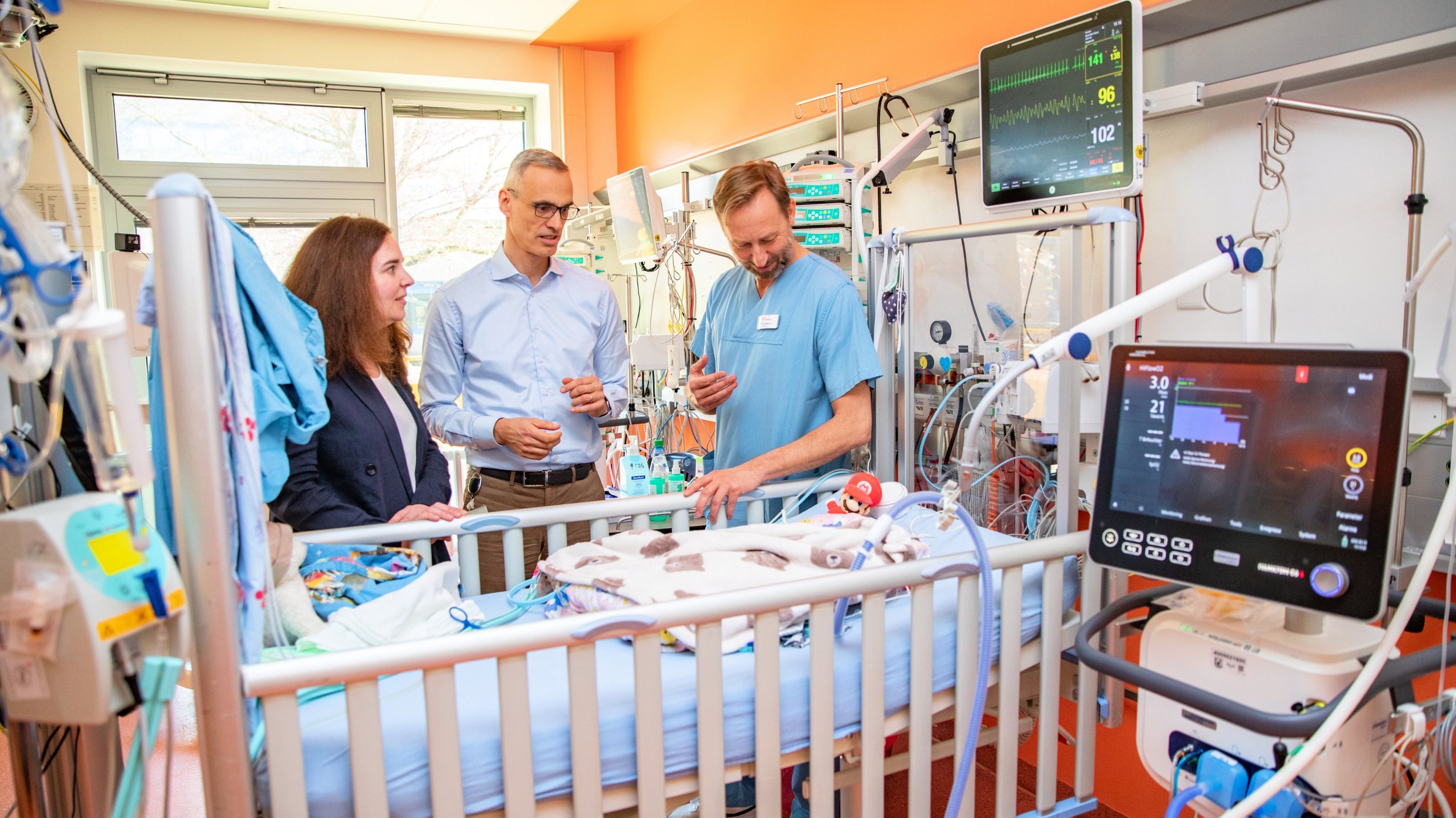
In the intensive care unit of the MHH Clinical Department of Paediatric Cardiology and Intensive Care Medicine (from left): Prof. Dr. Helena U. Zacharias (PLRI), Dr. Bernd Auber (MHH Institute of Human Genetics), and associate professor Dr. Thomas Jack (MHH Clinical Department of Paediatric Cardiology and Intensive Care Medicine). Copyright: Karin Kaiser/MHH
About four million people in Germany suffer from one of the many different, mostly genetically caused rare diseases. Most of them are children, some of whom also require intensive medical care. Helping them receive a diagnosis more quickly and, building on that, improving treatment in a targeted manner—that is the goal of many physicians and researchers. An interdisciplinary team led by Dr. Bernd Auber from the Institute of Human Genetics at the Medical University (MHH) has now moved a step closer to this goal — with the new AI-LIGHTS project.
“With AI-LIGHTS, we aim to make the diagnosis of rare genetic diseases in critically ill newborns and children faster and more reliable, better understand disease mechanisms, and enable more targeted therapeutic decisions,” says Dr. Auber. A total of 400 young, critically ill newborns and children being treated in the MHH’s intensive care units and suspected of having a rare disease are to be included in the study. Their genetic material will be examined using so-called modern long-read genome sequencing. This involves analyzing very long DNA segments, which allows even complex genetic changes to be better identified. Additional technologies will also be used, such as for analyzing gene regulation, proteins, and other metabolic products.
The project will begin on June 1, 2026, run for four years, and is funded by the State of Lower Saxony and the Volkswagen Foundation with approximately 4.3 million euros as part of the zukunft.niedersachsen program. The team includes researchers and clinicians from MHH, Leibniz University Hannover, and the Technical University of Braunschweig. The MHH will receive approximately 75 percent of the funding. AI-LIGHTS stands for “AI-assisted Long-read Genomics and Integrated OMICs for Healthcare Solutions.”
From Diagnosis to Personalized Therapy
The project builds on the Baby-Lion study, in which ultra-fast genome sequencing was established at MHH for critically ill children. It was demonstrated that genetic diagnoses can be made within a very short time for nearly half of the children and that they can have an immediate impact on treatment: For more than 70 percent of children with a genetic diagnosis, the treating physicians reported concrete clinical benefits.
AI-LIGHTS now takes this a step further: In addition to speed, the focus is primarily on more comprehensive genetic analysis, a better understanding of disease mechanisms, and the evaluation of data using artificial intelligence. The aim is to further improve diagnoses, better predict individual disease courses, identify commonalities between different rare diseases, and systematically investigate the concrete benefits of this expanded diagnostics for patient care.
The Consequences of Genes
Currently, around 9,000 different rare diseases are known. A disease is considered rare if it affects no more than five out of every 10,000 people. An early diagnosis can be crucial for those affected: It not only makes it easier to manage the disease but also enables more targeted treatment in many cases.
For example, epileptic seizures are a common symptom among the children to be included in the study. “If we diagnose the genetic cause of their condition, there is a possibility of personalizing the therapy and thus reducing the number of seizures or even bringing the seizure disorder to a complete halt,” says Dr. Auber. In the case of metabolic disorders as well, a genetic diagnosis can have immediate therapeutic implications — such as through specific dietary adjustments or enzyme replacement therapy. Furthermore, the identification of a causative genetic mutation lays the foundation for future, individually tailored therapeutic approaches, including gene therapy.
Close collaboration between medicine, natural sciences, and computer science
The project thrives on close collaboration between medicine, natural sciences, and computer science. On the MHH side, participants include the Institute of Human Genetics, the Center for Pediatrics and Adolescent Medicine, the Peter L. Reichertz Institute of Medical Informatics (PLRI), the Hannover Unified Biobank (HUB), and the Central Research Facility for Proteomics.
Text: Bettina Bandel