The use of simulation patients
in your lessons or examination
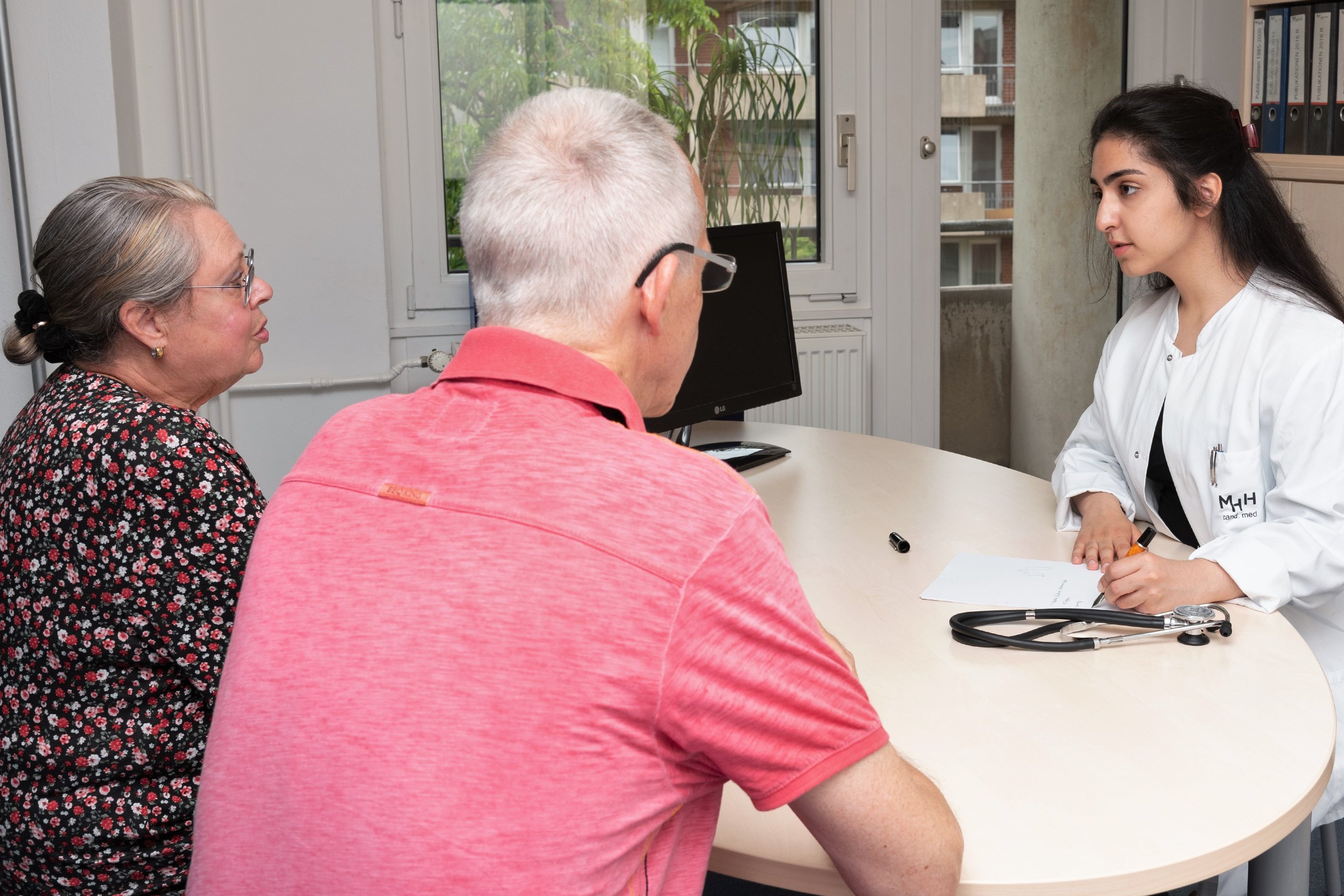
Simulation patients play desired scenarios and case studies with defined bio-psycho-social characteristics. They are able to present different patient types or clinical pictures several times in one teaching unit. Tailored to learning objectives and competence levels, simulation patients can also show strong emotions if necessary (e.g. in emergency scenarios) and allow students to try out challenging situations.
All simulation patients receive training in basic acting skills and feedback skills in order to provide students with individual re-registration on their behavior and actions in the simulation from the patient's perspective, if desired.
Our simulation patients currently receive an expense allowance of 20.00 euros per hour.
Procedure
Planning a successful simulated patient assignment takes time. Depending on the scope and complexity of the simulated scenarios and roles, we allow at least several weeks for this.
These steps are necessary during the process:
1. first contact
Together, we discuss the objectives of the SP deployment, which scenario is to be simulated and what the existing framework conditions are.
2. planning the implementation
Many aspects need to be considered in order to plan the exact implementation: How many people will take part in the event, how many simulations should be carried out, how long should each last? How many simulation patients are needed and are there specific requirements for factors such as gender, age, etc.? Should different case studies be played or should a different approach be tested on the same case study? Is feedback from the patient's perspective desired? Are physical examinations planned? Should props be used?
3. preparation of the case studies and roles
Once it has been clarified how many different case studies are to be simulated, these must be specified. The situation, the physical symptoms and the background of the role to be simulated are described in detail in case vignettes. For physical examinations in particular, all steps are described with instructions for action. You will receive sample vignettes from us. We support you in creating and revising the case studies. Several rounds of corrections are usually necessary until the respective case is ready for use
4. availability and preparation of the simulation patients
Based on the requirements of the planned simulations, we select suitable simulation patients from our pool, check their availability and assign the case studies. The simulation patients then need time to familiarize themselves with the new roles and learn them. In some cases, there are also questions and adjustments to the role descriptions.
Even if the actual planning is complete at this point, there are also a few things to consider during the implementation and follow-up that should be planned in advance.
5 Implementation
Before the assignment, a briefing of the simulation patients must take place in which the teaching or examination situation and the requirements placed on them are discussed. Details of the implementation and open questions from both sides are also clarified here. After the event, a short debriefing should take place in order to find a common conclusion with the simulation patients and thus support them in fully assuming their roles.
6. follow-up
In order to keep the quality of the SPP-MHH high, we rely on the re-registration of the lecturers after the simulation patients have been used. We are happy to provide feedback forms for this purpose. In addition, the use in the respective courses should be evaluated internally. How did it work, what went well, where is there potential for improvement? Do adjustments need to be made for a repetition, e.g. in the time planning or the case studies?
Contact us
If you are considering using simulated patients for your lessons or examinations, please contact us.
Please download the linked form, fill it out and send it by email to simulationspatienten@mh-hannover.de