It's up and running - the new Central Laboratory!
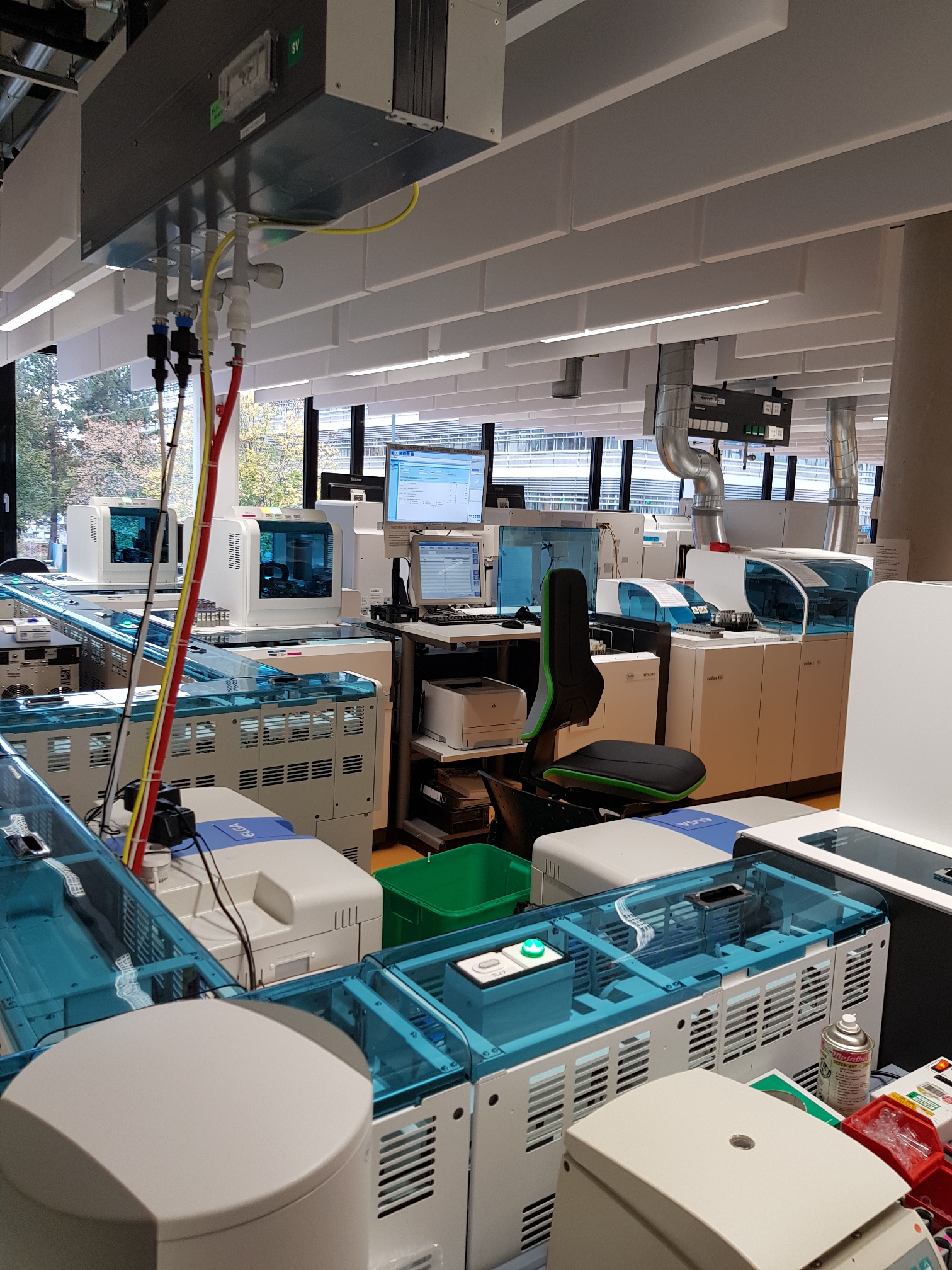
Yes, the new Central Laboratory is really up and running! We were able to visit the MHH's new high-tech laboratory on Thursday, October 18 as part of the TA Forum and, in particular, take a look at the new laboratory line.
Two senior TAs are responsible for the staff in the laboratory line. Jens Große gave us a tour of the Preanalytics and Haematology departments, while Margarete Ohlendorf and Jens Hildewerth-Lüders introduced us to the equipment in Clinical Chemistry. The Clinical Chemistry and Haematology departments play a leading role in the laboratory line, which was also known as KAP (Consolidated Analytical Platform) when it was created.
Since the conversion of the LIS and the pneumatic tube system on 24.4.18 set the course for the Central Laboratory, there has been no going back to the old system and the old premises. All the test material for the departments involved ends up in a central location in the new building, where it is prepared, distributed and examined. The work that preceded this day is probably unique in the professional lives of those involved. They were busy for months: Training on the new equipment, validations, trial runs........ and all, of course, while examination operations in the old areas were maintained in their tried and tested form. Hats off to the medical staff and the TAs, who put their hearts and souls into their work and spared no overtime to get a system up and running that looks like this from the outside:
The new central pneumatic tube ward spits out over 1000 bombs a day with the samples. This means that, statistically speaking, each bomb ends up in the Central Laboratory 1.02 times a day with around 1000 pneumatic tube bombs at the MHH. The coded tubes with the material to be examined are automatically assigned to the appropriate pre-analysis, the prepared contents are then examined and measured on one of the three fully automated lines of the laboratory line on the corresponding analysis modules, the findings are recorded and validated, while the material is briefly archived for possible follow-up examinations.The declared aim of all those involved is to keep the respective TAT (turn-around time = time between arrival of the sample and transmission of the findings) as short as possible and to reduce it even further. More than 3000 samples are examined daily in the Central Laboratory. These range from 'simple' analyses to recently developed special analyses that can only be carried out at the MHH. This makes the laboratory one of the five most efficient laboratories in Europe!
Everything runs automatically? So what do the staff actually do? Due to the high-tech equipment, the job description of the TAs has changed a lot in recent years. Monitoring and maintenance of the laboratory line, quality management, validation of results and work in the control center are the main focus. But manual work is also still required: "In a hospital with as many seriously ill patients as we have at the MHH, for example, not all blood cells can be recorded and correctly assigned using standard machine procedures," explains Jens Große. Manual work, for example 'proper' microscopy and diagnosis, is still necessary here. There are also tasks in teaching, studies and ring trials.
In addition, possible 'teething troubles' of the laboratory line need to be dealt with and, above all, the training courses need to be continued. Given the shortage of staff, not all colleagues have had the opportunity to learn how to use all the new equipment, let alone the equipment in the neighboring department. However, this is necessary in order to maintain operations during night shifts or at weekends and to cover for each other - 365 days a year, 24 hours a day, around the clock.
Incidentally, the open-plan laboratory with the laboratory line only takes up part of the new building. Many special analyses will continue to be carried out in separate rooms, particularly in the clinical immunology, virology and gastroenterology laboratories. However, there is a tendency to integrate further analysis techniques into the laboratory street as quickly as possible. But one thing is clear: laboratory diagnostics is a dynamic system. For every analysis that can be integrated into the laboratory line, there is at least one newly developed method that is initially carried out on smaller machines by TAs with manual and mental work until it is 'ready for the KAP'. How could this be any different at a university hospital!
by Birgit Teichmann, 25.10.2018