
Of sugars and the standstill in transplant medicine
In the "Advent Lecture 2021", new strategies against organ shortage and organ loss will be presented and discussed.
This year, the Transplant Centre once again invited all MHH employees and external guests to the "Advent Lecture". As in 2020, when Lower Saxony's Minister President Stephan Weil spoke about the coronavirus pandemic, the audience was mainly connected online.
On December 15, 2021, the focus was on the question: What strategies does transplant medicine have to overcome the precarious situation of a persistent organ shortage and the relatively high loss of transplanted organs due to rejection? Are we currently experiencing a prolonged standstill or is there finally a new dawn?
Professor Hermann Haller, Director of the Clinical Department of Nephrology at MHH, gave a Christmas-themed and scientific answer with his lecture "The Icing on the Cake - Sugar in Transplantation Medicine". For decades, the "icing on the cake" of protein molecules was underestimated. Today we know that it is not only proteins (antigens) that ensure the individuality of body cells, but also sugars that are attached to the proteins on their way through the cell. They help to determine how different donor and recipient cells are - a finding that could have an impact on better donor-recipient matching, but has not yet had any clinical consequences.
Machine perfusion, on the other hand, is very real and has already arrived in clinical practice in some cases. This involves flushing the donor organs with blood or a physiological preservative solution immediately after removal and during transportation. This is standard practice at the MHH for heart and lung transplants, but is not funded by the health insurance companies. Professor Axel Haverich, Head of the Transplant Centre at the MHH, pointed out the advantages of perfusion: In the so-called Organ Care System, the fixed time specifications for the transportation time of heart and lungs can be extended. This means that organs can also be retrieved and transplanted from distant countries. Operations become more predictable and therefore safer.
In contrast, perfusion for liver and kidney transplants is still in its infancy in Germany. The Vice President of the German Medical Association, Dr. Günther Matheis, lamented the slow implementation of innovative procedures, partly due to the lack of a say of the medical profession in the Federal Joint Committee, which decides on the funding of new procedures. Professor Frank Lammert reported that the MHH is participating in a multi-center study on machine perfusion in liver transplantation. The experts agreed that Germany is a developing country in international comparison when it comes to machine perfusion. Studies have shown that organs can be saved or improved in quality with perfusion.
The panel also agreed that the number of transplants urgently needs to be increased. In recent years, around 2,800 organs have been donated in Germany. Compared to the other Eurotransplant countries, Germany lags far behind with 10.4 organ donors per million inhabitants.
Two legislative proposals were passed in 2019 and 2020 to remedy the situation, but have yet to be fully implemented. For example, not all transplant officers who are responsible for identifying organ donors in hospitals with intensive care units have been appointed or sufficiently released from their duties. The national register, which records the decision to donate organs, and numerous educational measures are also still outstanding. The panel of experts at the MHH agreed that a great opportunity was missed with the failure of the objection solution in the Bundestag at the beginning of 2020.
In contrast, an initiative to increase living donation was viewed more optimistically. Elke and Patrick Kaul reported on their experiences. It had taken too long for dialysis physicians to discuss living donation as an alternative. Their own need for information was then very great and the process was sometimes lengthy and arduous, but the effort was worth it. However, it was complained that it was difficult for both the recipient and the donor to get the necessary rehabilitation measures financed by the health insurance company.
The number of kidney transplants after living donation has also decreased in recent years. One of the reasons for this is legal uncertainty and the lack of competence of the German Medical Association. The German Medical Association has just decided to change this, said Dr. Matheis. A corresponding amendment to the law is planned.
Watch the recording of the event!
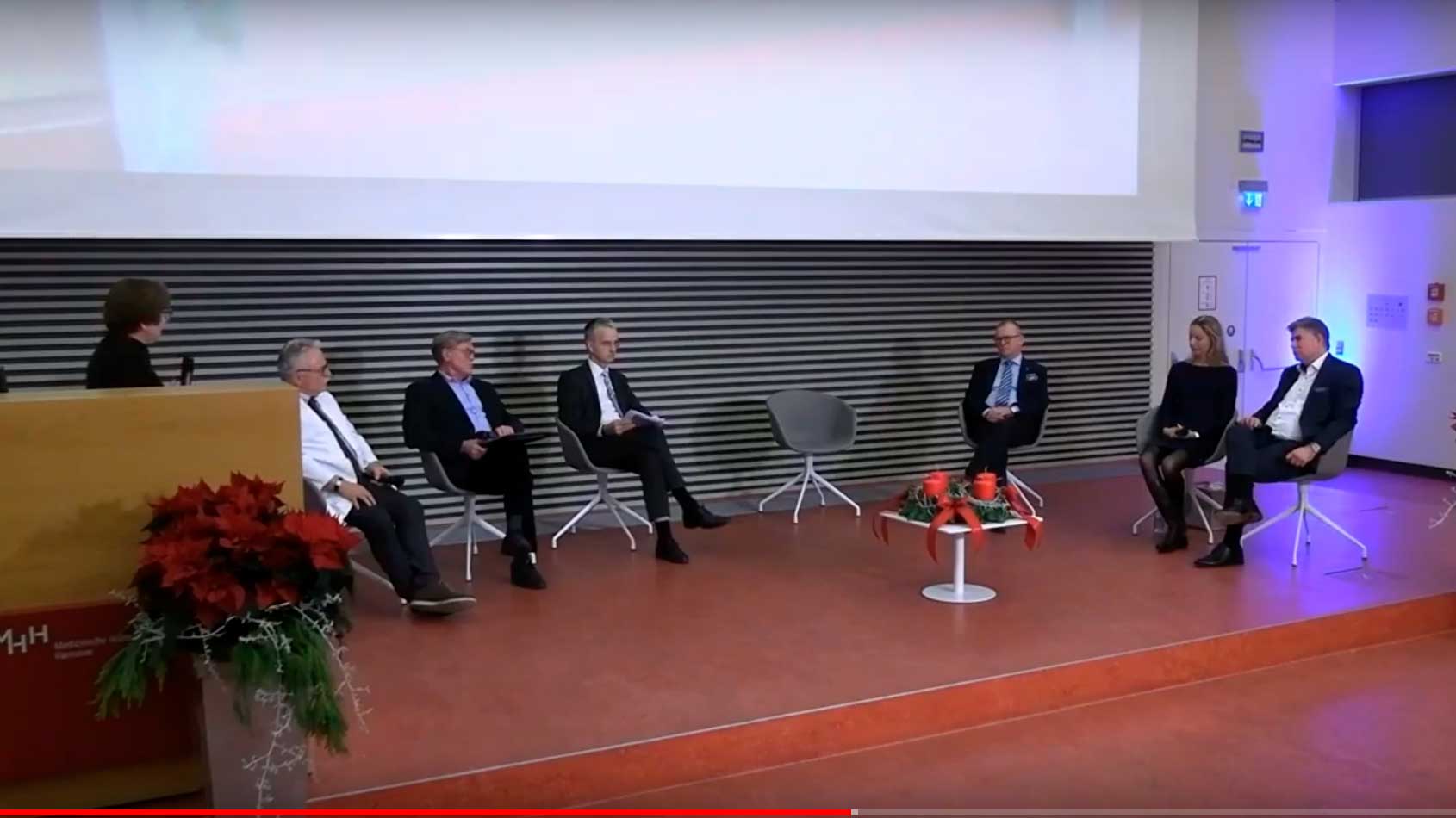
Advent Lecture: The Icing on the Cake - Sugar in Transplantation Medicine
Prof. Hermann Haller, Clinical Department of Nephrology and Hypertension
Panel discussion: Transplantation Medicine in Germany: Stagnation or New Beginnings
Dr. Annette Tuffs, Tx Management, Transplant Centre & Moderation
Dr. Günther Matheis, President of the Rhineland-Palatinate Medical Association, Vice President of the German Medical Association
Elke and Patrick Kaul, MHH Transplant Centre Patient Advisory Board
Prof. Dr. Frank Lammert, Vice President and Member of the Board, Patient Care
Prof. Axel Haverich, Head of the Transplant Centre