AG Polytrauma
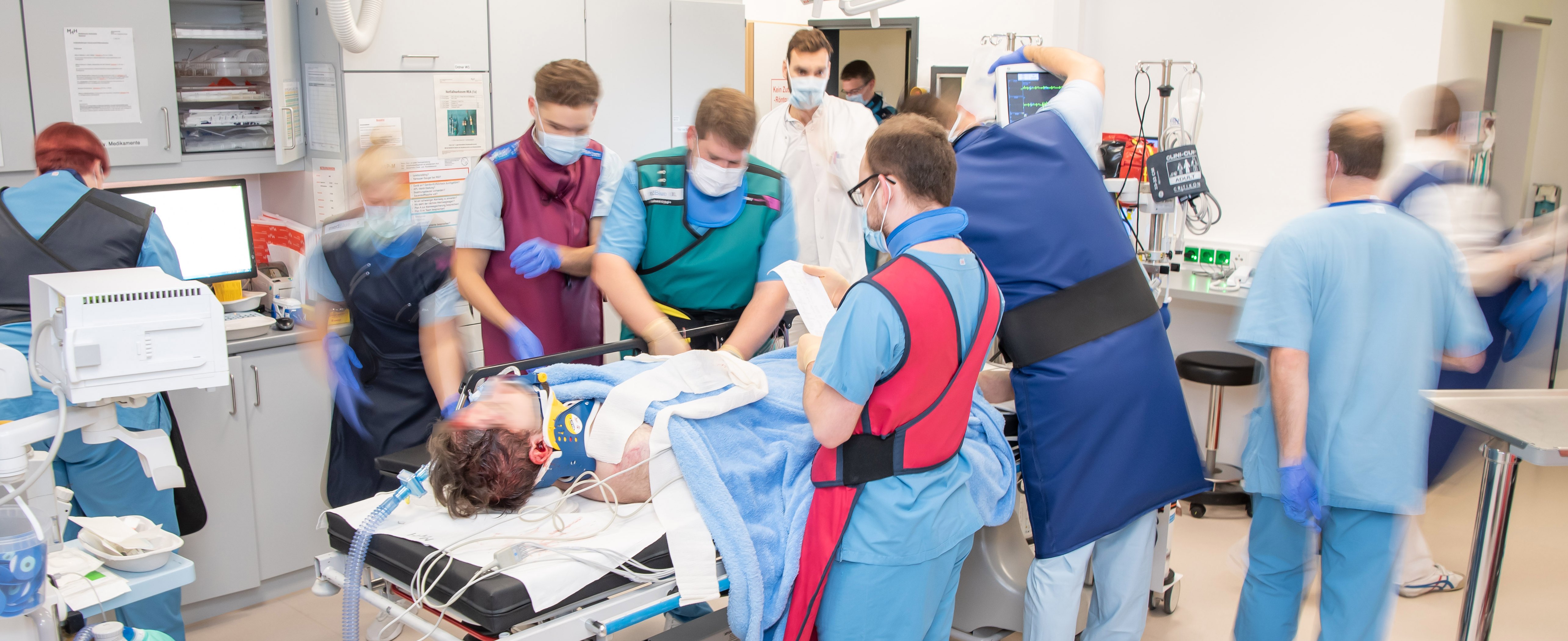
In medicine, a polytrauma is defined as several simultaneous injuries to different parts of the body, one of which or a combination of which is life-threatening (definition according to Prof. Dr. med. Harald Tscherne). In Germany, polytrauma is mainly caused by traffic accidents and accidents at work or during leisure time. 70% of seriously injured patients are male and on average around 40 years old. However, the proportion of patients over the age of 70 has risen continuously over the last 10 years.
By improving preclinical and clinical care (e.g. shock room care according to Advanced Trauma Life Support® [ATLS®]) for severely injured patients, it has been possible to significantly reduce mortality in recent decades. Nevertheless, polytrauma is still the most common cause of death among people under 45. According to the German Society for Trauma Surgery (DGU), one in eight seriously injured people die.
Accordingly, from a socio-economic perspective, accident-related deaths are more relevant than malignant neoplasms or cardiovascular diseases, as they are associated with a greater loss of years of life. Around half of the patients who die succumb to their injuries in the first 24 hours after the accident as a result of severe craniocerebral trauma or unstoppable bleeding. The remaining 50% of fatalities succumb to multiple organ failure or generalized infection (sepsis) in the further clinical course. Both clinical pictures are based on a complex inflammatory reaction of the entire organism.
Furthermore, complications in fracture healing occur significantly more frequently after polytrauma compared to patients who have only suffered an isolated fracture. The average hospital stay of 3 weeks is followed by a long phase of health, social and occupational rehabilitation, so that a complete reintegration of severely injured patients is only achieved on average 49 weeks after the original accident.
Our working group is therefore investigating the underlying mechanisms after polytrauma in order to understand these and subsequently be able to positively influence them for better and faster healing and reintegration of our patients into their old lives.
As the research topics in this working group are very diverse, you will find below an overview of the publications of the polytrauma working group from 2015 onwards:
- Long Y, Bundkirchen K, Gräff P, Krettek C, Noack S, Neunaber C. Cytological Effects of Serum Isolated from Polytraumatized Patients on Human Bone Marrow-Derived Mesenchymal Stem Cells. Stem Cells Int. 2021 Nov 28;2021:2612480. doi: 10.1155/2021/2612480. PMID: 34876907; PMCID: PMC8645412.
- Homeier JM, Bundkirchen K, Winkelmann M, Graulich T, Relja B, Neunaber C, Macke C. Selective Inhibition of IL-6 Trans-Signaling Has No Beneficial Effect on the Posttraumatic Cytokine Release after Multiple Trauma in Mice. Life (Basel). 2021 Nov 17;11(11):1252. doi: 10.3390/life11111252. PMID: 34833127; PMCID: PMC8617644.
- Leditzke K, Wagner MEH, Neunaber C, Clausen JD, Winkelmann M. Neutrophil Gelatinase-associated Lipocalin Predicts Post-traumatic Acute Kidney Injury in Severely Injured Patients. In Vivo. 2021 Sep-Oct;35(5):2755-2762. doi: 10.21873/invivo.12560. PMID: 34410965; PMCID: PMC8408701.
- Relja B, Yang B, Bundkirchen K, Xu B, Köhler K, Neunaber C. Different experimental multiple trauma models induce comparable inflammation and organ injury. Sci Rep. 2020 Nov 19;10(1):20185. doi: 10.1038/s41598-020-76499-z. PMID: 33214576; PMCID: PMC7678855.
- Peters H, Macke C, Mommsen P, Zeckey C, Clausen JD, Krettek C, Neunaber C, Winkelmann M. Predictive Value of Osteoprotegerin and Neutrophil Gelatinase- associated Lipocalin on Multiple Organ Failure in Multiple Trauma. In Vivo. 2019 Sep-Oct;33(5):1573-1580. doi: 10.21873/invivo.11639. PMID: 31471407; PMCID: PMC6754992.
- Yang B, Bundkirchen K, Krettek C, Relja B, Neunaber C. Traumatic injury pattern is of equal relevance as injury severity for experimental (poly)trauma modeling. Sci Rep. 2019 Apr 5;9(1):5706. doi: 10.1038/s41598-019-42085-1. PMID: 30952899; PMCID: PMC6450898.
- Fitschen-Oestern S, Lippross S, Klueter T, Weuster M, Varoga D, Tohidnezhad M, Pufe T, Rose-John S, Andruszkow H, Hildebrand F, Steubesand N, Seekamp A, Neunaber C. A new multiple trauma model of the mouse. BMC Musculoskelet Disord. 2017 Nov 21;18(1):468. doi: 10.1186/s12891-017-1813-9. Erratum in: BMC Musculoskelet Disord. 2019 Feb 11;20(1):72. PMID: 29157219; PMCID: PMC5697084.
- Schultze C, Hildebrand F, Noack S, Krettek C, Zeckey C, Neunaber C. Identification of potential biomarkers for post-traumatic complications released after trauma-hemorrhage from murine Kupffer cells and its investigation in lung and liver. Biomarkers. 2016 Nov;21(7):645-52. doi: 10.3109/1354750X.2016.1171908. Epub 2016 Apr 27. PMID: 27120970.
- Relja B, Horstmann JP, Kontradowitz K, Jurida K, Schaible A, Neunaber C, Oppermann E, Marzi I. Nlrp1 inflammasome is downregulated in trauma patients. J Mol Med (Berl). 2015 Dec;93(12):1391-400. doi: 10.1007/s00109-015-1320-0. Epub 2015 Aug 2. PMID: 26232934.
- Neunaber C, Angela Y, Safi S, Krettek C, Zeckey C. Beneficial effects of finasteride on hepatic and pulmonary immune response after trauma hemorrhage in mice. Cytokine. 2015 Jul;74(1):123-9. doi: 10.1016/j.cyto.2015.03.018. Epub 2015 Apr 20. PMID: 25907835.
