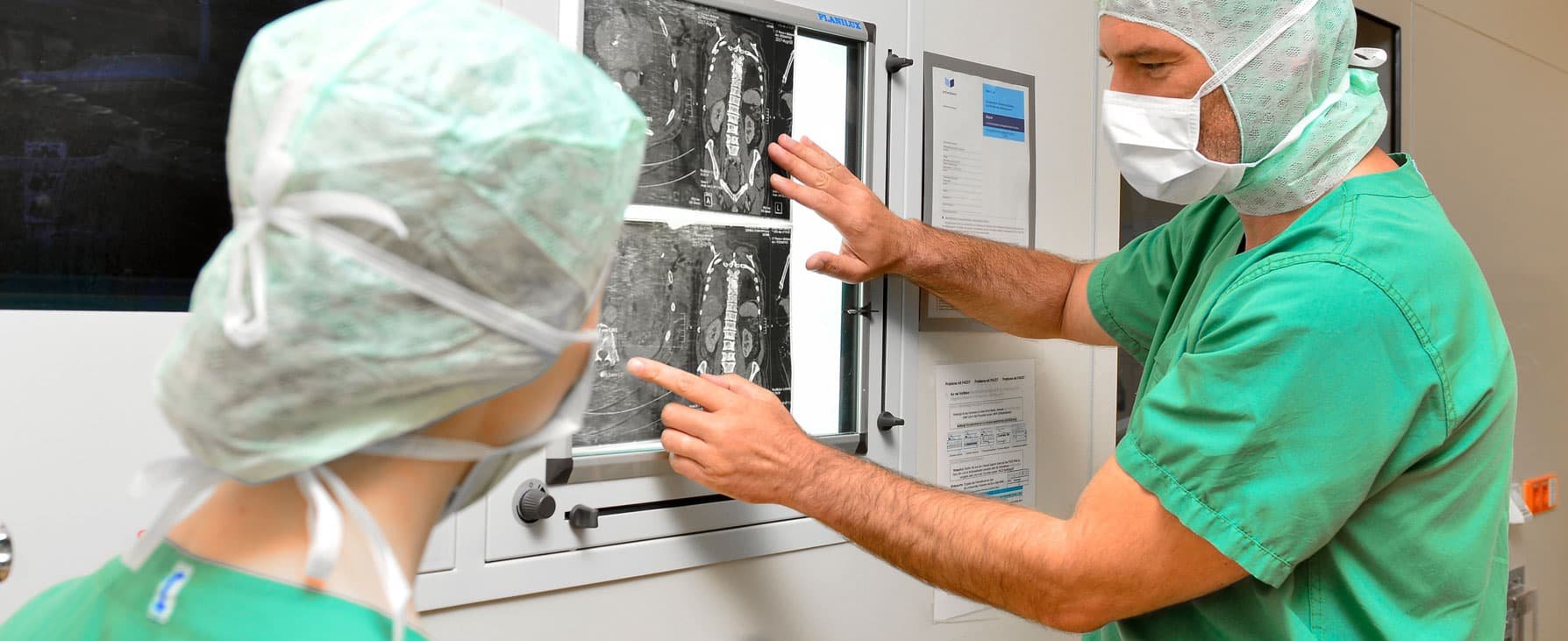
to the Interdisciplinary Tumor Conference
of the Comprehensive Cancer Center of the MHH
Online study for sarcoma patientsto "Evaluation of the rehabilitation of sarcoma patients and their provision with aids and remedies - REHSa"
The early detection and stage-appropriate surgical treatment of bone and soft tissue tumors (including sarcomas) has a long tradition as a focus in the Clinical Department of Trauma Surgery. Patients with unclear processes or tumors of the musculoskeletal system receive targeted diagnostics and detailed advice in the special clinic for musculoskeletal tumor surgery. We understand the emotionally upsetting situation in the phase of diagnostic uncertainty and know how to contribute to a rapid diagnosis with suitable imaging and the initiation of subsequent medical measures, such as taking tissue samples.
If you have a diagnosis relating to the musculoskeletal system that requires clarification, you are cordially invited to present yourself at the special clinic for musculoskeletal tumor surgery.
Our interdisciplinary tumor conference for bone and soft tissue tumors was founded in 1979 as one of the first tumor conferences at the MHH, which has been under the direction of trauma surgery ever since.
Based on the findings compiled in the special consultation, your case will be discussed in the tumor conference for bone and soft tissue tumors if interdisciplinary consultation is required and the appropriate treatment concept will be determined for you individually. Approximately 800 such case presentations are made each year.
Types of tumors
Bone tumors
A basic distinction is made between the rare primary and the more common secondary bone tumors. Primary bone tumors originate from the various tissue cells of the bone itself, while secondary bone tumors represent a metastasis of a distant tumor (e.g. lung, breast, prostate, kidney, thyroid gland) in the bone.
Primary bone tumors
Primary bone tumors are rare and should always be treated by a specialist surgeon, as misinterpretation and incorrect treatment can have disastrous consequences. A basic distinction is made between the more common benign bone tumors and the rare malignant bone tumors.
Benign bone tumors (enchondroma, osteochondroma, cysts) are often incidental findings in the context of another complaint clarification and lead to attention being focused on the "new" finding. It is often difficult to differentiate between this latent, inactive incidental finding and the concurrent, but otherwise justified complaints, and requires a consistent work-up of the sometimes chronic symptoms. In most cases, however, the all-clear can be given and regularly scheduled follow-ups are sufficient to detect any secondary activity at an early stage. More rarely, however, a benign tumour (e.g. aneurysmal bone cyst, giant cell tumour) can grow aggressively and thus require surgical treatment to remove the tumour and stabilize the bone section.
Malignant bone tumors
Malignant bone tumors show locally destructive growth, sometimes exceeding the bone boundaries, which is associated with the ability to metastasize early in the organism (mainly lungs and skeleton). Malignant bone tumors (sarcomas) account for only 0.2% of all cancers. As these tumors predominantly occur in childhood and adolescence, they account for 3-4% in the younger age group. Typically, these are osteosarcoma, Ewing sarcoma and chondrosarcoma. In addition to the type of tumor (typing), the degree of maturity (grading) also influences the aggressiveness of a malignant bone tumor.
The number of new cases per year for benign soft tissue tumors is given as 3000 per 1 million people, while malignant soft tissue tumors (soft tissue sarcomas) occur less frequently with only 30 new cases per 1 million people and account for approx. 1% of all malignant diseases. The difficulty lies in differentiating between the 100 times more common benign soft tissue tumors and the rare soft tissue sarcomas and initiating the correct, necessary treatment.
75% of soft tissue sarcomas are localized on the arms and legs, only 10% each are found on the trunk and in the posterior abdomen. A distinction is made between tumors of different soft tissue lines:
Tumors of adipose tissue (lipomatous) origin
- Lipoma
- Atypical lipomatous tumor (ALT)
- Liposarcoma
Tumors of connective tissue (fibroblastic) origin
- Nodular fasciitis
- Aggressive fibromatosis (desmoid tumor)
- Myxofibrosarcoma
Tumors of smooth muscle origin
- Leiomyoma
- Leiomyosarcoma
Tumors of skeletal muscle origin
- Rhabdomyosarcoma
Tumors of nervous (neurogenic) origin
- Neurofibroma
- Schwannoma
- Malignant peripheral nerve sheath tumor (MPNST)
Tumors of vascular origin
- hemangioma
- hemangiosarcoma
Tumors of uncertain/multiform origin
- Pleomorphic sarcoma
Bone metastases are the most common malignant bone tumors. Although metastases in the bone are considered to be a generalization of an underlying tumour, the prognosis of the course of the disease can be improved by local surgical measures, depending on the initial tumour (breast, prostate, lung, kidney, thyroid) and its stage. Another important aspect is your quality of life in the event of tumour disease, which can be improved by reducing pain and restabilizing impending or actual bone fractures. Maintaining independent mobility by means of moderate surgical interventions is a key factor in your continued active acceptance of coping with the disease. Thanks to additional multimodal therapy concepts for the initial tumours, the overall course of the disease has improved.
Examination, treatment & aftercare
Local tumor spread
- X-ray image in 2 planes
- Ultrasound diagnostics (sonography)
- Magnetic resonance imaging (MRI with contrast medium)
- Computed tomography (CT with contrast medium)
Body-wide tumor spread (so-called staging)
- Computed tomography of the chest and abdomen (CT thorax & abdomen)
- 3-phase skeletal scintigraphy (bone scinti)
- Positron emission tomography (PET CT)
A definitive tumor diagnosis can often only be made after a tissue biopsy has been performed. If a malignant tumor is still suspected after imaging, a biopsy is absolutely necessary. In the case of soft tissue tumors, a tissue sample can usually be obtained minimally invasively using a punch biopsy (hollow chamber needle) after interpretation of the MRI imaging. In the case of primary bone tumors with hard basic substance of the tumor, we usually perform an incisional biopsy (open biopsy) under general anesthesia under inpatient conditions. A small "preliminary operation" is therefore necessary. This should be carried out in a center with experience in the treatment of tumors of the musculoskeletal system. Experience has shown that an incorrect biopsy technique can make definitive tumor removal significantly more difficult or increase the risk of local recurrence. We pay attention to meticulous hemostasis and avoid unnecessary contamination of healthy tissue.
Depending on the type of tumor, tumor removal follows basic surgical principles (Enneking criteria). Important for surgical therapy is the definition of the border zone between the tumor tissue and the surrounding healthy tissue.
- Intralesional resection means partial removal of the tumor from the inside, i.e. the tumor is opened and removed in several parts.
- Marginal resection means surgical removal of the tumor as a whole (en bloc) without opening it but close to the tumor pseudocapsule
- Wide resection means complete surgical removal of the tumor and the pseudocapsule with a sufficient safety margin (healthy tissue cuff), taking the biopsy area with it.
- Radical resection means complete surgical removal including the tumor-bearing tissue/muscle layer, accepting severe functional deficits.
While benign tumors can usually be adequately removed by marginal resection, a wide or even radical resection should be attempted in the case of malignant bone and soft tissue sarcomas. The most unfavorable margin to the tumor, however small it may be, is decisive for the prognostic assessment. Thus, local elimination of the tumor has the highest priority, and preserving the function of a limb remains secondary to the primary goal.
Remaining bony defects after tumor removal require reconstruction of the affected skeletal section.
Biological reconstruction
Autologous bone transplantation (autograft)
- Cancellous bone
- Bone chip
- Vascularized fibula
Foreign bone transplantation (allograft)
- Femoral heads
- Bone granules
Bone transportation
- Callus distraction
- Segment transport
Non-biological (alloplastic) reconstruction
Tumor endoprosthetics (megaprostheses, e.g. MUTARS)
- Alloplastic joint replacement (hip, knee, shoulder and elbow)
- Alloplastic skeletal replacement (pelvis, thigh, tibia, upper arm)
Endoprosthetics with modular megaprosthesis systems have a firm place in the treatment of bony defects following tumor removal. Almost any skeletal segment can be replaced thanks to the variability of the prosthesis systems.
Important information
Interdisciplinary tumor conference for bone and soft tissue tumors
Mondays 16:00 - 17:30
in the radiology lecture hall (S level, node E)
Registration
by 12.00 noon on the Thursday of the previous week
Incl. imaging on CD and referral
for the attention of Ms. Maren Herten
Phone: +49 511 532-5818
Fax: +49 511 532-5877
uch-team-tumor@mh-hannover.de
Head
N.N.
As a basis for a differentiated consultation, please bring the following documents with you to your appointment:
- Referral from a specialist in surgery, trauma surgery or orthopaedics
- Previous imaging (X-ray/CT/MRI) on a CD ROM in DICOM format, incl. findings/diagnoses.
- Reports from previous treatments (e.g. surgical reports)
- Reports of tissue samples (pathology findings)