Just live normally ...
Rebecca, a lung transplant since 2015 at the age of 5
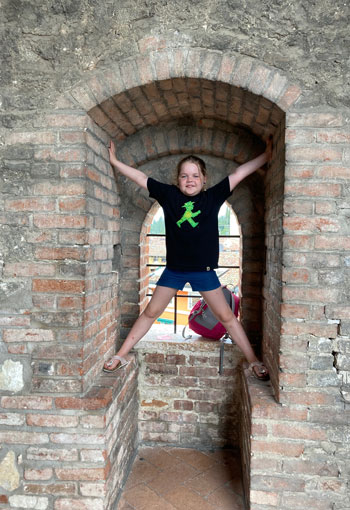
When we came to the MHH for the first time at the beginning of July 2015 with our then four-year-old daughter Rebecca, we already had a lot behind us: we had always thought we had two healthy children. But from October 31 (Halloween!) 2014, everything happened suddenly and in one fell swoop: from the diagnosis of a rare disease (histiocytosis Langerhans, LCH for short) to the first, still mild chemotherapy to a week-long coma, after which she first had to learn to walk, stand and even just sit again, and a tracheostoma for ventilation. A second really intensive chemotherapy treatment was carried out largely during the coma and brought the disease to a standstill.
We celebrated Rebecca's 5th birthday on the ward
LCH can affect all organs, skin and bones - in Rebecca's case it had affected some bones and the lungs. Bones heal - lung tissue does not, so we were advised to go to the MHH for a transplant.
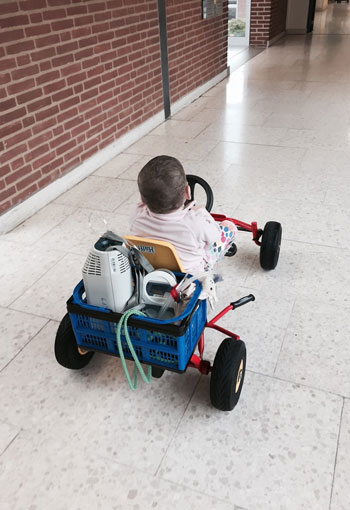
Dr. Schwerk and Dr. Müller there quickly agreed that a transplant would be possible and sensible, but we parents wanted to wait and see - after all, hardly anything can heal or grow new tissue during chemotherapy. So we agreed - rather against the physicians' wishes - to wait two months to see if anything would improve now that the chemotherapy was over. During the 2 months, Rebecca developed magnificently, learned to walk again and - although she almost permanently needed 4 chest drains and oxygen - drove through the long corridors of the MHH in her borrowed Kettcar. And as always with 2 pumps for the drains and the heavy oxygen bottle on the long tube behind her. We celebrated her 5th birthday on the ward, which was lovingly decorated.
At midnight it was clear: the lung is good and will be transplanted
Rebecca was actually doing really well in September compared to when she arrived at the MHH, so everyone, including the physicians, thought that something positive must have happened. Unfortunately, a CT scan in mid-September revealed that her lungs were just as damaged as they had been in July, with just 20% healthy lung tissue remaining. So in the end we agreed to the transplant and she was put on the waiting list in mid-September.
Thankfully, we were able to spend the waiting time in Viersen, close to our home - this was not a matter of course, as Rebecca's illness and condition are rather unusual for a relatively small children's hospital like St. Nikolaus in Viersen. Here she could finally be visited by friends again, for whom the 320 km to Hanover would have been too far. But the wait didn't really last long - THE call came at the beginning of October. So we went back to the MHH by ambulance with flashing blue lights, where we arrived at around 9pm. At midnight it was clear: the lung was good and would be transplanted. At 2:00 a.m. we went into the operating room.
Only 3.5 weeks after the operation, she was finally able to go home
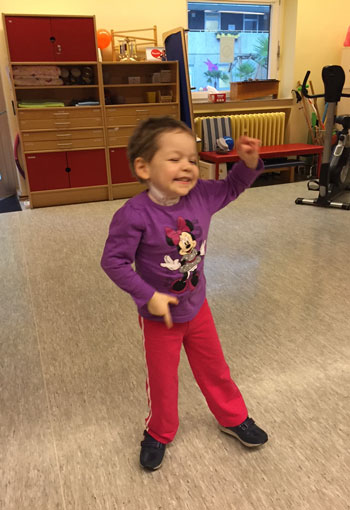
Shortly before midday, we received a call from Dr. Müller to say that everything had gone well and we were able to see her in the intensive care unit in the early afternoon. Rebecca was already feeling so well again that she actually wanted to get up and walk straight away and it was difficult to explain to her that she would be better off lying down for the first 24 hours after the operation. So in the end she was sedated again - that was better for everyone involved - her, us, but also the physicians and nurses. The next morning she was finally allowed to get up with the physiotherapist, and after a few days the drains were removed - the first time in months that we had seen our daughter without drains. Finally, the tracheostomy tube was removed during a bronchoscopy. When she woke up, however, she was so upset about the nasal cannula (for the oxygen) that her saturation levels plummeted. In the end, we tried without the nasal cannula and therefore without any additional oxygen - and then suddenly everything was ok. Rebecca recovered very quickly and was soon able to leave the intensive care unit and return to 61b, which we knew well. And just 3 ½ weeks after the operation, she was finally able to go home on November 2, 2015, after having to stay in various Clinical Departments without interruption since February 6.
No regular school attendance, but continued therapies and hospital stays...
Unfortunately, things didn't go so smoothly: we had to cancel our subsequent rehab in Tannheim due to an acute rejection and a subsequent serious bacterial infection. However, both were treated well so that we were able to celebrate Christmas at home.
In February, we then received the news that she had post-transplant lymphoma (PTLD). This was treated with Rituximab, which worked so well that everything seemed to be fine again in May 2016. So we planned to start school in the summer.
However, during our 2nd rehab attempt in July 2016, the PTLD returned and therefore had to be treated with chemotherapy. So no regular school attendance, but continued therapies and hospital stays ...
Rebecca started school anyway, received home schooling and after finishing chemotherapy in March 2017, she was finally allowed to go to school normally after the Easter vacations. Fortunately, she was already able to read, write and do maths, so she had no problems keeping up at school. And she also quickly made some nice friends.
We just try to live as normally as possible
Since then, we have actually led a relatively normal life. Of course, there is always the worry of how long this will last. But as it's no use worrying - because it doesn't change the outcome - we just try to live as normally as possible and enjoy our new-found family life. Of course, we have to go to the outpatient clinic in Hanover every 3 months and have regular blood samples taken by the pediatrician, and of course Rebecca has to swallow lots of tablets twice a day. Fortunately, this wasn't a problem right from the start and everything can be easily integrated into everyday life.
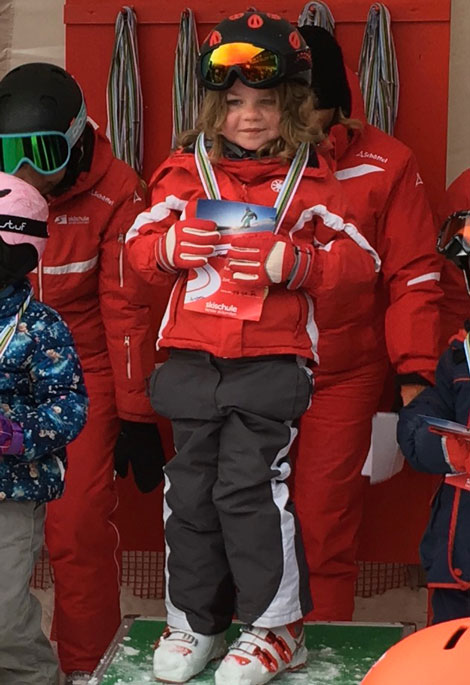
A lot has happened since then that we would never have thought possible in 2015: Rebecca is now in year 6 at the same secondary school as her older sister. We have been on vacation to the North Sea, Lanzarote, Croatia and now Italy. Rebecca has learned to swim and cycle and has actually learned to ski. In her first ski course at the beginning of 2018, she won the gold medal in the final race, which of course made her very proud.
On her 3rd attempt, our family rehab in Tannheim was finally a success!
Rebecca herself comments:
"There were of course some difficulties, but there were also many advantages, for example the rehab (I can only recommend the "Aftercare Clinical Department in Tannheim") It's always four weeks of good vibes when we're there. And the physicians are all very nice. I'm now back to normal and I hope you or your child get through it. Good luck and take heart!"
We can only say thank you
We have been able to experience so many wonderful moments because a family has managed to find the strength in their grief to decide in favor of organ donation. We can only say thank you!
And of course we would also like to thank the many nurses, physicians, physiotherapists and everyone else who helped Rebecca and us to get through it all, especially
- Dr. Carsten Müller, Dr. Julia Carlens and Dr. Nicolaus Schwerk from the MHH, who supported us throughout the transplant and continue to do so today
- Dr. Christoph Aring, Head Physician at the St. Nikolaus Children's Hospital in Viersen and his team, especially on P2 and P4, who have made so much possible for us and are always there for us.
- Dr. Thomas Pabst and the team in intensive care unit E2 at the Amsterdamer Straße Children's Hospital in Cologne, who lovingly cared for Rebecca for 100 days.
- Kirsten from the physiotherapy department at the MHH, who always had an open ear for us and gave Rebecca many wonderful hours, and her colleagues
- Clinic clown Cocktelia from Cologne and Viersen for funny and wonderful moments
- Klaus Rüggeberg, chaplain at the children's clinic in Cologne
- Dr. Andrea Dickmanns, our pediatrician, and her practice team for their support