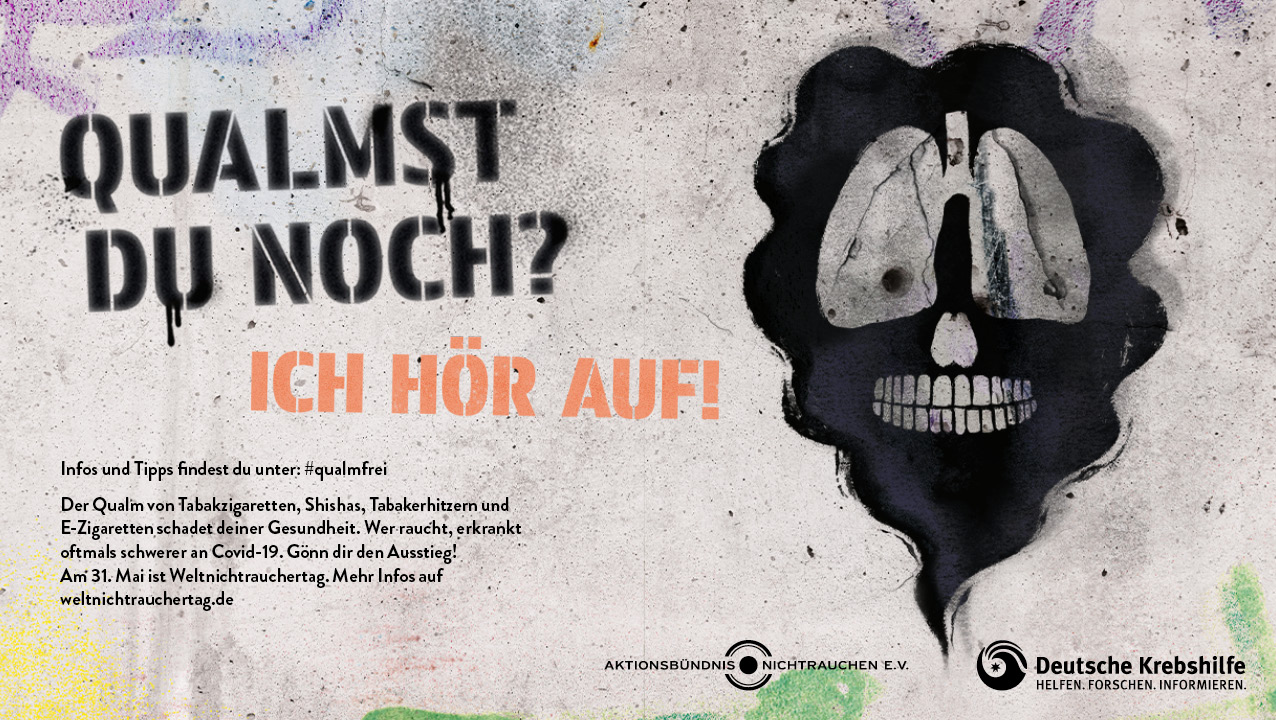
May 31 is World No Tobacco Day
Give yourself a break!
Status: May 28, 2021
Smoking contributes significantly to the development of various cancers, cardiovascular diseases and lung diseases. Quitting smoking can reduce the risk of these diseases. Especially now during the pandemic, it can be helpful to stop smoking, as recent studies show that smokers often develop severe cases of COVID-19. However, quitting smoking is not always easy. Smoke-free programs help people to stop smoking.
- 10 reasons to stop smoking from the German Cancer Research Center (dkfz)
"The smoke-free program" at the MHH
As it has been proven that it is more successful to help and motivate each other in a guided group, the course is a group program. The course is subject to ongoing professional development and is regularly evaluated. The smoke-free program at the MHH includes a free information event, three group meetings and two individual telephone appointments.
The program was developed by the Institute for Therapy Research (IFT) and is certified by IFT-Gesundheitsförderung. The course leader is Dr. Meike Jungen, a specialist in internal medicine and pneumology at the Voss Dirks pulmonary practice in Hanover. The program takes place in cooperation with the BREATH site of the German Center for Lung Research (DZL).
To register for the information event, please send an e-mail to: rauchfrei@mh-hannover.de. Current dates and further information can be found at www.mhh-rauchfrei.de.
Contact:
Hannover Medical School
The Smoke-Free Program
BREATH, German Center for Lung Research
Carl-Neuberg-Str. 1, 30625 Hannover
Tel.: 0511 532-5600 (Tuesday - Friday from 09.00 to 15.00)
Smoking as the most important risk factor for lung cancer
With over 50,000 new cases per year , lung cancer is one of the most common forms of cancer in Germany and is usually caused by smoking. It is the second most common cancer in men and the third most common in women. Dr. med. Isabelle Bodmann from the Clinical Department of Pneumology at the MHH explains what happens to our lungs when we smoke or vape.
What actually happens to our lungs when we smoke?
"When we inhale cigarette smoke, more than 70 different carcinogenic substances enter the lungs. These substances accumulate there. The toxins in the smoke destroy the alveoli and damage the immune system. Gene mutations also occur in the lungs, which promote the development of cancer cells. Regular smoking irritates the bronchial system and increases the production of bronchial mucus. At the same time, the self-cleaning mechanism of the lungs is severely impaired: Cilia of the bronchial mucosa are destroyed. Their actual task, the removal of harmful substances, is made considerably more difficult as a result. The composition of the mucus also changes. These processes lead to a build-up of mucus in the lungs. This often makes it difficult for those affected to cough up," explains Dr. Bodmann .
The e-cigarette - a "healthier" alternative to conventional cigarettes?
Bodmann: "So far, there have only been a few studies on vaping and hardly any long-term observations. It can be said that although e-cigarettes contain fewer harmful substances than conventional cigarettes, vaping can also trigger lung diseases such as inflammatory reactions or contact allergies. We therefore strongly advise against switching from a normal cigarette to an e-cigarette."
What is harmful about vaping an e-cigarette?
"Flavored liquids are vaporized in an e-cigarette. The devices consist of a power source (battery), an electric heating element (nebulizer) and a cartridge for the liquid to be vaporized (liquid). The result is not smoke, but aerosol, which is inhaled and can irreversibly damage the lungs. When the liquids are heated, substances such as acetaldehyde and formaldehyde are produced. Due to the possibility of being able to individually adjust the voltage and thus the temperature of certain e-cigarette models, 5 to 14 times the amount of formaldehyde enters the lungs when vaping 3 ml of liquid, for example. This corresponds to an amount that would be absorbed when smoking 20 tobacco cigarettes - i.e. an entire packet."
"Party smokers" - "occasional smoking doesn't matter"?
"According to major epidemiological studies, there is no lower limit at which smoking is safe. In addition, occasional smokers run a high risk of becoming addicted and not just smoking occasionally. Therefore, party smoking is also not recommended!" says Dr. Bodmann.
(Interview on World No Tobacco Day 2020)
Further information:
German Cancer Aid: World No Tobacco Day 2021 Action Alliance Non-Smoking e.V.: World No Tobacco Day 2021This might interest you:
Prevention and early detection The smoke-free program at the MHH Lung Cancer Center (MHH)Lung cancer center with recommendation of the German Cancer Society e.V.