
About the Ina-Pichlmayr-Mentoring
The program is aimed specifically at women with doctoral degrees who are working toward their habilitation and whose career goal is a professorship. The aim is to increase the proportion of women in leadership positions by actively countering existing gender disparities and drawing attention to this very issue. The goal is to make it easier for early-career female researchers to enter the profession and to support them in their career development and planning. The mentoring program for early-career female researchers has been in place since 2004. In each cycle, approximately 20 mentors volunteer to help plan their mentees’ career steps—regardless of hierarchical structure—to facilitate their integration into networks, and sometimes simply to encourage them to forge their own path. Currently, three female researchers from the University of Veterinary Medicine Hannover Foundation are also accepted into each cycle.
Program objectives by target group
For the mentees
The mentoring program enables participants to acquire knowledge about structures, processes, norms and rules in the scientific system and the scientific community.
In addition, the young female scientists are supported with the following challenges
- goal-oriented career planning
- Acquiring key qualifications outside the field
- Successful acquisition of third-party funding
- Integration into formal and informal academic networks
- Increasing the number of publications
For the mentors
- the promotion of young academics,
- expanding their advisory skills and
- receiving new impulses and perspectives.
For the university
- increasing the university's volume of third-party funding
- increasing the proportion of female academics who can be appointed to a professorship and
- Strengthening the university's gender equality profile
Program components
The Ina Pichlmayr Mentoring program is based on the quality standards of Forum Mentoring e. V..
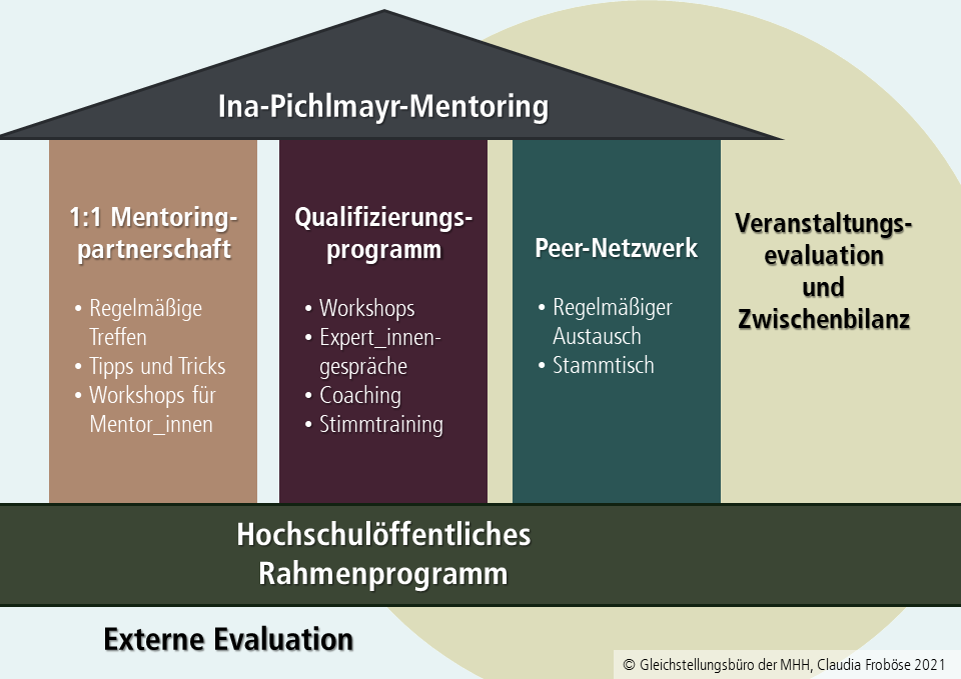
The mentoring process within the framework of this program is based on three pillars:
1. the mentoring partnership between mentee and mentor, which is intended to provide informal knowledge transfer and support and advice for the mentees.
2. the qualification program, which aims to provide the program participants (workshops, group coaching sessions, expert discussions) with the necessary non-specialist knowledge they need to successfully plan and shape their professional careers.
3. the idea of networking. Networking enables participants to exchange ideas with like-minded people and make new contacts.