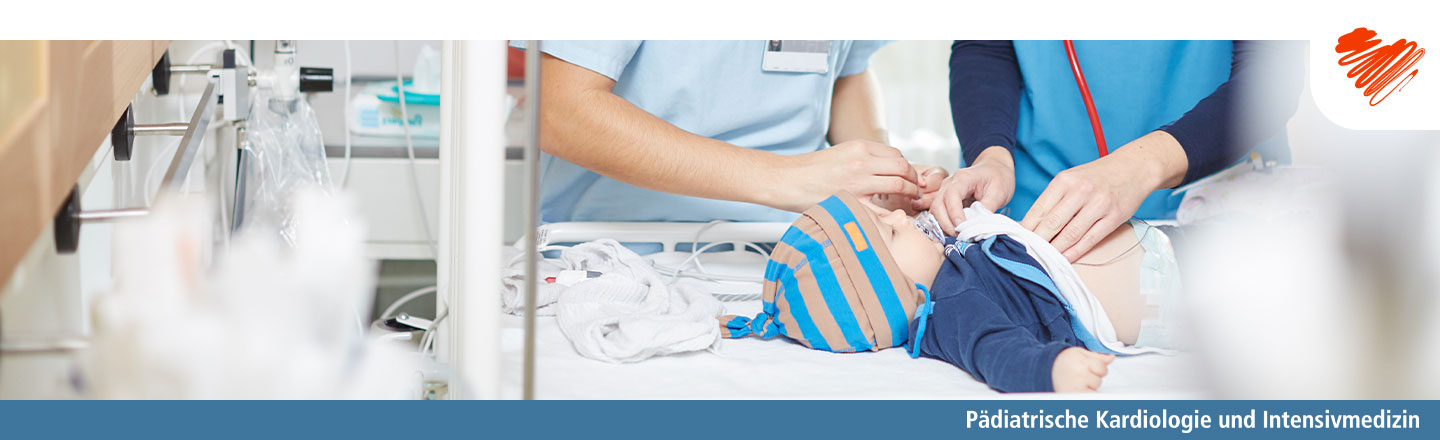
We have prepared a small compilation of information for you here for some of the patient groups we care for. This concerns pulmonary hypertension, cardiac arrhythmia, heart failure and myocarditis. Simply click on the corresponding drop-down boxes on the rest of this page. If you would like more information, please do not hesitate to contact us.
If you need information on congenital heart defects, take a look at our heart defect encyclopedia.
Pulmonary hypertension Cardiac arrhythmias Heart failure Myocarditis
Pulmonary hypertension & right heart failure
If the pressure in the vessels to the lungs - the pulmonary arteries - is too high, this can have dramatic consequences for the heart: The right ventricle, which pumps blood to the lungs, has to do more work until the ventricle can no longer do so, becomes larger (dilated) and squeezes (compresses) the left ventricle.
We have a special outpatient clinic for patients with pulmonary hypertension (PH), which looks for the causes and offers special therapy concepts, from drug therapy to cardiac catheterization or surgical interventions to a possibly necessary lung transplant. Please register for the consultation hours here under "Pulmonary hypertension outpatient clinic".
More information:
Rhythm diagnostics & rhythm therapy
Sometimes even very young patients need a pacemaker immediately after birth because the heart beats too slowly in the womb. For example, in the case of a congenital conduction defect (AV block III°). These and other patients with a pacemaker system need regular monitoring of their pacemaker therapy.
On the other hand, there are older patients who, for example, have a high risk of fatal cardiac arrhythmias due to heart muscle disease and therefore need a system to prevent these events (ICD - implantable cardioverter defibrillator). Or patients who repeatedly suffer from phases of very fast heartbeats (tachycardia) and require drug therapy or an electrophysiological examination with obliteration of a conduction pathway. Sometimes it is necessary to record the arrhythmia with a portable system (event recorder) in order to plan the appropriate therapy.
In cooperation with the cardiology team, we will find an individual solution tailored to each patient after appropriate diagnostics. Please make an appointment, stating the previous diagnosis and, if applicable, the pacemaker or ICD already implanted.
More information:
Conservative therapy
Patients often require drug therapy before or after heart surgery or for diseases of the heart muscle. In the case of small children, adjustment to the medication often takes place during an inpatient stay, usually on ward 68.
A good and sufficient supply of food and therefore calories is of crucial importance for a child to thrive. It is therefore sometimes necessary to feed small children via a tube (usually through the nose into the stomach). In this way, they do not exhaust themselves during the drinking phases and can gain weight despite heart disease.
More information:
Heart muscle disease (myocarditis)
In addition to congenital heart diseases, there are also myocardial diseases caused by transmissible pathogens, such as myocarditis. This can involve the heart muscle as part of an infection caused by viruses. Patients may still feel weak even after the acute phase because the heart is pumping fast but not well. Blood samples, ultrasound examinations and a cardiac catheterization with removal of a tiny piece of heart muscle for microscopic examination are used to make a diagnosis. Therapeutically, stabilizing measures in the intensive care unit are often necessary at first, followed by help in the form of tablets or syrup. If the heart does not recover, an artificial heart system is sometimes required. In many cases, the inflammation heals again.
We are taking part in a systematic examination of all patients who present with suspected myocarditis in order to gain new insights in this area. You can find more information on the Internet at www.mykke.de. Further information and help on the subject of myocardial disease can also be found under the following links.