Radiology in the Breast Center
Dear patient,
Welcome to the website of the Institute of Diagnostic and Interventional Radiology at the MHH Breast Center.
In our Breast Center, the various specialist disciplines work hand in hand. The Department of Gynecology and the Institute of Diagnostic and Interventional Radiology cooperate closely in the diagnosis and treatment of breast cancer. The highest level of specialist expertise and state-of-the-art equipment ensure optimal care for patients. Our Breast Center is certified by the German Cancer Society and the German Society for Senology (breast diseases), and our quality management is audited and certified in accordance with DIN EN ISO 9001.
The Institute of Human Genetics looks after families with a high incidence of breast and ovarian cancer and makes recommendations regarding screening intervals. At the Institute of Diagnostic and Interventional Radiology, affected women can take advantage of the Intensified Early Detection service.
This provides for close-meshed early detection examinations using MRI, ultrasound and mammography.
Further cooperation partners in the Breast Center can be found here.
Breast diagnostics at the Institute of Diagnostic and Interventional Radiology
Our Institute offers all common methods for the diagnosis and clarification of breast cancer:
Mammography is an X-ray examination of the breast. It is the best-studied method in breast diagnostics. Despite the further development of other methods, it is still indispensable for the detection of so-called microcalcifications. This calcification visible in the mammogram can, but does not necessarily have to, indicate an early form of breast cancer (a so-called ductal carcinoma in situ, "DCIS").
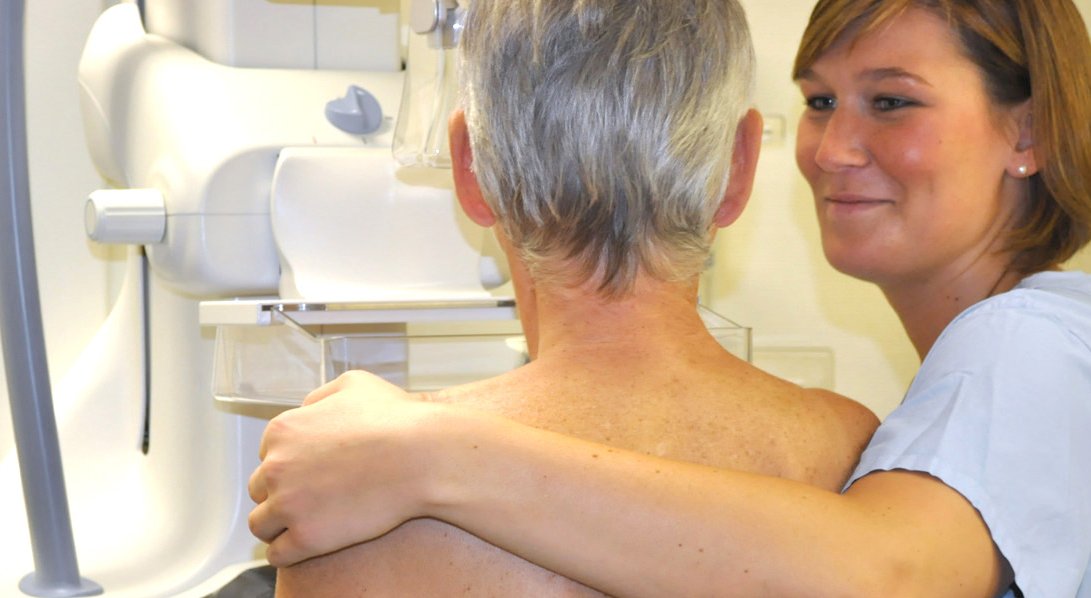
A mammogram consists of two images per breast in different projections. For the examination, the MTRA has to fix the breast in a device for a few seconds. This is uncomfortable, but this fixation ensures a sharp image and a reduction in radiation exposure by reducing the breast diameter. The compression plate is automatically released after the image is taken. In general, the examination is well tolerated despite the compression.
The radiation exposure of a mammogram depends on the size of the breast and the density of the mammary gland tissue. The probability of developing breast cancer as a result of exposure to radiation from a mammogram is extremely low. Our new device installed in 2016 guarantees optimum image quality with low radiation exposure.
If an abnormal finding is found in a mammogram, this abnormality is first clarified using ultrasound and, if necessary, a vacuum biopsy.
It is not necessary to prepare the patient for a mammogram. However, care should be taken to ensure that no deodorant or powder is applied to the skin of the breast and armpit, as these substances can lead to artifacts in the image.
Please bring your previous mammography images (with findings if possible) with you to your appointment!
While mammography is a projection image, tomosynthesis is a layered examination of the breast from several images. The different structures of the breast are shown in the individual layers without superimposition. This examination can help to clarify summation effects in a mammogram as an additional examination. Tomosynthesis is not yet recognized as a stand-alone examination. As with mammography, the radiation exposure depends on the size of the breast and the density of the mammary gland tissue.
In rare cases, it may be useful to perform a mammography or tomosynthesis with intravenously administered contrast medium. In this way, tumors that are increasingly supplied with blood and therefore absorb more contrast medium can be better visualized under certain circumstances. Iodine-containing X-ray contrast medium is administered venously for this examination; contraindications include an allergy to iodine, hyperthyroidism and impaired kidney function.
A pathological secretion of the breast (a one-sided, bloody secretion from a milk duct) can be examined by means of a milk duct imaging (galactography).
This involves probing the secreting milk duct with a soft, very small cannula. Very small amounts of contrast medium are then injected into the milk duct. The examination is generally not painful.
Following the injection of the contrast agent, a mammogram is performed to show any pathological changes in the secreting milk duct.
A galactography can only be performed if a bloody secretion can be produced at the time of the examination.
If a galactography cannot be performed, but also often in addition to a galactography, other examination procedures, such as an MRI, may be necessary to further clarify the secretion.
Alongside mammography, sonography is one of the most important methods of breast examination. This examination does not involve exposure to radiation.
Ultrasound is used for further clarification of abnormal findings found in the mammogram, as this method can be used to distinguish benign findings (e.g. cysts) from malignant masses (breast cancer).
Ultrasound is also recommended as an additional examination to mammography if the latter is only of limited value due to a high density of breast tissue.
During the ultrasound, the patient lies on her back. The examiner uses an ultrasound probe to examine the entire breast without any gaps while applying moderate compression.
This examination is usually well tolerated.
Magnetic resonance imaging is a "slice examination" in which no X-rays are used.
The entire cross-section of the breast is imaged in thin, high-resolution slices.
For the examination, the patient is placed in a prone position in an examination tube. The examination takes about 20 minutes. It is important that the patient remains very still during this time, as even the slightest movements can reduce the image quality and therefore the assessability.
During the examination, an MRI contrast agent is administered intravenously; this is a non-iodine-containing contrast agent that rarely causes allergies and should only not be used if kidney function is severely impaired.
Breast MRI is a very sensitive method and can help to detect breast cancer even at an early stage. This is why this examination is the most important method for the early detection of breast cancer in "intensive early detection" for women with a high familial risk of breast cancer.
However, many benign findings, such as those caused by hormones, can also lead to accumulations of contrast medium. In such cases, this can be clarified by a follow-up examination or a biopsy (tissue sample).
The MRI should be performed between the 7th and 14th day of the menstrual cycle to minimize hormonal influences as far as possible.
In the case of abnormal findings in these examinations (but also in the case of abnormal findings obtained in external examinations not carried out at the MHH), we offer the entire range of methods for bioptic clarification of these abnormalities:
If a mammogram reveals an abnormal finding that cannot be clarified further by ultrasound, it must be examined with a small tissue sample (biopsy).
The patient is positioned on her side or in a sitting position on an examination table. The breast is fixed under compression in a similar way to a mammogram. The findings are visualized again using mammography-like images or by means of tomosynthesis so that the biopsy can be performed accurately.
The area to be biopsied is then locally anaesthetized. Finally, a biopsy needle is inserted into the correct position under image control. Once several small biopsies have been taken, the needle is removed and the site marked with a small clip. This is necessary so that the correct location for the operation can be found again in the event of pathological findings.
The puncture site is treated with a plaster and a pressure bandage. A small hematoma (bruise) is a common but generally harmless consequence of the biopsy. In most cases, this hematoma subsides on its own after a few days.
The vacuum biopsy is a routine examination that is well tolerated.
If the sonography (ultrasound) reveals abnormal findings, a biopsy is necessary for further clarification.
During this examination, the patient is placed in the supine position. The area to be biopsied is anaesthetized with a local anaesthetic. Several small tissue samples are then taken from the abnormal findings under sonographic control.
This procedure only takes a few minutes and is well tolerated. The puncture site is treated with a plaster and a pressure bandage. Apart from a small bruise (hematoma), no complications are generally to be expected. In most cases, the hematoma subsides on its own after a few days.
In a few cases, the tumor-suspicious finding can only be detected by magnetic resonance imaging (MRI) and cannot be reproduced by mammography or ultrasound. In this case, magnetic resonance imaging must be used for image-guided sampling.
The patient is positioned in the prone position. The breast is fixed under slight compression. MRI images are first taken again to localize the findings.
The biopsy itself is performed outside the MRI "tube".
The area to be biopsied is anaesthetized with a local anaesthetic. The biopsy needle is then inserted into the correct position and several small tissue samples are taken. The position of the needle is repeatedly checked in between by taking MRI images.
Following the procedure, the biopsy site is marked with a small marker (clip) so that further procedures can be carried out without MRI imaging in the event of pathological findings.
The procedure takes about 30 minutes in total, as multiple MRI images are taken. The actual biopsy procedure only takes 30-60 seconds.
The puncture site is treated with a plaster bandage and a pressure bandage. Apart from a small bruise (hematoma), no complications are generally to be expected. In most cases, the hematoma subsides on its own after a few days.
A biopsy (diagnostic tissue sample) is essential to clarify a finding before a possible operation and is required for treatment planning. If the biopsy proves the findings to be benign, there is no need for an operation. The examination results are assessed in our interdisciplinary tumor conference with the disciplines responsible for diagnosis and therapy (e.g. gynecology, pathology and radiotherapy) so that optimal therapy can be offered.