Working Group "Quantitative and Metabolic Neuroimaging"
Responsible: Prof. Dr. med. Dr. rer. nat. X. Ding
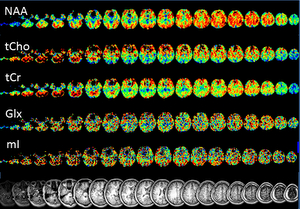
The Ding working group is concerned with the establishment of new MR methods to detect and investigate microstructural and metabolic changes in the brain in vivo. One research focus of the working group is quantitative MR imaging (qMRI). Various quantitative mapping methods have been developed and optimized as tools for scientific research and clinical application, such as T1, T2, T2* and T2' mapping. In combination with DTI, qMRI is often able to detect subtle pathological changes in various neurodegenerative diseases that are not visible on conventional MRI. Another field of research is 1H-MR spectroscopy (1H-MRS). 1H-MRS can be used to determine the concentrations of metabolites - such as N-acetyl-aspartate (NAA) as a marker for neuronal tissue integrity, total choline (Cho) as a marker for membrane phospholipid metabolism, total creatine (tCr) as a marker for energy metabolism or myo-inositol (mI) as a marker for gliosis and as an osmolyte and glutamine/glutamate (Glx) as a neurotransmitter - in vivo in the brain and obtain information on neurometabolism. Further information...
Working Group "Petrous bone imaging"
Responsible: Priv.-Doz. Dr. med. A. Giesemann
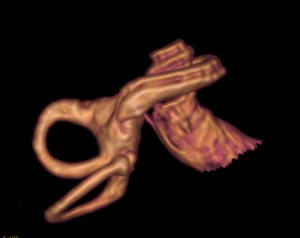
Our working group is concerned with the optimization of imaging diagnostics of the temporal bone using CT and MRI and with the subtle morphological imaging of inner ear structures, particularly in congenital and acquired hearing disorders.
Technical developments in magnetic resonance imaging offer the possibility of using increasingly high-resolution sequences and increasing diagnostic reliability in the submillimeter range. State-of-the-art CT devices can provide cross-sectional images of the highest quality with low radiation exposure. Further information...