Working Group "Quantitative and Metabolic Neuroimaging"
Head: Prof. Dr. med. Dr. rer. nat. X. Ding
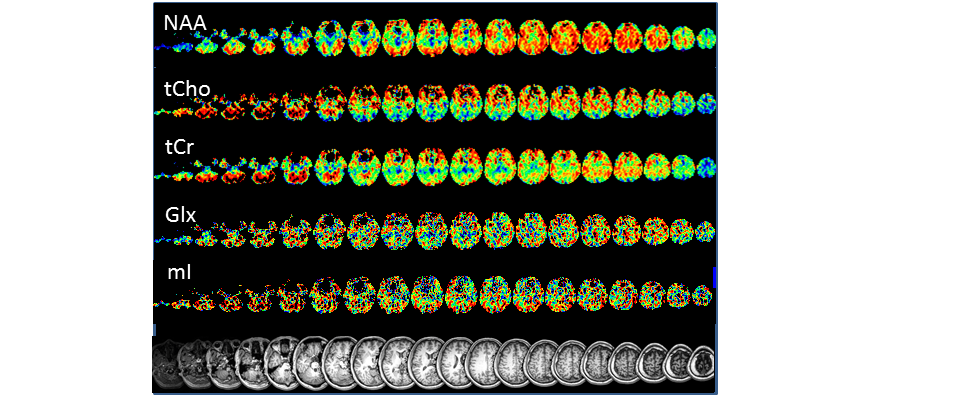
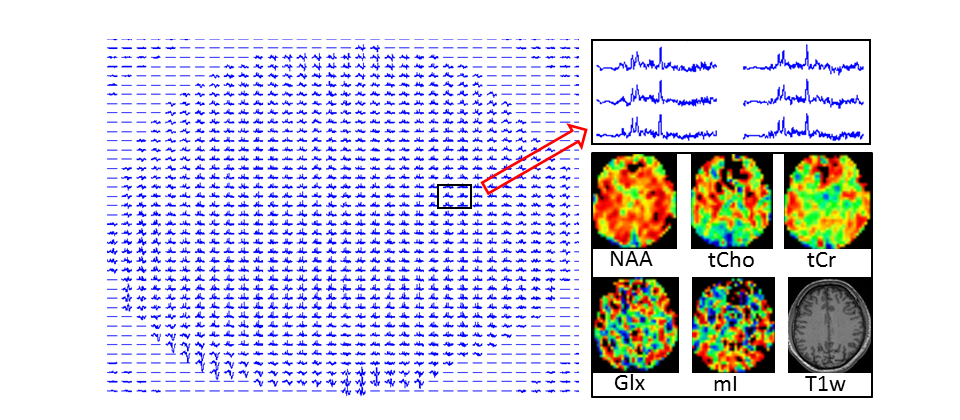
The WG Ding is concerned with the establishment of new MR methods to detect and investigate microstructural and metabolic changes in the brain in vivo. One research focus of the working group is quantitative MR imaging (qMRI). Various quantitative mapping methods have been developed and optimized as tools for scientific research and clinical application, such as T1, T2, T2* and T2' mapping. In combination with DTI, qMRI is often able to detect subtle pathological changes in various neurodegenerative diseases that are not visible on conventional MRI. Another field of research is 1H-MR spectroscopy (1H-MRS). 1H-MRS can be used to determine the concentrations of metabolites - such as N-acetyl-aspartate (NAA) as a marker for neuronal tissue integrity, total choline (Cho) as a marker for membrane phospholipid metabolism, total creatine (tCr) as a marker for energy metabolism or myo-inositol (mI) as a marker for gliosis and as an osmolyte and glutamine/glutamate (Glx) as a neurotransmitter - in vivo in the brain and obtain information on neurometabolism. However, current 1H-MRS methods can only examine a small area of the brain each time, and with a relatively long examination time. This limits the use of 1H-MRS. As a recent success, the working group has successfully established a worldwide novel method for whole-brain magnetic resonance spectroscopy imaging (wbMRSI) at the MHH with the help of an international cooperation funded by the DFG. wbMRSI can be used to create so-called metabolite maps for the entire brain (Figure 1), which contain detailed information on metabolite distributions in the brain (Figure 2). With this valuable tool, we can introduce completely new aspects in the research of neurometabolism and gain new/deep knowledge, e.g. about the physiological ageing processes in healthy individuals or about the pathological neurodegenerative processes in patients.
As a physicist and medical physician she has been/is principal investigator of different research projects founded by German Research Foundation (DFG) and Federal Ministry of Education and Research (BMBF), for example, the project "Classifying Leukodystrophies with unknown defects according to neuroradiological criteria: applications of MRI patterns and MRS characteristics" (BMBF), or the project "Assessment of metabolic and microstructural correlates in aging human brain and in patients by using an innovative whole brain 1H magnetic resonance spectroscopic technique in combination with quantitative magnetic resonance imaging" (DFG). She is experienced in Mössbauer spectroscopy, MR imaging and MR spectroscopy, and combines both professions - physics and medicine - in the scientific research.
1. assessment of metabolic and microstructural correlates in patients with Parkinson's disease and with major depression by use of whole brain 1H magnetic resonance spectroscopic technique in combination with quantitative magnetic resonance imaging
2. influence of a 72 hours fasting on brain metabolism in healthy subjects and in patients
3. quantitative MR brain morphological measurements in normal aging human and in patients
4. physiological and pathological microstructural alterations in aging human brain studied with diffusion tensor imaging
Recent publications:
1 Reichardt, J. L., Dirks, M., Wirries, A. K., Pflugrad, H., Nösel, P., Haag, K., Lanfermann, H., Wedemeyer, H., Potthoff, A., Weissenborn, K. and Ding, X. Q. (2022). "Brain metabolic and microstructural alterations associated with hepatitis C virus infection, autoimmune hepatitis and primary biliary cholangitis." Liver Int 42(4): 842-852.
2 Ahlswede, M., Nösel, P., Maudsley, A. A., Sheriff, S., Mahmoudi, N., Bronzlik, P., Lanfermann, H. and Ding, X. Q. (2021). "Alterations of Striato-Thalamic Metabolism in Normal Aging Human Brain-An MR Metabolic Imaging Study." Metabolites 11(6).
3. Klietz, M., Elaman, M. H., Mahmoudi, N., Nösel, P., Ahlswede, M., Wegner, F., Höglinger, G. U., Lanfermann, H. and Ding, X. Q. (2021). "Cerebral Microstructural Alterations in Patients With Early Parkinson's Disease Detected With Quantitative Magnetic Resonance Measurements." Front Aging Neurosci 13: 763331.
4 Fu, T., Kobeleva, X., Bronzlik, P., Nösel, P., Dadak, M., Lanfermann, H., Petri, S. and Ding, X. Q. (2021). "Clinically Applicable Quantitative Magnetic Resonance Morphologic Measurements of Grey Matter Changes in the Human Brain." Brain Sci 11(1).
5. Stapel, B., Nösel, P., Heitland, I., Mahmoudi, N., Lanfermann, H., Kahl, K. G. and Ding, X. Q. (2021). "In vivo magnetic resonance spectrometry imaging demonstrates comparable adaptation of brain energy metabolism to metabolic stress induced by 72 h of fasting in depressed patients and healthy volunteers." J Psychiatr Res 143: 422-428.
6 Fu, T., Klietz, M., Nösel, P., Wegner, F., Schrader, C., Höglinger, G. U., Dadak, M., Mahmoudi, N., Lanfermann, H. and Ding, X. Q. (2020). "Brain Morphological Alterations Are Detected in Early-Stage Parkinson's Disease with MRI Morphometry." J Neuroimaging 30(6): 786-792.
7 Dirks, M., Pflugrad, H., Tryc, A. B., Schrader, A. K., Ding, X., Lanfermann, H., Jäckel, E., Schrem, H., Beneke, J., Barg-Hock, H., Klempnauer, J., Falk, C. S. and Weissenborn, K. (2020). "Impact of immunosuppressive therapy on brain derived cytokines after liver transplantation." Transpl Immunol 58: 101248.
8. Kahl, K. G., Atalay, S., Maudsley, A. A., Sheriff, S., Cummings, A., Frieling, H., Schmitz, B., Lanfermann, H. and Ding, X. Q. (2020). "Altered neurometabolism in major depressive disorder: A whole brain (1)H-magnetic resonance spectroscopic imaging study at 3T." Prog Neuropsychopharmacol Biol Psychiatry 101: 109916.
9 Pflugrad, H., Nösel, P., Ding, X., Schmitz, B., Lanfermann, H., Barg-Hock, H., Klempnauer, J., Schiffer, M. and Weissenborn, K. (2020). "Brain function and metabolism in patients with long-term tacrolimus therapy after kidney transplantation in comparison to patients after liver transplantation." PLoS One 15(3): e0229759.
10 Dirks, M., Haag, K., Pflugrad, H., Tryc, A. B., Schuppner, R., Wedemeyer, H., Potthoff, A., Tillmann, H. L., Sandorski, K., Worthmann, H., Ding, X. and Weissenborn, K. (2019). "Neuropsychiatric symptoms in hepatitis C patients resemble those of patients with autoimmune liver disease but are different from those in hepatitis B patients." J Viral Hepat 26(4): 422-431.
11 Maghsudi, H., Schmitz, B., Maudsley, A. A., Sheriff, S., Bronzlik, P., Schutze, M., Lanfermann, H. and Ding, X. (2019). "Regional Metabolite Concentrations in Aging Human Brain: Comparison of Short-TE Whole Brain MR Spectroscopic Imaging and Single Voxel Spectroscopy at 3T." Clin Neuroradiol.
12. Klietz, M., Bronzlik, P., Nosel, P., Wegner, F., Dressler, D. W., Dadak, M., Maudsley, A. A., Sheriff, S., Lanfermann, H. and Ding, X. Q. (2019). "Altered Neurometabolic Profile in Early Parkinson's Disease: A Study With Short Echo-Time Whole Brain MR Spectroscopic Imaging." Front Neurol 10: 777.
13 Dirks, M., Pflugrad, H., Tryc, A. B., Schrader, A. K., Ding, X., Lanfermann, H., Jackel, E., Schrem, H., Beneke, J., Barg-Hock, H., Klempnauer, J., Falk, C. S. and Weissenborn, K. (2019). "Impact of immunosuppressive therapy on brain derived cytokines after liver transplantation." Transpl Immunol: 101248.
14. Goede, L. L., Pflugrad, H., Schmitz, B., Lanfermann, H., Tryc, A. B., Barg-Hock, H., Klempnauer, J., Weissenborn, K. and Ding, X. Q. (2019). "Quantitative magnetic resonance imaging indicates brain tissue alterations in patients after liver transplantation." PLoS One 14(9): e0222934.
15. Maghsudi, H., Schutze, M., Maudsley, A. A., Dadak, M., Lanfermann, H. and Ding, X. Q. (2019). "Age-related Brain Metabolic Changes up to Seventh Decade in Healthy Humans : Whole-brain Magnetic Resonance Spectroscopic Imaging Study." Clin Neuroradiol.
16. Schmitz, B., Pflugrad, H., Tryc, A. B., Lanfermann, H., Jackel, E., Schrem, H., Beneke, J., Barg-Hock, H., Klempnauer, J., Weissenborn, K. and Ding, X. Q. (2019). "Brain metabolic alterations in patients with long-term calcineurin inhibitor therapy after liver transplantation." Aliment Pharmacol Ther 49(11): 1431-1441.
17 Ding, X. Q., Maudsley, A. A., Schweiger, U., Schmitz, B., Lichtinghagen, R., Bleich, S., Lanfermann, H. and Kahl, K. G. (2018). "Effects of a 72 hours fasting on brain metabolism in healthy women studied in vivo with magnetic resonance spectroscopic imaging." J Cereb Blood Flow Metab 38(3): 469-478.
18 Pflugrad, H., Schrader, A. K., Tryc, A. B., Ding, X., Lanfermann, H., Jackel, E., Schrem, H., Beneke, J., Barg-Hock, H., Klempnauer, J. and Weissenborn, K. (2018). "Longterm calcineurin inhibitor therapy and brain function in patients after liver transplantation." Liver Transpl 24(1): 56-66.
19 Schmitz, B., Wang, X., Barker, P. B., Pilatus, U., Bronzlik, P., Dadak, M., Kahl, K. G., Lanfermann, H. and Ding, X. Q. (2018). "Effects of Aging on the Human Brain: A Proton and Phosphorus MR Spectroscopy Study at 3T." J Neuroimaging 28(4): 416-421.