Study costs
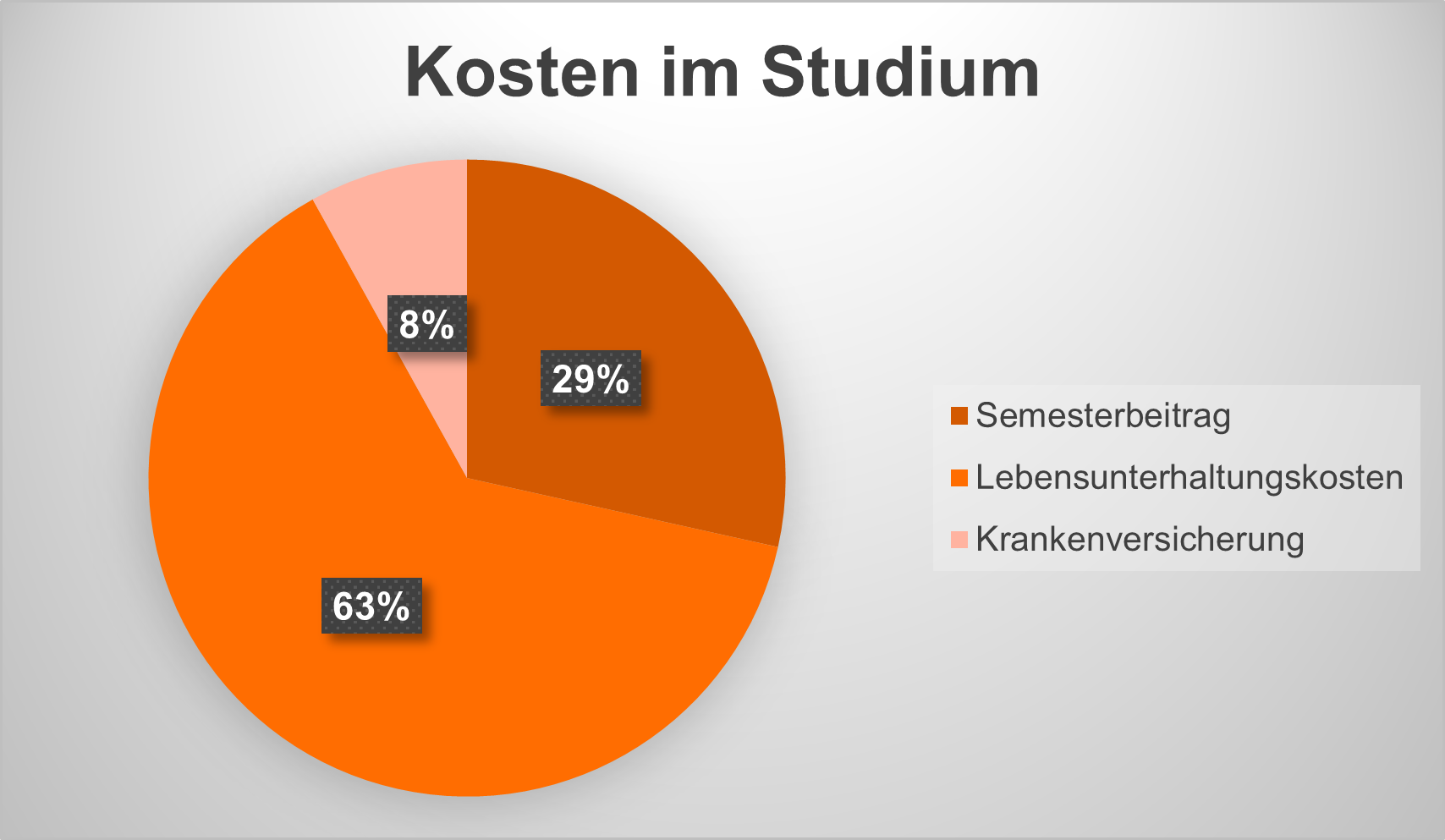
Financial security during their studies is an important consideration for many students. There are various ways to finance your studies at Hannover Medical School, such as savings, scholarships, part-time jobs or Federal financial aid. First of all, be clear about what and how much money you will be spending during your studies. The main expenses during your studies at the MHH are the semester fee, health insurance and living expenses.
All MHH students have to pay a semester fee, which consists of contributions to the Studentenwerk Hannover and the student self-administration (AStA). The fee varies depending on the semester (around 389 euros in the summer and winter semesters). The exact amounts and deadlines for transferring the semester fee can be found on the Student Office website.
In order to apply for a visa to study in Germany, proof of financial resources must be provided, which since January 1, 2023 has been 934 euros per month. This can be proven by proof of income from parents, a blocked account, a guarantee or a recognized scholarship. Many international students use a blocked account to finance their studies in Germany. The account can be applied for for a fee of 50 to 150 euros and allows the withdrawal of a certain amount per month. For more information, please visit the website of the Federal Foreign Office.
Health insurance is required for enrollment at a German university, even for students from other EU countries. If the insurance cover from your home country is not valid in Germany, students must take out their own insurance. The contributions for statutory health insurance are around 110 euros per month.
Living costs can be very individual and include expenses such as rent, mobile telephony, food and leisure activities such as sports, culture and excursions. It is also important to note that costs for deposits for rooms or apartments should also be planned for at the beginning of your studies. Overall, the average monthly costs amount to around 867 euros, a significant sum.
It is advisable to draw up a financial plan for your studies at an early stage and to find out about possible financing options, scholarships and support offers in order to ensure solid financial security during your studies at Hannover Medical School.
(Source: DAAD)
Financing options for your studies at the MHH
We would like to introduce you to a few ways in which you can receive funding to cover your monthly expenses.
Scholarships
There are many funding opportunities for studying in Germany. In this section, we would like to present a small selection of scholarships and refer you to others.
The German National Academic Foundation is the oldest and largest organization for the promotion of gifted students in the Federal Republic of Germany. Supported by funds from the Federal Ministry of Education and Research and other state and non-state sponsors, it provides financial and non-material support to particularly talented and committed students and doctoral candidates. The exact requirements and application procedures can be found on the foundation's website.
The German Academic Exchange Service (DAAD) supports well over 100,000 German and international students and scientists around the world every year - making it the world's largest funding organization of its kind. It supports internships, research stays, doctorates and also studies in Germany. You can find an overview of the scholarship programs on the DAAD website.
The Deutschlandstipendium is a Germany-wide scholarship program for talented, capable and committed students and first-year students who are supported with 300 euros per month. Half of the funding comes from private sponsors, the other half is provided by the federal government. Applications are open to anyone enrolled at the MHH, regardless of subject area or degree.
All those who apply for the Deutschlandstipendium also have the opportunity to take part in the application process for the Niedersachsenstipendium. The Niedersachsenstipendium supports enrolled students who are not on academic leave. A one-off payment of 500 euros is made.
- Promos
The Federal Ministry of Education and Research (BMBF) provides the DAAD with so-called PROMOS funds, which can be used to support study visits and internships by all regularly enrolled MHH students through residence scholarships (= so-called partial scholarships) and/or travel allowances. The stays can take place worldwide and may last a maximum of 6 months. The amount of funding depends on the respective destination country.
- Erasmus+
All selected program participants who complete an ERASMUS+ study visit (SMS) or ERASMUS+ internship (SMP) in another European country receive a so-called mobility grant from the EU, which varies depending on the destination country. You can find more information on this grant under Erasmus+ (SMS) and Erasmus+ (SMP).
In addition to Erasmus, Promos and the like, there are other funding opportunities for internships and clinical traineeships abroad, which you can find out more about here.
The portal barrierefrei-studieren.de provides an overview of suitable study programmes and funding opportunities for people with a chronic illness or disability.
The advancement scholarship supports committed specialists with vocational training and practical experience in their first academic degree course. Every year, the Federal Ministry of Education and Research awards around 1,000 new advancement scholarships via the SBB. The application is also possible before the start of studies, but the funding starts after enrollment.
Federal financial aid
Federalfinancial aid (Federal financial aid) stands for the Federal Training Assistance Act and regulates state support for pupils and students in Germany. Colloquially, the funding itself is also referred to as "Federal financial aid". Federal financial aid is the most cost-effective form of student financing if you are eligible, as it contains both an interest-free loan component and a grant component. As a rule, the loan must be repaid five years after graduation and is limited to a maximum of 10,010 euros.
You can apply for Federal financial aid online at the following link. However, it is important to note that the requirements and procedures for Federal financial aid may vary depending on the federal state, as the funding is administered by the respective federal states. It is advisable to check the specific regulations in your federal state.
It is also interesting to know that Federal financial aid is compatible with a mini-job of up to 520 euros per month without this counting towards Federal financial aid benefits. However, it is important to observe the current rules and regulations, as these may change.
For further questions and detailed advice on Federal financial aid (Federal financial aid), you can contact the Studentenwerk Hannover or the Federal financial aid office in your federal state. It is important to be well informed about the requirements, the application process and the repayment modalities of Federal financial aid in order to receive the best possible support for your education.
Second job
Many students start working alongside their studies at an early stage, not only to earn money, but also to gain professional experience, meet new people and make contacts in the professional environment. There are various sources of information for looking for work, for example the AStA job exchange for internal job vacancies at the MHH or e-mail offers for students with a student e-mail address. If you are unsure about what type of work would suit you best or exactly how working in Germany works, you can find out more on the Studentenwerk Hannover website under Financing. There you will also find videos that can give you a more detailed insight into the topic.
It is important to note that certain regulations apply to working students in Germany, such as limits on weekly working hours, compliance with minimum wage regulations and consideration of tax aspects. It is advisable to inform yourself about the applicable laws and regulations in order to avoid any problems. In addition to working, there are other funding options for students in Germany, such as Federal financial aid (Bundesausbildungsförderungsgesetz), scholarships, student loans or family support.
It is advisable to carefully consider all options and seek professional advice if necessary in order to develop the best financial strategy for your studies.
Further offers in Hanover
Housing benefit is a state subsidy for rent that can be applied for in Germany if your own income is not sufficient to cover all of your housing costs. It can be applied for by people who live and work in Germany but are not entitled to Federal financial aid.
If you are entitled to housing benefit, the housing benefit office will pay a subsidy towards the costs of an appropriate, owner-occupied residential property. You can use the following page to get an overview of how much housing benefit you may be entitled to and to obtain further information.
Students in financial need have the opportunity to receive a subsidy for lunch. If you would like to apply for the Canteen-Freitische, simply write an email to the responsible AStA officer.
The Alumni Association of Hannover Medical School supports financially needy first-year students of dentistry with a one-off amount of € 500 for the start of their studies. The support is intended in particular for the purchase of materials for the practical courses at the beginning of the course. The award criteria for the scholarship are, for example, social need, an existing disability, employment or caring responsibilities. Interested parties can apply by submitting the relevant supporting documents. Further information can be found here.
Offers for students from abroad (without German citizenship)
The STIBET graduation scholarship of the MHH Hannover Lisa adds later
Current page: Graduation scholarships for foreign students, graduates and researchers at the MHH
With so-called STIBET funds from the DAAD, which are provided by the Federal Foreign Office, the MHH can support foreign students and graduates (so-called Bildungsausländer*innen) both in undergraduate study programmes (state examinations) and in advanced study programmes (e.g. Master's) as well as foreign PhD students through so-called graduation scholarships. The prerequisite for funding is that the students, graduates and PhD students have performed well and are expected to successfully complete their studies within one year. The scholarships are also intended to provide financial support to enable foreign students, graduates and PhD students who are in need through no fault of their own to complete their studies. Comprehensive and specific information on scholarships for students from abroad can be found in the scholarship database of the DAAD (German Academic Exchange Service). Further information is available from the International Office.