Big Data Leads to National Victory: A 20-year-old FWJ intern at the MHH impressed the jury with her systematic approach.
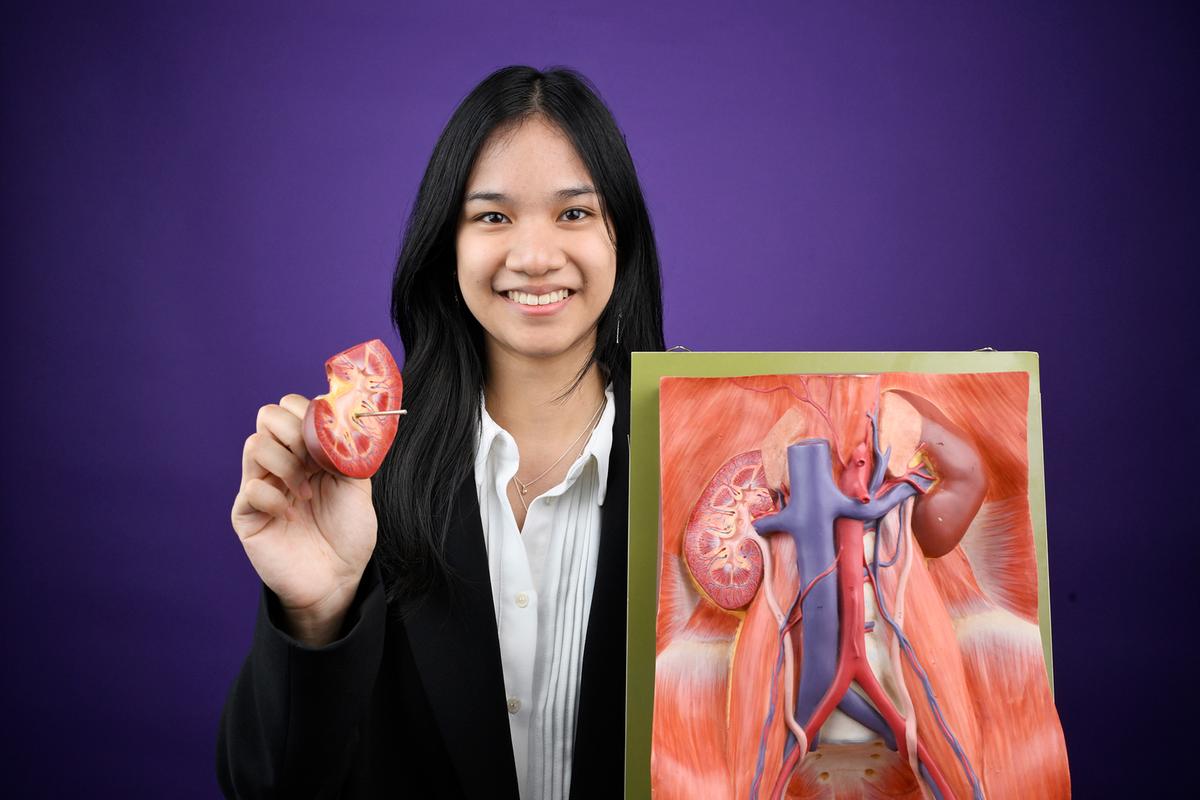
Jamila-Cate Tran impressed the jury in the national competition in the field of biology. Copyright: Stiftung Jugend forscht e.V.
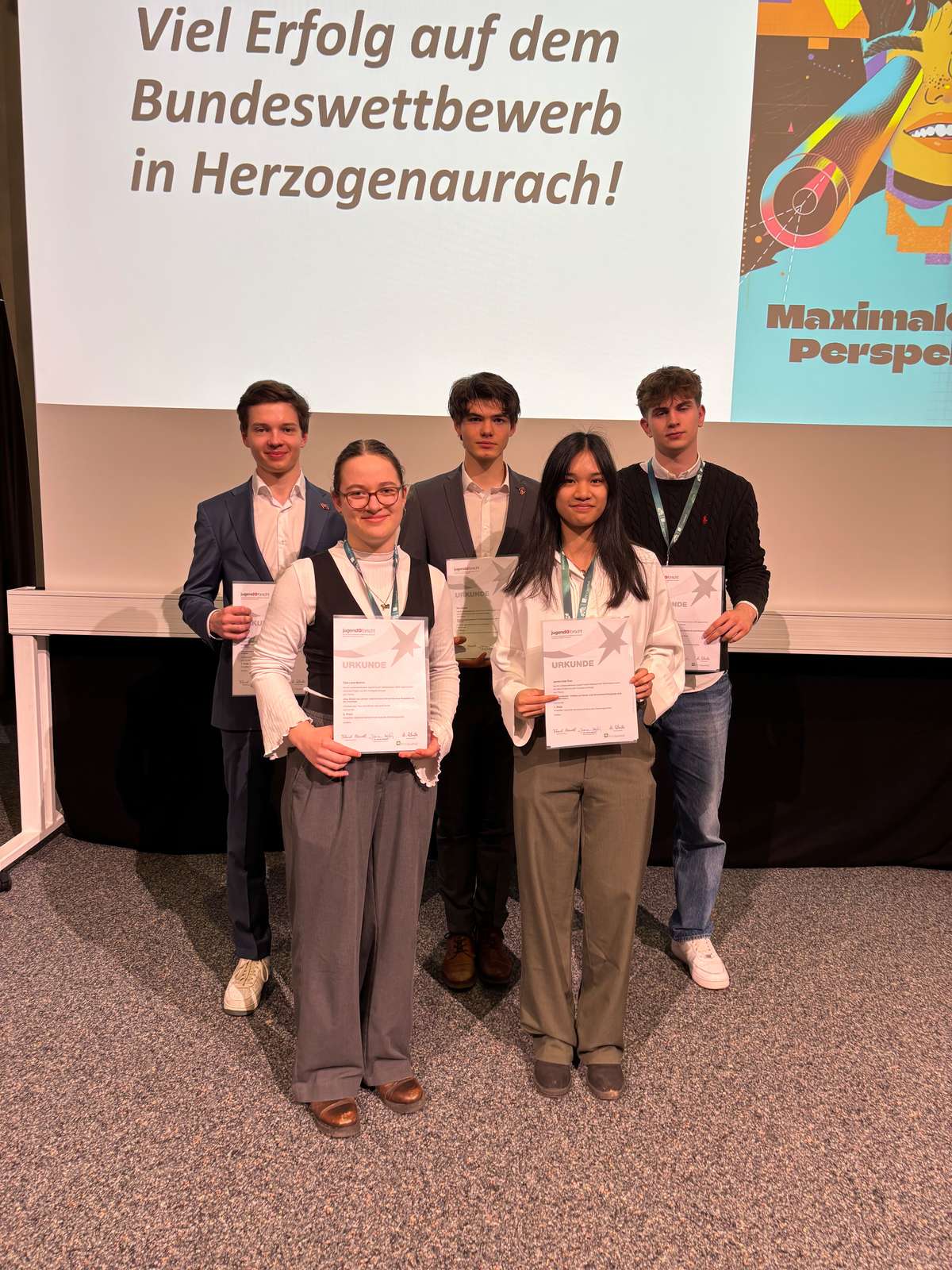
These young researchers were successful with their MHH projects at the state-level “Jugend forscht” competition in Lower Saxony (from left): Jonas Knaup, Ben Schüler, Lukas Bucan (back row), as well as Tara Mertins and Jamila-Cate Tran (front row). Copyright: Bernhard Schmidt / MHH
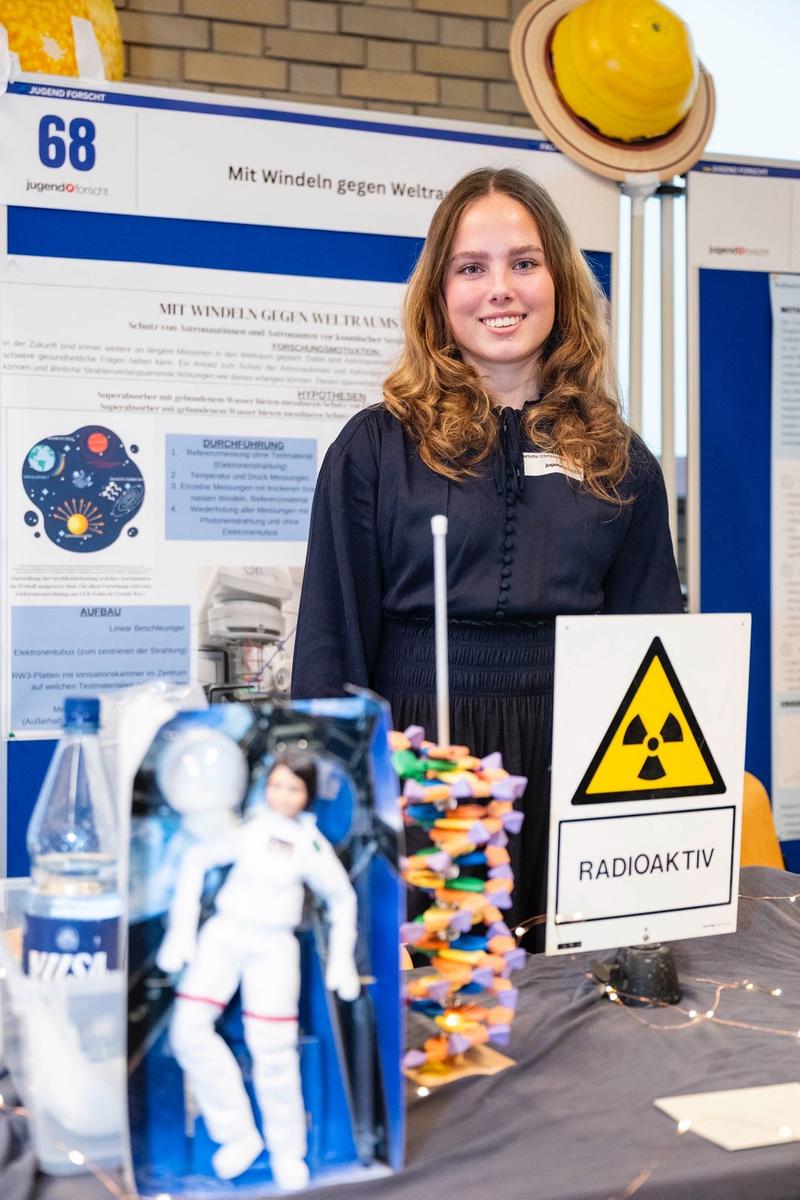
Charlotte Christiansen impressed the judges at the regional competition with her booth showcasing the project “Using Diapers to Block Space Radiation.” Copyright: Moritz Küstner
The national winners of the “Jugend forscht” competition were honored over the weekend. Jamila-Cate Tran from Hanover won in the biology category. She also received the European Prize from the German Research Foundation (DFG) for her research on so-called SGLT-2 inhibitors, which are used in the treatment of diabetes. In a study, the 20-year-old demonstrated that these drugs can also help patients after a kidney transplant. “It feels absolutely wonderful to have won this competition,” said Tran. “I would have expected practical projects where you can see something to win, rather than a pure data analysis like the one I conducted in my research project.”
Jamila-Cate Tran is completing her Voluntary Scientific Year (FWJ) at Hannover Medical School (MHH). In her project, she investigated whether the drugs originally developed to treat diabetes can also reduce the risk of kidney and cardiovascular complications as well as mortality in kidney transplant patients without diabetes. To this end, she analyzed treatment data from more than 160 million people in the international TriNetX database. The young researcher was able to demonstrate that patients treated with SGLT2 inhibitors had better graft survival and lower mortality rates compared to control groups.
The research project impressed the jury above all with its systematic approach, the extensive range of statistical methods, and the young researcher’s deep medical understanding. Jamila-Cate Tran will now participate, along with two other young researchers awarded the DFG Europe Prize, in the European Union Contest for Young Scientists (EUCYS), which will take place in Kiel in September.
FWJ as a bridge between school and college
Tran is completing her FWJ at the MHH in the laboratory of the “Clinical Epidemiology” research group at theMHH Clinics for the Clinical Department of Nephrology and Hypertension and for the Clinical Department of Paediatric Kidney, Liver and Metabolic Diseases and Neuropediatrics, under the supervision of Prof. Dr. Bernhard Schmidt and Prof. Dr. Dr. Anette Melk. “Jamila’s findings may encourage transplant physicians to use SGLT2 inhibitors more frequently in their patients who were not included in previous studies but are very likely to benefit from them as well,” says Professor Schmidt. In her role as Dean of Academic Career Development at MHH, Professor Melk emphasized that the FWJ plays an essential bridging role between school education and MHH: “This outstanding success impressively demonstrates what a valuable tool the program is for MHH in attracting outstanding young talent to research at an early stage.”
Third prize in national competition for another FWJ project
A total of 159 young people had qualified for the “Jugend forscht” national competition. Like Jamila-Cate Tran, MHH FWJ participants Ben Schüler (20) and Jonas Knaup (19) also advanced to the national competition as winners of the Lower Saxony state competition in the field of biology. The two high school graduates researched a self-developed approach to the production of artificial recipient-nonspecific organs. In doing so, they first stripped existing tissue of cells and then repopulated it with new, specifically genetically modified cells. With this project, they won third prize.
Ben Schüler is completing his FWJ atthe MHH Institute of Transfusion Medicine and Transplant Engineering under Prof. Dr. Constanca Figueiredo, while Jonas Knaup is at the Clinical Department of Paediatric Pneumology, Allergology and Neonatology under Prof. Dr. Anna-Maria Dittrich. The two met at a seminar for FWJ participants and decided to continue working together on a research project initiated by Schüler. “I had already participated the previous year with a project on the decellularization and recellularization of liver tissue and placed second in the state competition,” reports the young researcher.
At the Institute for Transfusion Medicine, Schüler saw an opportunity to continue his experiments using the laboratory facilities there, together with Knaup. They achieved their goal of winning the state competition this time. “We were thrilled to be able to participate in the national competition and present our new findings,” explains Ben Schüler. “Above all, we were curious to see what other projects would be there and looked forward to exchanging ideas with the other state winners,” adds Jonas Knaup.
Special prize in medicine at the Braunschweig Regional Competition
In addition to the two FWJ projects, student projects were also successful in the regional and state competitions of “Jugend forscht.” For example, Tara Mertins (18) and Lukas Bucan (19) investigated the effect of an extract from field horsetail on breast cancer cells in Kerstin Reimer’s Laboratory for Regenerative Biology at theMHH Clinical Department of Plastic, Aesthetic, Hand and Reconstructive Surgery. In doing so, they were able to demonstrate that the extract specifically inhibited the growth of aggressive triple-negative breast cancer cells and triggered programmed cell death in the tumor cells, while healthy breast epithelial cells remained largely unaffected. Additionally, they found evidence that certain components of the extract might also possess immunomodulatory effects.
“What I found particularly exciting was that a plant you often just walk past in everyday life was actually able to demonstrate measurable effects on cancer cells in the lab. That motivated us to take a closer look,” explains Lukas Bucan. With this work, they won first place in biology and a special prize in medicine at the regional competition in Braunschweig. In the state competition, they took second place. Even though this wasn’t enough to qualify for the national competition, they can be proud of their result: “Tara and Lukas have shown that it’s worth investigating what lies behind old knowledge about medicinal plants,” says their advisor Dr. Sarah Strauß.
Special prize for the best booth
At the Hanover regional competition in the field of physics, 18-year-old Charlotte Christiansen also impressed the jury with her project “Using Diapers to Block Space Radiation.” The student from Sophienschule Hannover investigated the extent to which superabsorbents in diapers can shield against radioactive radiation. With her booth and presentation, Charlotte Christiansen not only won second place but also two special prizes: one for the “Best-Looking Booth” and one for “Quality Assurance Through Non-Destructive Testing.” The high school senior conducted the radiation experiments for her project at theMHH Clinical Department of Radiotherapy and Special Oncology. She was supported by medical physics expert Mirko Fischer: “New ideas expand the range of solutions available to everyone, and this project was also a lot of fun.”
The Voluntary Scientific Year (FWJ)
From biomedicine to chemistry and physics to engineering: In the FWJ, young people spend a year working full-time on a research project of their choice. They join a research team and study stem cells, gene therapies, and vaccines, or gain new insights into quantum physics, laser research, or materials science. The MHH coordinates the FWJ, but other universities also offer placement opportunities, such as Leibniz University Hannover, the Laser Zentrum Hannover e.V., Fraunhofer ITEM, the University of Music, Drama and Media, the University of Veterinary Medicine Hannover, as well as the Helmholtz Center for Infection Research in Braunschweig and the German National Metrology Institute in Braunschweig.
The next application round begins at the end of 2026 for the 2027/2028 academic year, but there are still open positions and projects available in the current selection round for the 2026/2027 academic year. Further information is available on the MHH website.
Text: Bettina Dunker