MHH researchers are investigating why lung transplant recipients live for varying lengths of time with their donor organs.
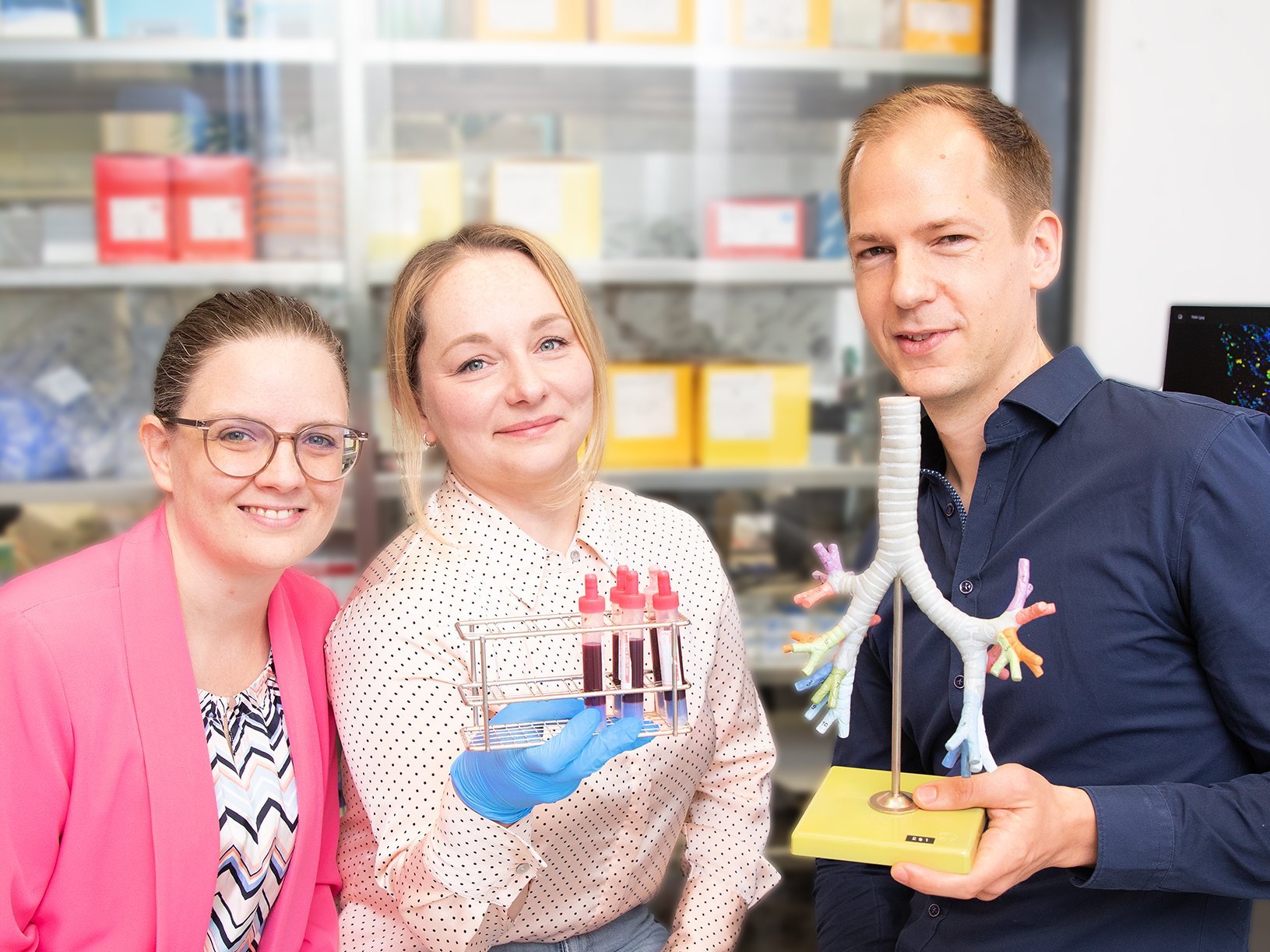
Searching for biomarkers for longer survival after lung transplantation (from left) PD Dr. Lavinia Neubert, PhD student Edith Katharina Schwarz, and PD Dr. Jan-Christopher Kamp. Copyright: Karin Kaiser/MHH
A lung transplant is a life-saving treatment for people whose lungs are so severely diseased that they are at risk of failing completely. The treatment is now well established. However, due to a shortage of donor organs, it remains the exception rather than the rule worldwide. In 2026, the 3,000th lung was transplanted at Hannover Medical School (MHH), one of Europe’s leading centres for lung transplants. Despite significant progress, there are major differences in how well the new lung functions and how long transplant patients can continue to live with it.
A research team led by Associate Professor (PD Dr.) Dr. Lavinia Neubert, a pathologist and head of the Lung Research Group at the MHH Institute of Pathology, and PD Dr. Jan-Christopher Kamp, co-head of the interdisciplinary working group and a physician at theMHH Clinical Department of Pneumology and Infectious Diseases, now aims to determine how the predicted success of lung transplants can be better assessed and how the survival rate following transplants can be increased. The project launched on June 1, 2026, and is scheduled to run for two and a half years. The State of Lower Saxony and the Volkswagen Foundation are supporting the project with approximately 465,000 euros as part of the “Rare Diseases” funding line of the “zukunft.niedersachsen” program. Funding is provided for projects aimed at developing new diagnoses and therapies for rare diseases. Diseases are considered “rare” if they affect fewer than five out of every 10,000 people. They are often particularly difficult to diagnose and treat.
Urgent need to improve survival rates
“Although survival time after a lung transplant has increased in recent years, half of all transplant recipients still die after about six to ten years,” says PD Dr. Lavinia Neubert. “We urgently need to improve that.” One of the most common causes of death is so-called chronic lung allograft dysfunction (CLAD) or “chronic rejection.” As a result, the transplant loses its function. “The crucial question is why some people do well after a lung transplant and others do not,” notes PD Dr. Kamp. The research team is focusing on the group of “super-survivors,” who show no signs of graft dysfunction for at least three years. In this group, many so-called alveolar macrophages can be found in the alveoli. Edith Schwarz, a PhD student and member of the Lung Research Group, recently demonstrated the protective and regulatory role of these immune cells after transplantation in a study. The biomarker project will now build on these findings.
Immune cells control inflammation in the lungs
The goal is to identify the macrophage variants and signaling pathways that may play a role in transplant tolerance and survival. “There are macrophages that protect the lungs and others that are involved in an inflammatory immune response in the lungs and thus may promote chronic rejection reactions,” explains PD Dr. Kamp. “We wanted to find out which conditions, at what point after transplantation, cause the macrophages to develop into the protective or inflammatory type.” The researchers then analyzed lung tissue from super-survivors, transplant recipients with confirmed CLAD, and healthy individuals. “There we found target structures that provide clues about the role of immune cells in inflammatory reactions in the lungs,” says the physician.
Goal: minimally invasive blood tests
The researchers now aim to use mass spectrometry to examine the totality of proteins in blood plasma and tissue samples from the comparison groups. “These analyses are developed and conducted here in the Core Facility Proteomics and form the basis for identifying new biomarkers,” says Prof. Dr. Andreas Pich, head of the central MHH research facility. In addition, cells from the so-called bronchoalveolar lavage fluid—obtained by flushing the airways with saline solution—are analyzed. A particular strength of the project lies in the fact that both plasma and tissue samples from the same patients are available at identical time points following lung transplantation. This enables a direct comparative analysis of the sample types. In addition, the researchers are analyzing immune system signaling molecules that regulate inflammatory responses—so-called cytokines. “We want to identify biomarkers that we can track using simple, minimally invasive blood tests throughout the post-transplant course to predict the long-term development of the transplant,” says pathologist PD Dr. Neubert.
Promoting protective factors
The findings are also intended to tangibly improve patients’ survival rates. “We want to use these findings to develop a treatment approach to promote protective factors in the lung transplant,” says PD Dr. Kamp. “If we could predict impending chronic rejection problems in a timely manner, this would be an important step toward preventive measures that might even avert chronic rejection problems in the long run.”
The project “Identifying liquid biomarkers for the prediction of clinical outcomes after lung transplantation using plasma proteomics” is a collaboration between the MHH Institutes of Pathology, Transplantation Immunology, Institute of Toxicology, and Institute of Diagnostic and Interventional Radiology, as well as the MHH Clinical Department of Pneumology and Infectious Diseases, the Hannover Unified Biobank (HUB), and the Fraunhofer Institute of Toxicology and Experimental Medicine (ITEM).
Text: Kirsten Pötzke