MHH researchers are developing a predictive model for cardiotoxicity based on cardiac organoids to ensure safer drug development.
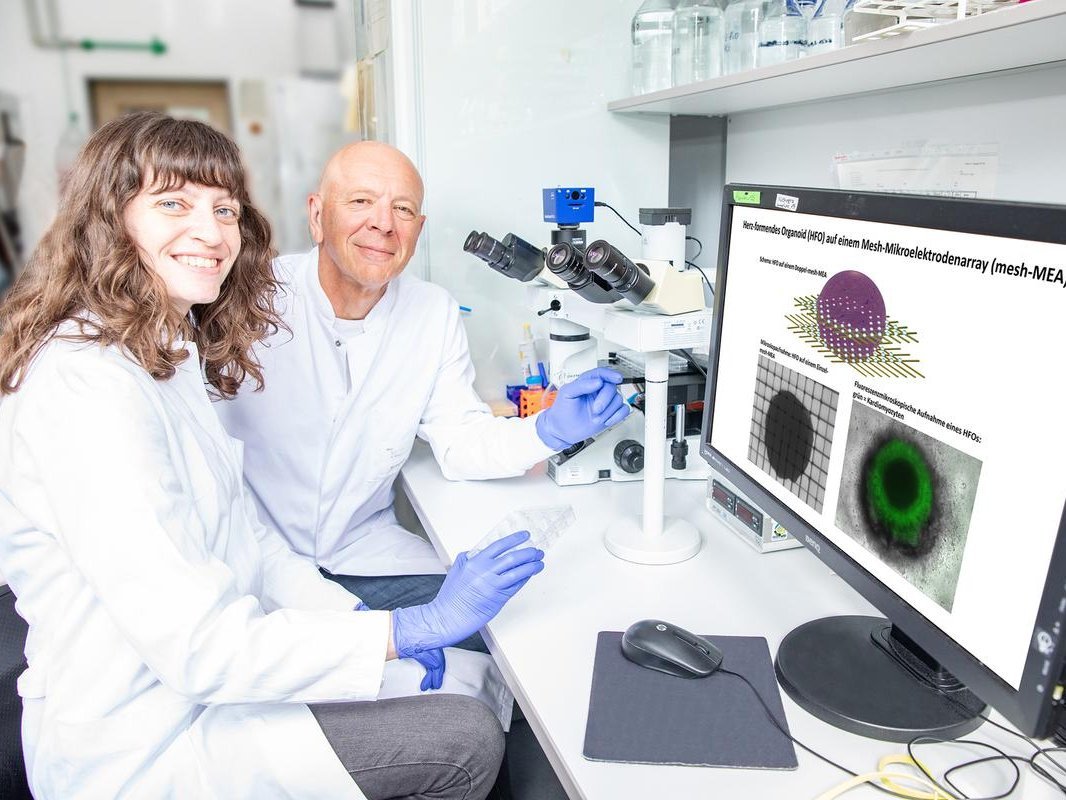
Dr. Lika Drakhlis and Prof. Dr. Robert Zweigerdt aim to integrate 3D organoids into a multilayer electrode network to better predict the cardiac safety of medications. Copyright: Karin Kaiser/MHH
It is not uncommon for medications to have adverse side effects on the heart. These cardiotoxic agents include not only specific heart and blood pressure medications themselves but also drugs such as pain relievers, antibiotics, or antidepressants. Before a new medication is brought to market, it is therefore necessary to assess its cardiac safety. To date, this assessment has relied on animal models or highly simplified cell culture tests, which often do not allow for reliable predictions about the effects on humans. This increases the risk of drug-induced arrhythmias and delays drug development. This is where the HEARTCORE project comes in. An international research team led by Prof. Dr. Robert Zweigerdt, a cell biologist and head of a research group at the Leibniz Research Laboratories for Biotechnology and Artificial Organs (LEBAO) at the Clinical Department of Cardiothoracic,Transplantation, and Vascular Surgery at Hannover Medical School (MHH), now aims to develop a platform for cardiotoxicity testing that does not rely on animal testing and simultaneously enables more accurate predictions of drug reactions. The project is funded by the European Union through the EIC Pathfinder Open program with a total of approximately three million euros.
New predictive models urgently needed
“The heart has a high energy turnover and often reacts more sensitively to medicinal substances than other organs,” explains Professor Zweigerdt. “To be able to predict adverse side effects of new drugs as early as possible in their development, we urgently need new predictive models.” To this end, the researchers are relying on 3D systems made of human tissue that they have developed and patented, known as heart-forming organoids (HFOs). These mini-organs, measuring just a few millimeters in size, consist of three cup-shaped layers and—similar to embryonic development—include the precursors of the heart, the liver, and the lungs, as well as the blood vessels and precursor cells of the sinoatrial node, which, in the mature heart, acts as an electrical pacemaker and plays a key role in determining the heart rate.
Integrated electrode array for Mini-ECG measurement
In the HEARTCORE project, the mini-hearts will grow not in a laboratory dish but within a two-layered 3D mesh microelectrode array (Mesh-MEA). This microscopically small electrode system is highly flexible and structured like a wafer-thin spiderweb. The organoids grow around and through this mesh, so that it becomes fully integrated into the organoid. This allows the electrical activity of the HFO to be recorded not only from the surface but directly from within the tissue. The cells are not damaged in the process and can continue to absorb nutrients and oxygen unimpeded. “Many active substances influence the heart’s electrical excitability,” explains Dr. Lika Drakhlis, a stem cell biologist and head of a junior research group at LEBAO. “With the Mesh-MEA platform, we aim to test cardiotoxicity using a kind of mini-ECG and predict drug reactions.” In addition, the researchers plan to integrate laser-based optoporation into the Mesh-MEA. In this method, a laser beam fired through a special microscope creates tiny, temporary pores in the cell membrane of the heart organoids. Optoporation also provides electrical signals from inside the cell. The process takes only a few minutes, after which the hole in the cell membrane closes on its own.
Will digital prediction be possible in the future?
“HEARTCORE is developing the world’s first integrated platform that combines 3D human heart organoids, multilayer mesh MEAs, laser optoporation, and AI-supported risk prediction—thereby enabling 3D electrophysiological recordings from human heart tissue,” says Prof. Zweigerdt. This is expected not only to drastically improve the accuracy of predictions regarding the effects and side effects of new drugs, but also to reduce the costs and time required for drug development. The collected data will also be fed into a virtual computational model using AI, which will eventually allow for digital predictions of adverse side effects on the heart—without the need for laboratory testing. “Then a computer simulation alone would suffice to map and predict the drug’s effect on biological processes in the heart,” notes the cell biologist. The platform’s potential extends beyond cardiology. It could be expanded to other excitable tissues and organs where electrophysiology plays a central role—such as the brain.
The HEARTCORE project is coordinated by the MHH. The consortium includes another university, an applied research institute, and two companies: the Universitat Politècnica de València, the NMI—Institute of Natural Sciences and Medicine at the University of Tübingen, Multi Channel Systems GmbH (MCS), and Foresee Biosystems (FBS).
Key term: heart organoid
Heart organoids are mini-hearts derived from human pluripotent stem cells (hPSCs). These are cells that can proliferate indefinitely in culture and develop into any type of cell. Using biological or chemical signals, hPSCs can be guided to form three-dimensional cell aggregates. “Heart-forming organoids” (HFOs) go beyond simple heart organoids: they are complex structures composed of at least seven different, clearly structured cell and tissue types. Unlike single-tissue organoids, HFOs—as multi-tissue organoids—replicate the simultaneous development of the heart, blood vessels, and foregut during human embryonic development. Since diseases and pharmacological treatments typically affect multiple organs simultaneously, HFOs are particularly well-suited for studying their potential effects on numerous tissues at the same time and under more controlled conditions.
SERVICE:
Further information on the HEARTCORE project can be found here.
Text: Kirsten Pötzke