Colorectal Cancer Month March
Status: 25.02.2022
When colorectal cancer is mentioned, malignant tumors in the colon (colon carcinoma) or rectum (rectal carcinoma) are meant. The term colorectal carcinoma is used to refer to both colon and rectal cancer. In contrast, malignant tumors in the small intestine are extremely rare.
Facts and figures
- Every year, around 33,100 men and 25,000 women are newly diagnosed with colorectal cancer in Germany (source: Robert Koch Institute).
- In Germany, bowel cancer is the third most common cancer in men and the second most common in women.
- Since 2003, the number of new cases has been falling slightly in both men and women. Experts believe that this development is due to improved early detection of bowel cancer.
Benign precursors enable "real prevention"
The most important examination for the early detection of bowel cancer is a colonoscopy. Another examination for early detection is the test for non-visible blood in the stool, as bowel tumors bleed more frequently than healthy bowel mucosa. However, colonoscopy is considered more reliable than the stool test. Precancerous lesions, known as intestinal polyps, can be detected during a colonoscopy and removed immediately, long before they become noticeable. Colonoscopy can therefore be regarded as a real "preventive measure".
Early detection program
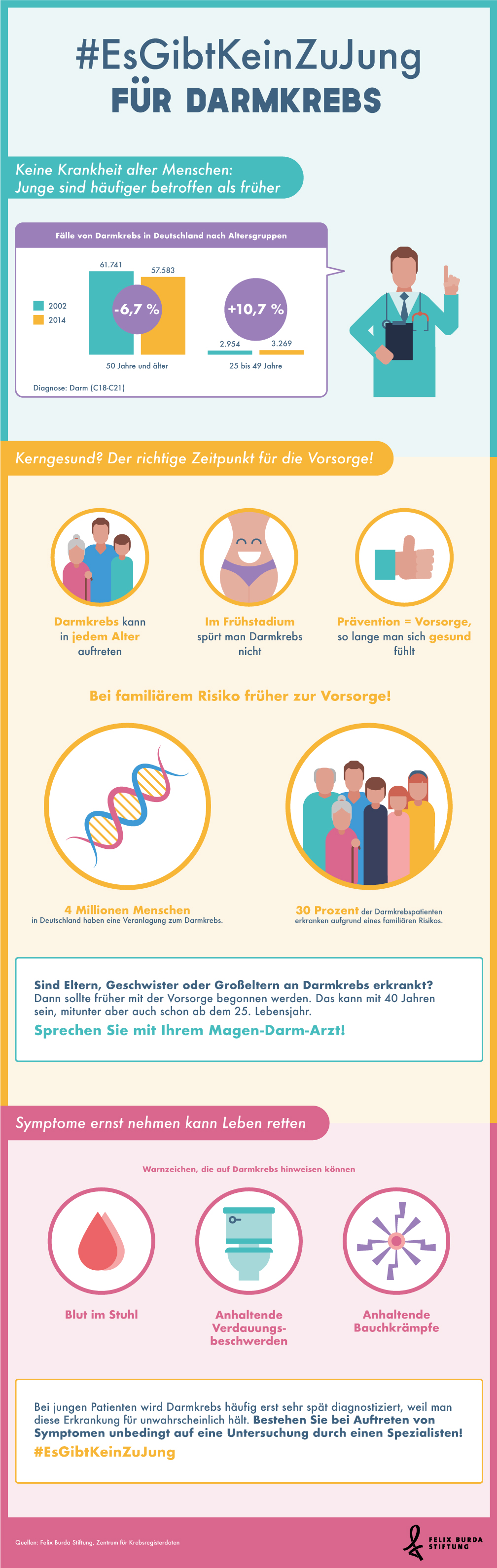
In Germany, every insured person over the age of 50 is entitled to regular examinations for the early detection of bowel cancer. The examinations are part of the statutory cancer screening program. The costs are covered by statutory and private health insurance companies.
There may be an increased risk of bowel cancer if cancer runs in the family, for example if direct relatives (grandparents, parents or siblings) have been diagnosed with bowel cancer, bowel polyps or a malignant tumor of the stomach or uterus. It is therefore particularly important for young people to ask about cancer in the family. If there is a family history of bowel cancer, talk to your physician about whether early detection examinations before the age of 50 make sense for you.
The Cancer Information Service provides detailed information on the various offers of the statutory screening program.
Prevention: what you can do yourself
Lifestyle plays an important role in the prevention of bowel cancer. Experts recommend avoiding obesity, eating a healthy diet (i.e. drinking little alcohol, eating little red meat or processed meat products, eating enough fiber, e.g. in vegetables), exercising regularly, living a smoke-free life and taking advantage of the statutory screening program.
Further information:
- Interview: How can healthy eating succeed?
Our nutrition experts at the MHH give tips on how to stay healthy throughout the day. -
Interview: Colorectal cancer (screening) - myths, fears and worries
With Prof. Dr. Wedemeyer, Director of the Clinical Department of Gastroenterology, Hepatology and Endocrinology at the MHH. -
Video: Colorectal cancer screening - how it works and why it is so important
With Prof. Dr. Wedemeyer, Director of the Clinical Department of Gastroenterology, Hepatology and Endocrinology at the MHH. -
Podcast: Neuroendocrine tumors of the small intestine - what do we know about these rare tumors?
With Dr. Thomas Wirth, Senior Physician at the Clinical Department of Gastroenterology, Hepatology and Endocrinology at the MHH.

"For no other type of cancer does screening offer such great opportunities as for bowel cancer"
Colorectal Cancer Awareness Month was proclaimed by the Felix Burda Foundation, the LebensBlicke Foundation and the Network Against Colorectal Cancer e.V. to raise awareness of colorectal cancer screening. This year marks the 21st time that March has been dedicated to colorectal cancer screening throughout Germany.