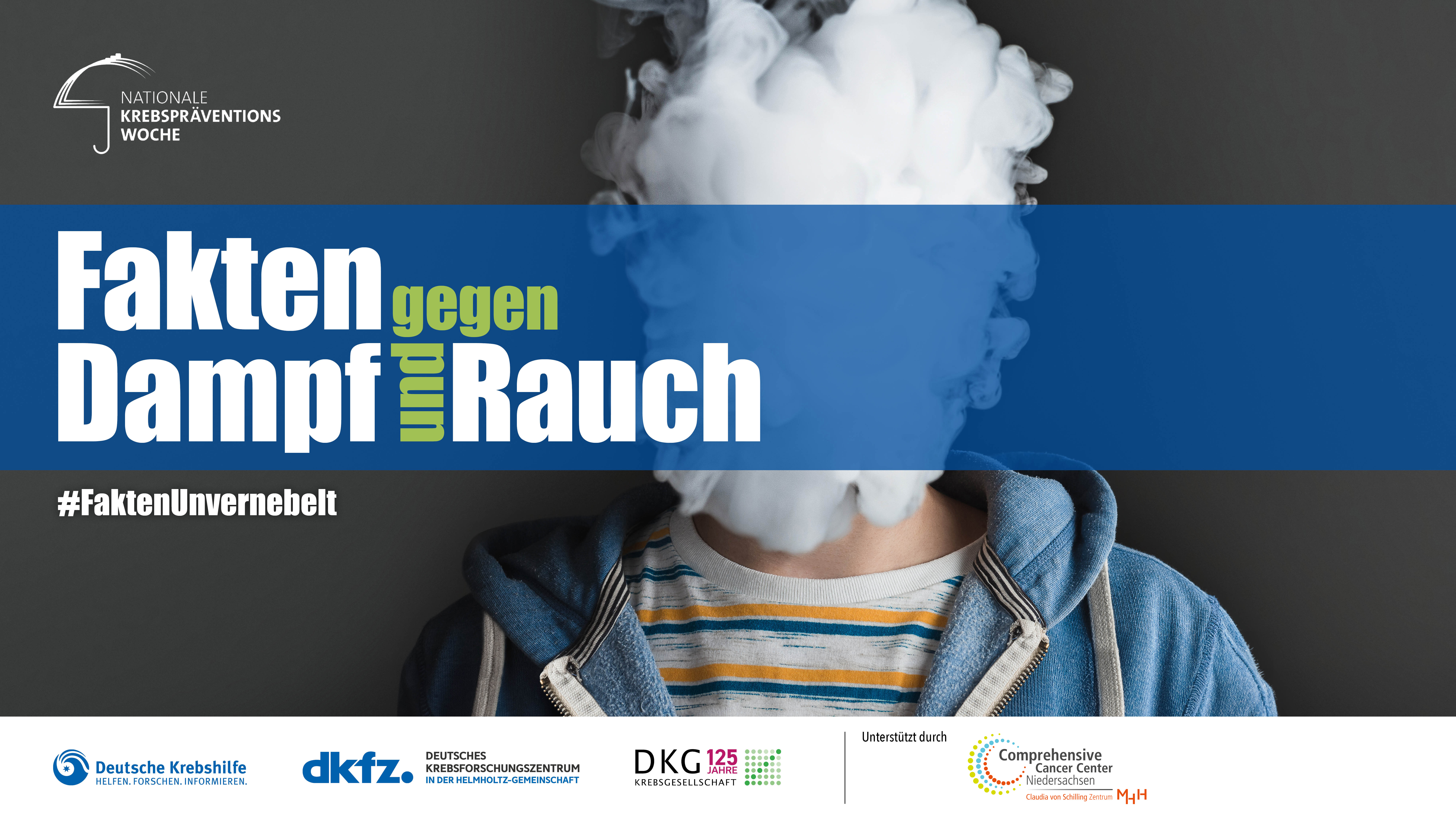
Facts against vapor and smoke
National Cancer Prevention Week: Together with the DKH, the DKG and the DKFZ, we are drawing attention to smoking as a cancer risk factor.
Smoking is one of the greatest avoidable health risks worldwide. This is particularly evident in connection with cancer. Numerous scientific studies have shown that tobacco consumption is a significant risk factor for the development of various types of cancer. The relationship between tobacco consumption and lung cancer is particularly striking.
Smoking as the most important risk factor for lung cancer
With over 50,000 new cases per year , lung cancer is one of the most common forms of cancer in Germany and is usually caused by smoking. It is the second most common cancer in men and the third most common in women. Find out what happens to our lungs when we smoke or vaporize here:
What actually happens to our lungs when we smoke?
When we inhale cigarette smoke, more than 70 different carcinogenic substances enter our lungs. These substances are deposited there. The toxins in the smoke destroy the alveoli and damage the immune system. Gene mutations also occur in the lungs, which promote the development of cancer cells. Regular smoking irritates the bronchial system and increases the production of bronchial mucus. At the same time, the self-cleaning mechanism of the lungs is severely impaired: Cilia of the bronchial mucosa are destroyed. Their actual task, the removal of harmful substances, is made considerably more difficult as a result. The composition of the mucus also changes. These processes lead to a build-up of mucus in the lungs. This often makes it difficult for those affected to cough up.
The e-cigarette - a "healthier" alternative to conventional cigarettes?
So far, there have only been a few studies on "vaping" and hardly any long-term observations. It can be said that although e-cigarettes contain fewer harmful substances than conventional cigarettes, vaping can also trigger lung diseases such as inflammatory reactions or contact allergies. We therefore strongly advise against switching from a normal cigarette to an e-cigarette.
What is harmful about vaping an e-cigarette?
Flavored liquids are vaporized in an e-cigarette. The devices consist of a power source (battery), an electric heating element (nebulizer) and a cartridge for the liquid to be vaporized (liquid). The result is not smoke, but aerosol, which is inhaled and can irreversibly damage the lungs. When the liquids are heated, substances such as acetaldehyde and formaldehyde are produced. Due to the possibility of being able to individually adjust the voltage and thus the temperature of certain e-cigarette models, 5 to 14 times the amount of formaldehyde enters the lungs when vaping 3 ml of liquid, for example. This corresponds to an amount that would be absorbed when smoking 20 tobacco cigarettes - i.e. an entire pack.
"Party smokers" - "occasional smoking doesn't matter"?
According to major epidemiological studies, there is no lower limit at which smoking is safe. In addition, occasional smokers run a high risk of becoming addicted and not just smoking occasionally. Therefore, party smoking is also not recommended!
Reducing risk: quitting is always worthwhile
Smoking is the most important preventable risk factor for cancer and represents a massive health risk - not only for smokers themselves, but also for the people around them. Quitting tobacco is one of the most effective measures to prevent cancer. Every stop smoking is a step towards a healthier life. The good news is that quitting smoking significantly reduces the risk of cancer. Within just a few years of quitting smoking, the risk of developing most types of cancer caused by tobacco smoking has fallen significantly. After around ten years, ex-smokers only have half the risk of lung cancer than if they had continued to smoke.
"The smoke-free program" at the MHH
As it has been proven that it is more successful to help and motivate each other in a guided group, the course is a group program. The course is subject to ongoing professional development and is regularly evaluated. The smoke-free program at the MHH includes a free information event, three group meetings and two individual telephone appointments.
The smoke-free program combines approaches from cognitive and behavioral therapy. It is one of the most successful certified smoking cessation programmes in Germany, which is recognized and subsidized by statutory health insurance companies. According to studies, more than 30% of all participants remain smoke-free even 12 months after the program.
To register for the information event, please send an e-mail to: rauchfrei@mh-hannover.de. You can reach the team by telephone on Tuesdays to Fridays from 9.00-15.00 on 0511 532-5600.
The next course is expected to take place in January 2026. Further information can be found at www.mhh-rauchfrei.de.
About the National Cancer Prevention Week
In Germany, around 500,000 people are diagnosed with cancer every year. According to experts, around 40 percent of all cancers could be prevented through a healthy lifestyle. According to experts, this percentage could be increased even further with findings from improved prevention research.
National Cancer Prevention Week is a joint initiative of German Cancer Aid, the German Cancer Research Center (DKFZ) and the German Cancer Society (DKG). The aim is to draw attention to the great potential of prevention. Their vision is to prevent cancer from developing in the first place.