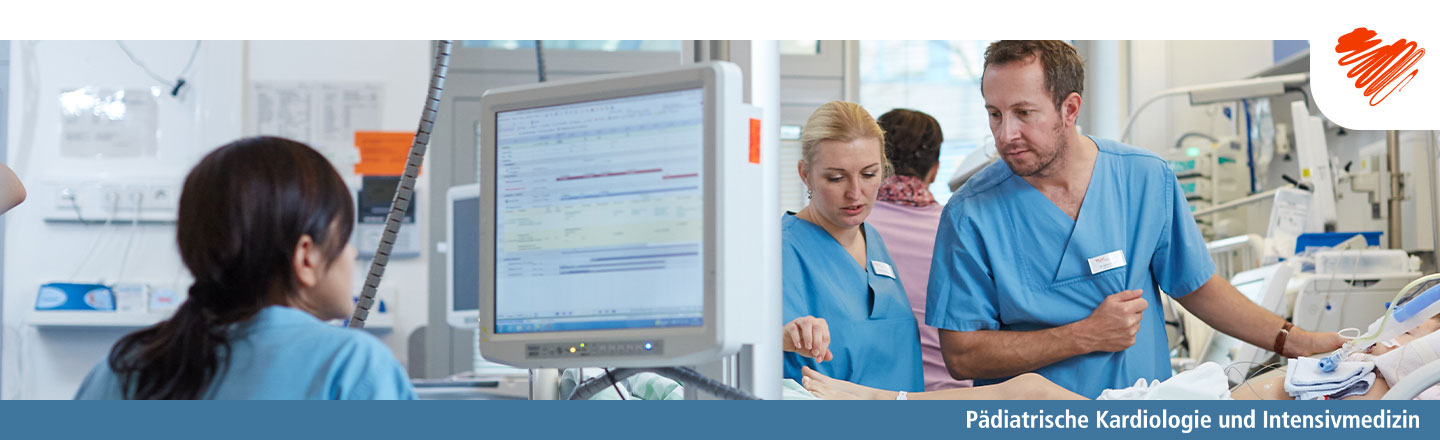
Intensive care medicine is a highly complex field. Many different illnesses can lead to the need for intensive medical care. Intensive care unit 67 treats around 1,200 patients a year from various specialist disciplines and therefore not only provides a large number of treatments, but also covers a very broad spectrum of diseases.
Our incentive: every patient entrusted to us receives the best possible treatment.
In the following sections, we will introduce you to some of the main areas of treatment in ICU 67:
Patients with congenital heart defects Patients with organ failure Patients after complex surgery Patients with sepsis
Patients with a congenital heart defect
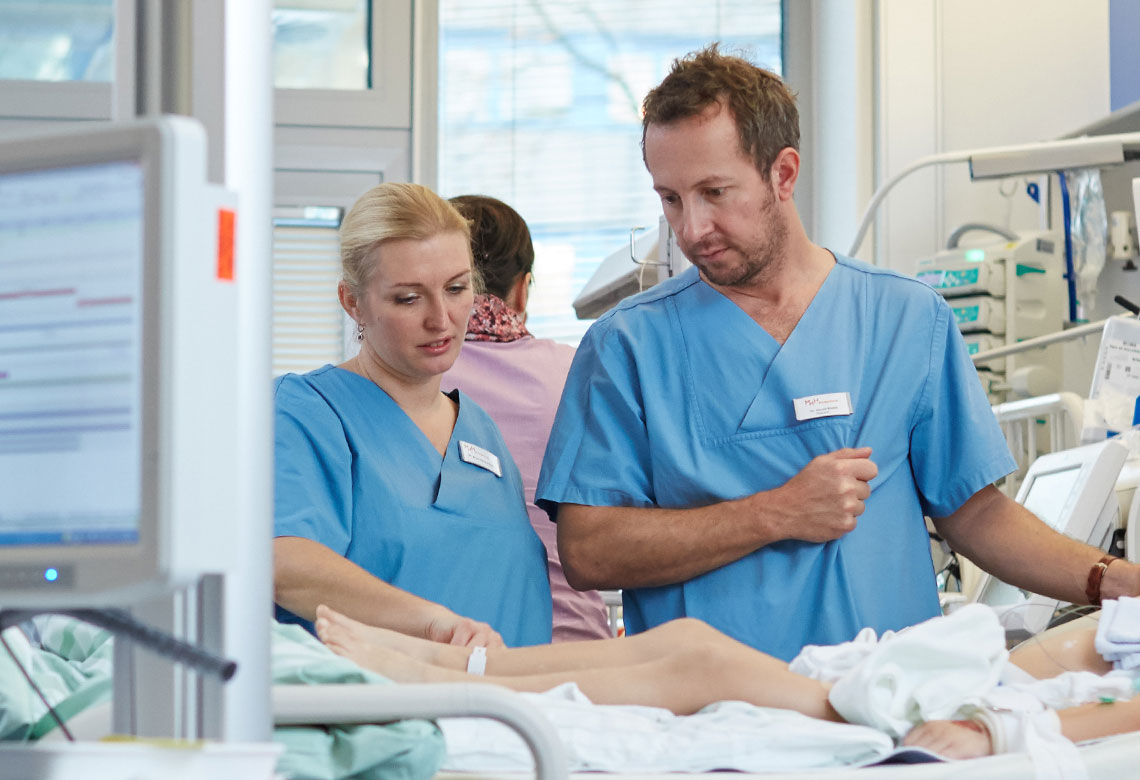
Around 400 cardiology and cardiac surgery patients of all ages are treated in intensive care unit 67 every year.
These include newborns with critical heart conditions such as critical aortic stenosis, transposition of the great vessels or hypoplasia of the right or left ventricle, as well as patients with cardiac arrhythmias, cardiomyopathies or myocarditis.
Larger children and adults with congenital heart defects are also cared for on our ward, usually before or after surgical interventions. For example, the postoperative care of a 12-year-old patient following pulmonary valve replacement takes place for a few hours in intensive care unit 67, just as we provide intensive care for a 44-year-old patient with Ebstein's anomaly following tricuspid valve replacement.
More information on heart failure surgery
Patients with organ failure
Cardiovascular failure
All forms of circulatory replacement are offered in the treatment of cardiovascular failure. In acute care, the main focus here is on the use of extracorporeal membrane oxygenation (ECMO), which is used around 30 times a year in our children's hospital. There is a lively exchange of experience with the Central Clinic of Hannover Medical School. Around 250 ECMO operations are carried out there each year.
Extracorporeal and intracorporeal VAD (Ventricular Assist Device) systems are available for further therapy, and a lively transplantation program for all thoracic organs is also supervised.
More information on ECMO
Multi-organ failure and respiratory failure
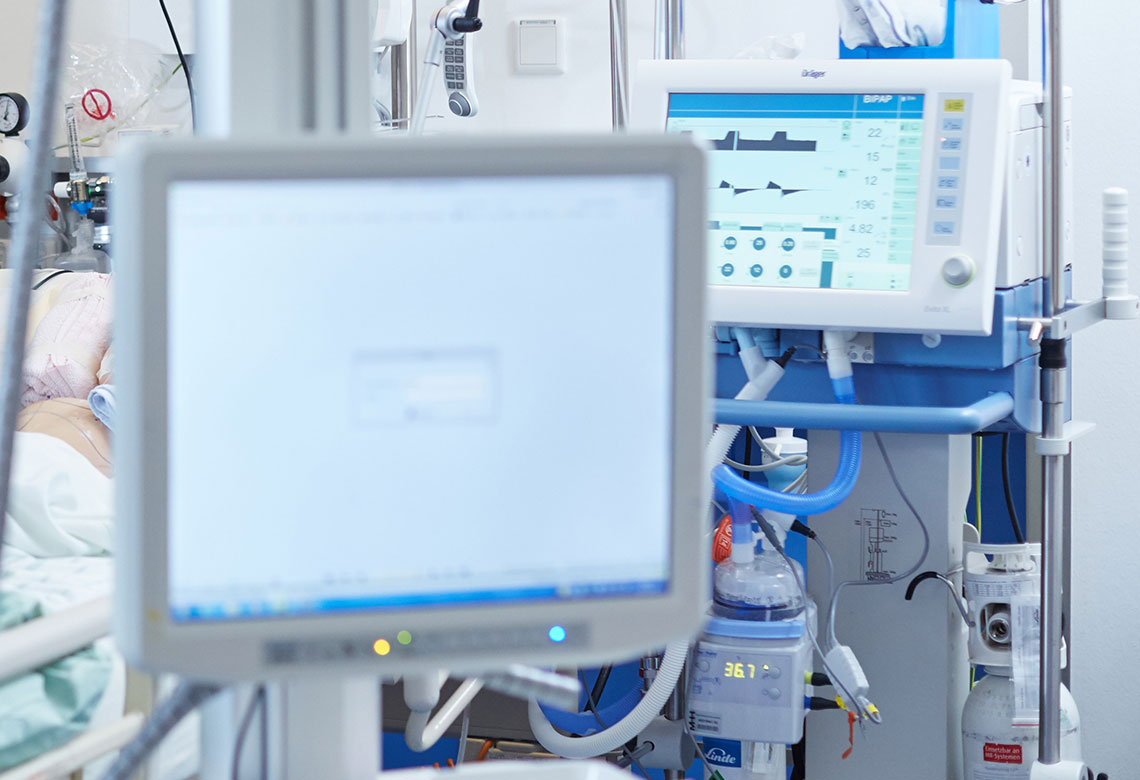
The treatment of multi-organ failure often focuses on the treatment of respiratory failure (ARDS). All common methods of mechanical respiratory support are offered in the care of patients. In addition to non-invasive ventilation using a mask, prongs or nasal tube in acute care, all common forms of conventional invasive ventilation as well as jet or high-frequency oscillation with and without inhaled nitric oxide are offered.
In addition, interventional bronchoscopy can be used to treat constrictions with laser therapy, segments can be occluded or treated with a valve.
If respiratory failure cannot be controlled conventionally, the use of extracorporeal membrane oxygenation may also be necessary. This is done both with a view to recovery of the patient's own lungs and as a bridge to a possible lung transplant.
Intensive care unit 67 also cares for chronically ill children with e.g. cystic fibrosis or neuromuscular diseases and helps to set up suitable forms of ventilation.
Kidney and liver failure
Acute kidney failure can be treated using peritoneal dialysis or invasively using intermittent or continuous venovenous haemofiltration and/or haemodialysis. These patients are cared for in cooperation with the KfH (Kuratorium für Dialyse). If a kidney replacement is necessary, the intensive care unit 67 also cares for children after kidney transplants.
Although liver failure in children is a rare event, advanced liver failure in children can also lead to the need for organ replacement. In collaboration with the Clinical Department of Pediatric Gastroenterology, Intensive Care Unit 67 cares for critically ill patients in liver failure before and after liver transplantation. Liver replacement failure can also be offered in cases of liver failure or severe hyperbilirubinemia.
More information on dialysis More information about the KfH-Center Hannover More information about the Clinical Department of Pediatric Gastroenterology
Patients after complex surgery/accidents
Our cooperation partners
In addition to the treatment of patients with severe heart disease and the care of organ failure of the heart, lungs, kidneys or liver, children from the Departments of Pediatric Surgery, ENT and Neurosurgery are primarily cared for postoperatively.
Supra-regional trauma care is provided for patients with complex injuries in an interdisciplinary approach, with all standard diagnostic (CT, MRI) and therapeutic options available at all times. Patients with severe craniocerebral trauma in particular make up a large proportion of this severely injured patient group.
More information on pediatric surgery More information on the ENT Clinical Department More information on neurosurgery
Patients with severe infection/sepsis - prevention
Severe infection and sepsis - speed counts
Another focus is the treatment of children with severe infectious and/or septic diseases. It is important to recognize these illnesses in good time and start the appropriate therapy as quickly as possible. The Pediatric Intensive Care Network was founded to achieve this goal. We are available for immediate assistance in such situations.
More information on the Pediatric Intensive Care Network (PIN) Emergency contact
However, our efforts are not limited to providing optimized therapy. Through the scientifically supported development of standardized programs to prevent catheter-associated infections, we hope to make serious complicating infections less likely. The success of the measures is consistently monitored as part of the ITS-KISS (national hospital infection surveillance system/intensive care units). We are happy to pass on the knowledge we have acquired to interested colleagues in infusion workshops.