Practical year and general information
Dear colleagues in the PJ,
You are thinking about spending part of your PJ in trauma surgery - perhaps you have already made up your mind. There are certainly good reasons for this and we are delighted that you are interested in our exciting specialty - welcome!
A particular challenge of the PJ is the need to constantly adapt to new technical and organizational peculiarities of different departments and, of course, to different people in relatively short time intervals. With this information, we would like to make it easier for you to get started in the Trauma Surgery Clinical Department.
We want to ensure that your time with us fulfills its purpose, namely to be able to work as independently as possible on trauma surgery patients under professional guidance and to gain a good insight into clinical trauma surgery work. This will provide you with valuable support in making a qualified decision for your future career choice.
Trauma surgery is characterized, among other things, by a sometimes restless daily routine - if you have the feeling that you are getting "run over" - let us know as early as possible. We will endeavor to remedy the situation and take your legitimate interests into account appropriately.
We look forward to working with you!
Virtual PJ Fair of the MHH
Virtual PJ Fair of the MHH

Information on the Clinical Department
Inpatient care in the Clinical Department of Trauma Surgery is provided by teams of physicians who are each responsible for different (sub)wards(17A / 17B / 18 / 27). The respective senior physician is responsible for managing the teams. In order to ensure the most comprehensive training possible for the junior physicians, the junior physicians are rotated to a different team every six months. There is also a team responsible for the Central Emergency Room. Furthermore, intensive medical treatment of trauma surgery patients is possible in the intensive care unit managed by trauma surgeons.
The day begins for you at 7.00 a.m. with the morning ward round by you and your team. On Thursday, there is an early training session at 7.30 a.m., so that the ward round is carried out afterwards. After the ward round or early training, a joint X-ray demonstration takes place at 7.45 a.m. in the MHH Information Technology (MIT) lecture hall. Afterwards, you will be deployed in the operating theater, Central Emergency Room or outpatient clinic by arrangement within the team. The day ends at 17:45, so you will work 40 hours over 4 working days. This gives you plenty of time for self-study, as there are no longer any study days.
Of course, you do not have to make use of our above-mentioned offer of a daily routine synchronized with your team, but can end your working day at 3:30 p.m. on all weekdays in consultation with the team.
After the early meeting (see above), one part of the team continues to care for the inpatients while the other part devotes itself to other tasks. Ward work includes preparing inpatient discharges, taking blood samples and checking and organizing examinations that have been carried out or are to be carried out. This gives you the opportunity to discuss patients' clinical pictures with the ward physician and to participate in the respective therapy yourself. In addition to patients who are already hospitalized, it is also necessary to prepare patients for elective operations on the following day. This includes taking blood samples, taking the patient's current medical history and taking physical examination findings. Additional measures such as an ECG and chest X-ray or an X-ray of the region to be operated on may also be necessary, depending on the patient's condition and previous illnesses.
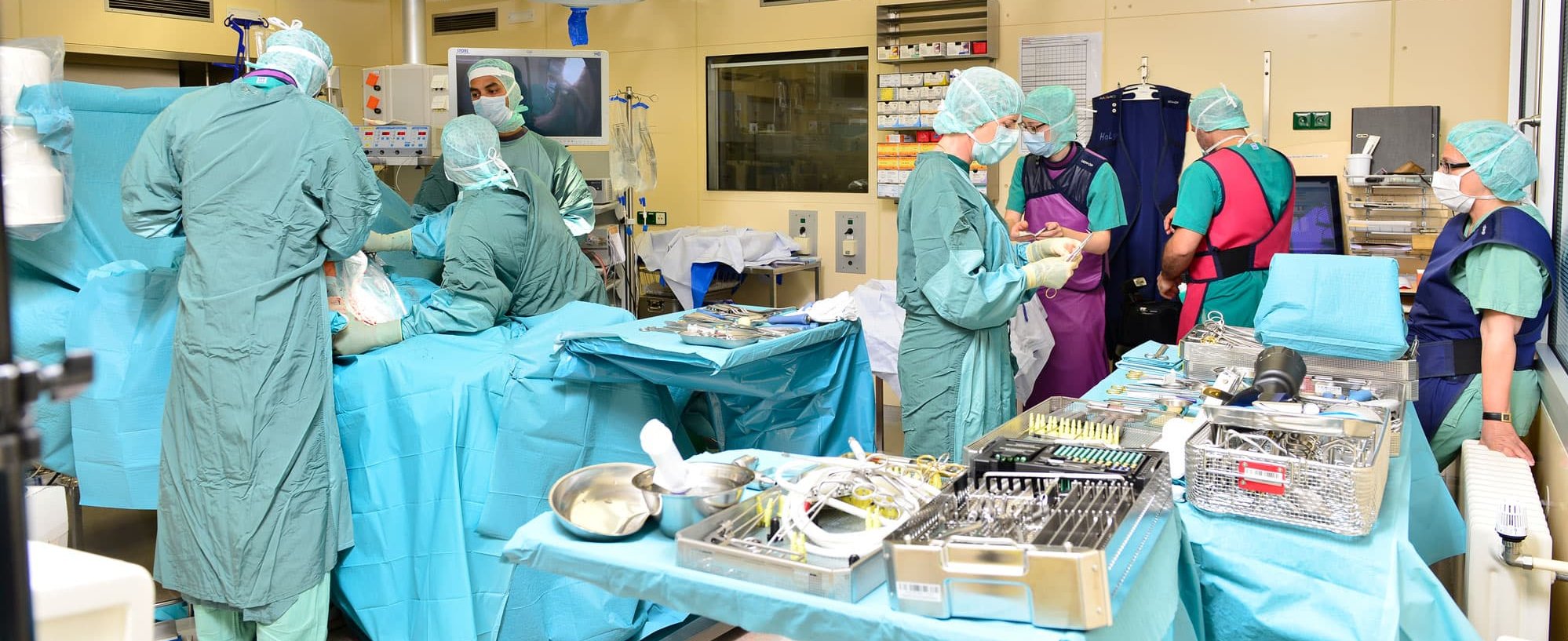
Your presence in the OR is expressly desired both during the block internship and, if applicable, during the PJ. Before you do your first assistantship, it is necessary to have the Clinical Department's radiation protection officer (Dr. Niemann 17-2028) explain the basic principles of radiation protection to you. You do NOT need to be equipped with a radiation dosimeter for the period of your presence in the Clinical Department as a block intern (clarified with the MHH's Radiation Protection Administrative Unit); in the PJ you will receive your own radiation dosimeter from the Polyclinic.
If you have been assigned to the OR in consultation with your team, you will go to the OR at 7.55 a.m. after the early meeting with your team assistant physician. The changing rooms are located on the 5th floor, node D, block II. You can gain access with your MHH ID card. After changing, go through the airlock area to the 4th floor. The trauma surgery operating theaters 6/9/10 are located on the operating level to the left of the staircase leading down from the 5th floor. You will prepare the operation with the respective assistant physician while the patient is already in the operating theater.
The following should be done before the operation begins:
1. hang up and check the surgical information sheet (before anesthesia induction)
2. is everything ready for correct positioning - consult with OR Nursing if necessary?
3. start the PC and call up the current imaging (X-ray/CT/MRI) and surgical planning
4. position the OR correctly and enter the patient data
5. move the patient to the operating room and position him/her
During the actual operation, follow the instructions of your team assistant. In order to benefit as much as possible from the respective procedure and to be able to become active yourself with increasing experience, you are expected to prepare for the respective operation the day before.
At the end of the operation, the following points must be observed and carried out:
1. remove the patient from the bed
2. transfer to the patient airlock/recovery room (do not forget the documents and, if necessary, the OP box!)
3. transfer the images from the BV to the visage (have the assistant show them)
4. if necessary, register the post-op X-ray in consultation with the assistant.
In the polyclinic, you will have the opportunity to learn about conservative treatment options for a wide range of musculoskeletal diseases. You will also see patients again after operations as part of follow-up checks and can thus learn about the post-operative healing process and the aftercare of various surgical procedures. The outpatient clinic is also the area where indications for elective operations are made as part of new patient presentations.
Each day of the week, a different team holds a consultation. You can either just follow an experienced assistant to the patient contacts or examine patients yourself and then present them to one of the assistants. Each referring physician is sent a written report of the patient's findings. If possible, this should be dictated on the same day to ensure a smooth process. The structure of such a letter is standardized, and your assigned assistant will be happy to help you prepare it. The last sheet of the patient file is a checklist as a memory aid, on which the medical history and examination findings are noted in keywords.
Please bear in mind that you will have to dictate a letter at the end of the day. X-ray results, diagnosis and procedure as well as any measures such as infiltrations should also be documented.
The MHH's Central Emergency Room is the point of contact for all patients with minor and major acute injuries. On arrival, patients are screened by Nursing according to the ESI triage system (Emergency Severity Index) and assigned to the appropriate Department. In acute, more serious cases, they are seen immediately by the physician on duty. The order of treatment depends on the severity of the injury, which unfortunately sometimes leads to a lack of understanding among waiting patients and therefore requires particularly good communication management.
Polytrauma poses a particular challenge in our specialist department, where good coordination between the different departments is essential. In this case, the senior physician or the first duty trauma surgeon takes the lead in the acute phase of patient care, but the trauma surgery assistant is responsible for preparation and coordination. In the case of seriously injured patients or an unclear injury pattern, up to 15 people from different specialist departments may be waiting for the patient in the trauma room (2-3 trauma surgeons, anesthesia, anesthesia care, 2-3 emergency room nurses, neurosurgery, oral and maxillofacial surgery, ophthalmologist, cardiothoracic surgery, abdominal surgery).
The trauma surgery physicians on duty usually sit together with the physicians from the other specialist departments in the physicians' room of the emergency room. Due to the initially rather confusing emergency room, a short guided tour by one of the physicians is useful for you, so that you later have the opportunity to act independently to a certain extent.
To ensure that everything runs as smoothly as possible, you should start by looking at the patients who are simply injured and who are assigned to you by the assistants. You can refine your examination technique with these patients and quickly become familiar with common clinical pictures. You are of course welcome to assist in the shock room with the most seriously injured patients. After your examination, you will then present your patient to the assistant physician, who will then arrange the necessary further examinations. You are welcome to assist with further care and later work on your own under supervision. You should have already written the outpatient physician's letter before completing the examination. The respective assistant physician will be happy to give you brief instructions on how to do this.
NEF 5 has been regularly staffed by the Department of Trauma Surgery at the MHH for over 50 years since the department was founded under Prof. Tscherne. During the PJ, you have the opportunity to ride along and gain an insight into preclinical Emergency Medicine. To do this, you must digitally complete and sign the declaration of exemption from liability and the obligation to maintain data confidentiality linked here and forward it to brauckmann.vesta@mh-hannover.de for further approval by the fire department. This process takes about a week. You should therefore apply for this as early as possible.
The Christoph 4 rescue helicopter is also stationed at the MHH. Unfortunately, it is not possible to fly on it for insurance reasons, but you are welcome to take a look around. The pilot of the Federal Police and the paramedic on duty can give you some information about this. Perhaps you will get a taste for it and can then take on this particularly challenging activity of primary care in your later work as a trauma surgeon at the MHH.
ICU
The trauma surgery intensive care unit 73 with 8 ventilation places is responsible for the postoperative monitoring of patients with an increased risk profile who cannot be transferred to the normal ward via the recovery room and, of course, for the challenge of treating polytrauma. Here you can get to know the basics of intensive medical care for a severely injured patient and gain an insight into the exciting world of trauma surgery in a supramaximal care unit.
Tumor conference
The interdisciplinary tumor conference, an important institution at MHH, takes place on Mondays at 4 p.m. in the radiology lecture hall (level S). For almost 30 years, patients suffering from benign or malignant tumors of the musculoskeletal system, bones and soft tissues have been discussed here once a week under the direction of trauma surgeons, and an interdisciplinary treatment concept is determined by the participating oncologists, paediatric oncologists, radiologists, radiotherapists, nuclear medicine specialists, pathologists, orthopaedic surgeons and trauma surgeons. You can find more information here.
Research
Of course, research at a university hospital is also a must - perhaps you are interested in one of our projects and would like to get involved? If you are interested, we can also provide you with stimulating contacts for carrying out and writing a doctoral thesis.
ATZ-Visite (AltersTraumaZentrum)
An important component of orthogeriatric cooperation to optimize the care of elderly patients is the twice-weekly interdisciplinary ward round for these patients.
During these visits, the expertise of the various specialist disciplines (Geriatrics / UCH / Nursing / Casemanagement / Clinical Pharmacology / ABS) is brought together, taking into account the special features of this patient group.
The aim is to reduce perioperative mortality and complication rates and to transfer patients to the early geriatric rehabilitation units of cooperating Clinical Departments as early as possible.
Where can I get clothes?
As a PJ student, you are entitled to two outfits from the university, consisting of trousers and a coat. After giving your clothing size to the Student Secretariat (Ms. Hanke, Tel. 3413), the collection slip will be issued there.
Please bear in mind that it takes approx. 1 week for the clothing to be ready, so please make sure you do this in good time. Clothing issue is node E Ebene U.
Where are the changing rooms?
If you do not have a locker in the student area, you can change in the ward's physician's rooms.
Where do I leave my valuables?
You should leave them at home, otherwise please carry them with you and do not leave them lying around anywhere. You can leave your valuables in the operating theater.
Is there an expense allowance?
Yes, for each month €688.60, this is paid out via the surgery office, you can find more information here.
What do I do if I have questions that are not answered on these pages?
If you have questions that are not answered here: Send us a short e-mail and we will get back to you as soon as possible: uch-lehre@mh-hannover.de