Project presentation 2022
OTUB1-dependent regulation of cell death signaling determines the outcome of Listeria-infection and central nervous system autoimmunity
Josephine Koschel, Gopala Nishanth, Sissy Just, Kunjan Harit, Andrea Kröger, Martina Deckert, Michael Naumann, Dirk Schlüter
The regulation of cell death of infected cells is a critical parameter for the course of infections. Cell death is controlled by different signal transduction pathways. Different external stimuli can induce cell death signaling pathways and, as in the case of tumor necrosis factor (TNF), activate cytoprotective signaling pathways in addition to cell death by apoptosis and necroptosis. The decision to induce TNF-dependent apoptosis, necroptosis or cell death-inhibiting NF-kB signaling is controlled by TNF receptor-associated signal transduction complexes. In these complexes, post-translational modifications by ubiquitination and deubiquitination of individual signal transduction molecules play a crucial role.
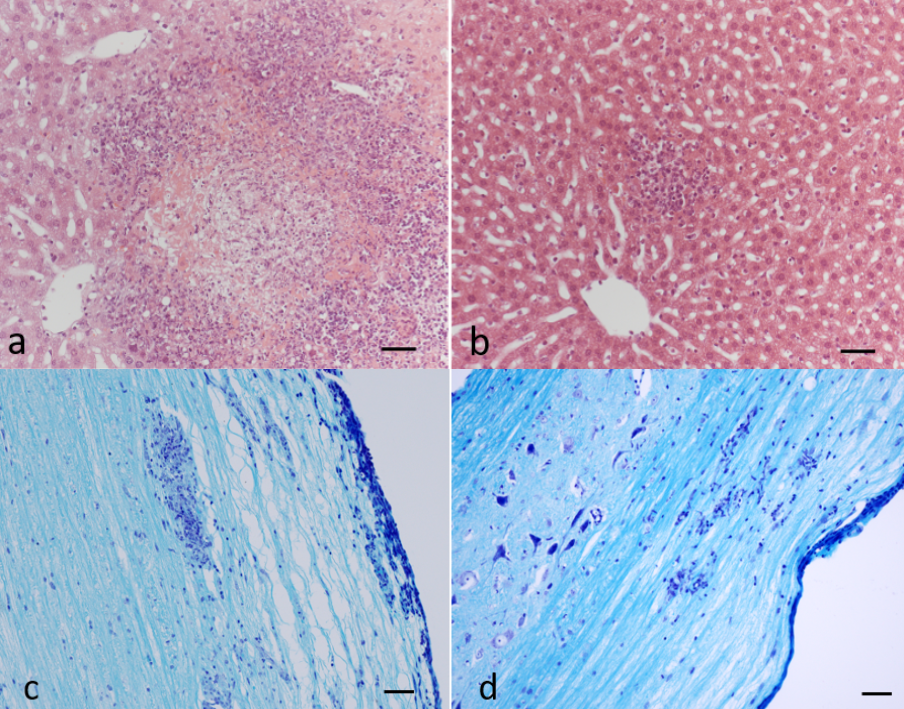
In the Research Report 2022, we present a project of the research group of microbiologist Dirk Schlüter, which reveals that the deubiquitinase OTUB1 prevents TNF-induced necroptosis of human and murine hepatocytes during infection with the bacterium Listeria monocytogenes. Mechanistically, OTUB1 reduces K48 polyubiquitination of the cellular inhibitor of apoptosis (c-IAP1) and thereby its degradation. In the absence of OTUB1, proteasomal degradation of c-IAP1 occurs, leading to reduced K63 polyubiquitination and increased phopshorylation of RIP kinase 1 (RIPK1) and the formation of the RIPK1/RIPK3 necrosome with subsequent cell death of hepatocytes. This mechanism of OTUB1-dependent cell death of hepatocytes occurred not only in the murine model of listeriosis, but also after stimulation with TNF, demonstrating the fundamental importance of OTUB1 for the regulation of TNF-dependent necroptosis in hepatocytes.
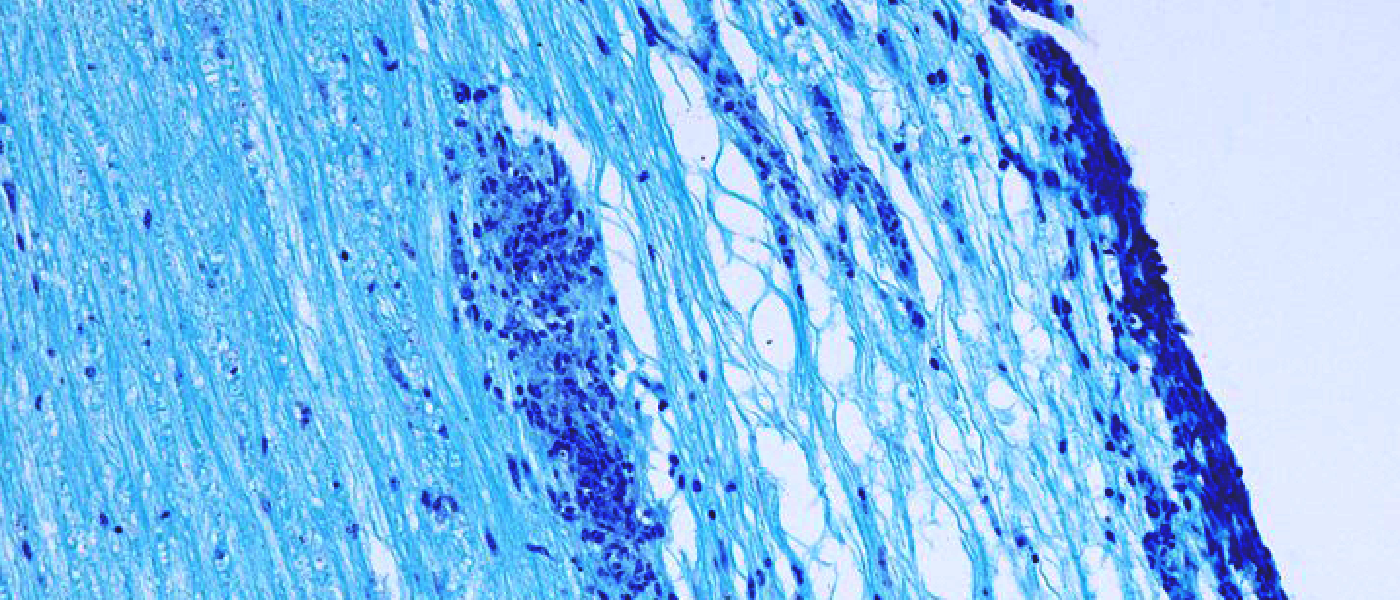
Induced cell death also plays an important role in autoimmune diseases and recent work from the Schlüter lab shows that OTUB1 prevents CD95-induced cell death of autoimmune CD4+ cells in the CNS in an experimental CD4+ T cell-mediated autoimmune disease of the central nervous system (CNS). This lack of elimination of intracerebral autoimmune CD4+ T cells leads to exacerbation and persistence of the clinical symptoms of the autoimmune disease.
In summary, these studies show that the complex and dynamic interplay of ubiquitination and deubiquitination has fundamental effects on cell death and a decisive influence on the course of infections and autoimmune diseases. further in-depth work is required to exploit the therapeutic potential of these mechanisms of cell death regulation, as these processes are regulated in a cell-type-specific and, in some cases, disease-specific manner.
Publication
OTUB1 prevents lethal hepatocyte necroptosis through stabilization of c-IAP1 during murine liver inflammation
Koschel J, Nishanth G, Just S, Harit K, Kröger A, Deckert M, Naumann M, Schlüter D.
Further information
Publisher:
President of Hannover Medical School
Prof. Dr. med. Michael P. Manns
Dean of Research at Hannover Medical School
Prof. Dr. med. Frank M. Bengel
Editing and contact person:
Reporting, Hannover Medical School
Alica Wollmann
Phone: 0511/ 532- 5578
E-mail: wollmann.alica@mh-hannover.de
Design:
Digital Media, Hannover Medical School
Phone: 05 11/ 532- 2963
Online implementation:
Office of the Dean of Research, Hannover Medical School
Jan Tauwaldt
and
Reporting, Hannover Medical School
Alica Wollmann
Phone: 0511/ 532- 5578
Research report 2022
Here you can find the research report created with the help of the Research Information System (FIS). As in previous years, we would like to take the opportunity here to explicitly present one project as a representative.
Research Information System (FIS)Here you can find further information on the Research Information System (FIS).
University bibliography- Project presentation 2022
- Project presentation 2021
- Project presentation 2020
- Project presentation 2019
- Project presentation 2018
- Project presentation 2017
- Research report 2016
- Research report 2015
- Research report 2014
- Research report 2013
- Research report 2012
- Research report 2011
- Research Report 2010
- Research Report 2009
- Research Report 2008
- Research Report 2007